Winning Products for Dropshipping in USA (2026 Update)
Explore seven U.S. dropshipping product categories, then use Drilify's product, sales, ad, and profit tools to choose and test a stronger offer.
Explore seven U.S. dropshipping product categories, then use Drilify's product, sales, ad, and profit tools to choose and test a stronger offer.
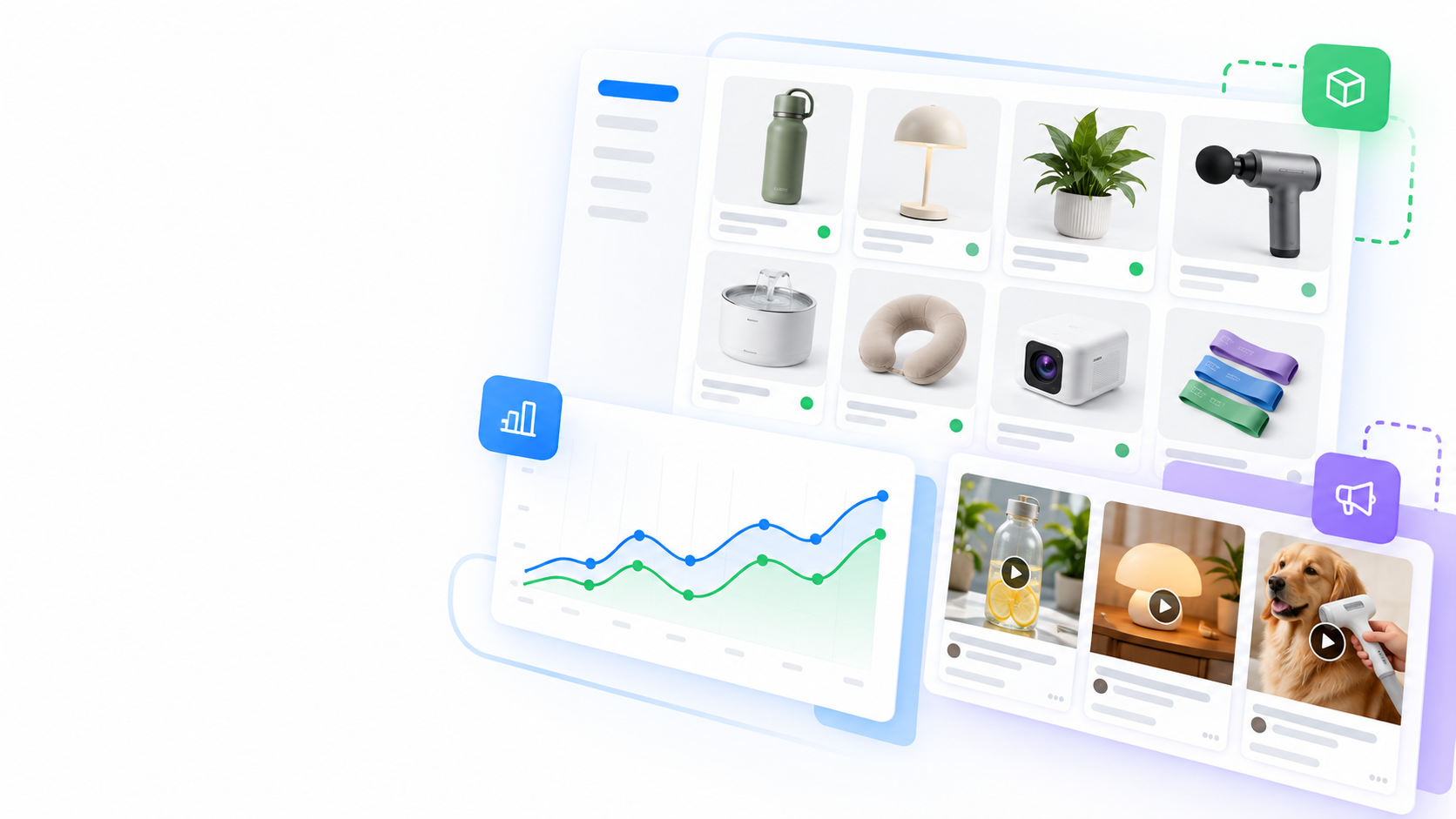
Winning products for dropshipping in the USA are found by testing a product idea against the market, not by copying a viral list. Start with a specific U.S. buyer and a useful product, then check demand, competition, delivery, and real margin. Drilify brings product, store, sales, and ad signals into the same research workflow, so you can narrow the field before spending on a test. Here are seven categories to explore and a nine-step process for choosing what deserves a launch.
The U.S. opportunity is large, but size alone does not validate a product. The U.S. Census Bureau's second-quarter 2026 report estimated $340.2 billion in seasonally adjusted retail e-commerce sales, equal to 17.1% of total retail sales. Use that market context as a reason to research carefully, not as evidence that every online product will sell.
A promising ad is only the beginning. The product still has to solve a buyer problem, stand apart from similar offers, arrive when promised, and leave room for profit after advertising and returns. Use Drilify to connect the early product and ad signals, then confirm supplier details and test the offer with real customers.
What makes a dropshipping product a winner in the USA in 2026?
A strong candidate solves a recognizable problem for a reachable U.S. buyer, has a clear reason to choose it over similar listings, and can be sold with healthy unit economics. The benefit should be easy to show in an ad and credible on the product page. Drilify helps you compare product, store, sales, and advertiser evidence before you commit to an offer.
Demand: recent sales signals, customer response, and stable interest support the idea.
Differentiation: the offer has a clear use case, angle, bundle, audience, or presentation that separates it from interchangeable listings.
Economics: the expected selling price can cover product cost, shipping, payment fees, advertising, refunds, and operating overhead.
Fulfillment: the supplier can serve the intended U.S. region with a delivery promise you can support.
Trust: the product, claims, creative, reviews, and store experience give the buyer enough confidence to purchase.
LATEST POSTS
More from Drilify
Interviews, tips, guides, industry best practices, and news.
14 min read
11 Best Dropshipping Product Research Tools for 2026
Compare 11 dropshipping product research tools by workflow, current pricing, features, and limitations, including Drilify and useful free resources.
Testability: you can run a bounded test with measurable pass and stop conditions before committing more capital.
Pro tip: treat 'winning' as a current product-market-offer fit, not a permanent label. Recheck demand, competition, price, shipping, and creative performance as conditions change.
Product categories worth researching for the U.S. market
Each category below has a buyer problem you can show clearly in short-form content. Use the examples to build a shortlist, then compare actual products in Drilify and investigate the category-specific risks before choosing an offer.
1. Small-space organization
Compact organizers, cable-control products, modular storage, and renter-friendly space savers can communicate their benefit quickly. Look for products that visibly reduce clutter without requiring permanent installation. The main risks are saturated generic offers, unrealistic size expectations, and bulky shipping. A stronger angle targets a specific room, routine, or household instead of selling a vague 'organizer.'
2. Pet travel and grooming accessories
Pet owners often respond to products that make travel, cleanup, grooming, or daily care easier. The category has a substantial U.S. customer base: the American Pet Products Association's 2026 industry update reported that 95 million U.S. households owned at least one pet in 2025. That does not make a specific accessory a winner. Check material quality, sizing, washability, safety language, and customer complaints carefully, and avoid medical promises unless they are properly supported and permitted.
3. Reusable hydration and meal-prep accessories
Products that support commuting, school, fitness, and meal planning can address repeatable daily jobs. Research leak resistance, cleaning, food-contact materials, capacity, and replacement parts. The category is competitive, so the offer needs a distinct format, audience, bundle, or convenience benefit rather than another undifferentiated bottle or container.
4. Phone, creator, and desk accessories
Small products for filming, charging, organizing, lighting, or ergonomic desk setups are easy to demonstrate and usually inexpensive to ship. Compatibility is the central risk. Confirm device fit, power standards, included components, and setup requirements, then make those limitations clear in the listing.
5. Auto interior organization and protection
Car organizers, cleaning accessories, protective liners, and travel-convenience products solve visible problems for commuters and families. Verify vehicle compatibility, attachment method, dimensions, heat tolerance, and any safety concerns. Avoid products that could interfere with driving controls, airbags, or visibility.
6. Low-impact fitness and recovery accessories
Mobility, stretching, posture, and home-workout accessories can work when the content teaches a simple routine. The risk is overstating health outcomes. Keep the offer focused on product function and user experience, not disease treatment or guaranteed physical results. Durability and instructions matter as much as the visual demonstration.
7. Seasonal yard, patio, and home-convenience products
Seasonal products can create a strong purchase window because the use case is timely. Research lead time, regional weather, storage, returns, and how quickly demand could fade. Order and advertise early enough that customers can receive the item while the need is still relevant.
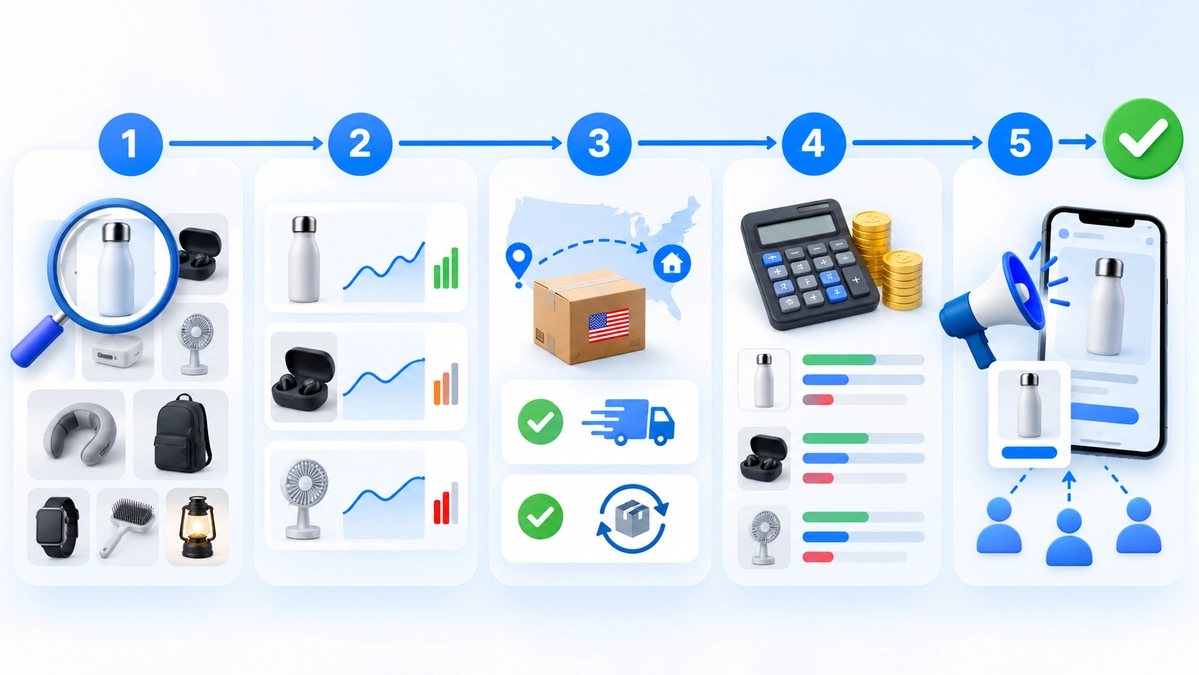
A 9-step method to find winning products for dropshipping in the USA
Take these steps in order, from a broad product search to a small market test. In Drilify, you can move from Product Library to Sales Tracking and Ad Spy without losing the thread of your research; supplier fit, costs, and customer response complete the decision.
1. Define the buyer, problem, channel, and price band
Write a one-sentence hypothesis before opening a research tool: 'This product helps this type of U.S. buyer solve this problem, and I can demonstrate the benefit on this channel at this price.' A defined hypothesis stops you from collecting random products. It also tells you what evidence you need from sales data, ads, suppliers, and a test campaign.
Choose one primary buyer and one concrete job the product performs.
Choose the first acquisition channel, such as Meta or TikTok, based on how the benefit can be shown.
Set a preliminary selling-price range and a maximum delivered product cost.
List non-negotiable constraints such as size, delivery time, compatibility, or restricted claims.
2. Build a candidate list with Drilify Product Library
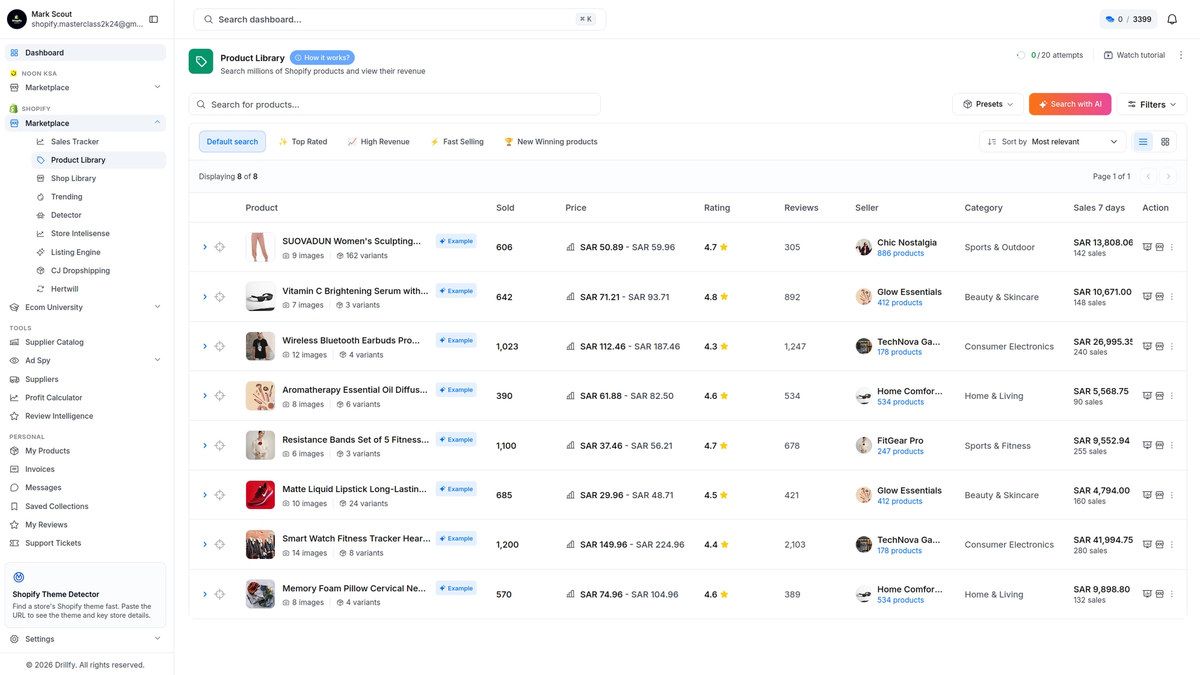
Use Drilify Product Library to browse and filter product research across supported commerce sources. Start with a category and price range, then compare sold count, recent sales or revenue estimates, rating and review context, seller or store information, and the available seven-day and 30-day signals. These fields help turn a broad category into a shortlist that deserves deeper research.
Drilify Product Library brings product, sales, review, seller, and store signals into one research view.
Pro tip: do not sort by the biggest number and stop. A smaller product with improving recent momentum, credible reviews, a workable price, and a clear audience may be more testable than the most visible item in a crowded category.
3. Compare demand, customer response, and competition together
Demand without context can be misleading. Compare recent movement with rating volume, review quality, seller concentration, price spread, and how many nearly identical offers appear. Read positive and negative reviews for the job customers hired the product to do, the words they use, and the problems that create returns. Look for unmet needs you can address through product selection, instructions, bundles, creative, or customer support.
Competition is not automatically bad. It can confirm demand. The question is whether you can enter with a credible reason to choose your offer. If every seller uses the same images, price, promise, and bundle, the product may force you into a costly race. If complaints reveal fixable gaps, the same category may still contain a useful opening.
4. Check momentum over time with Sales Tracking
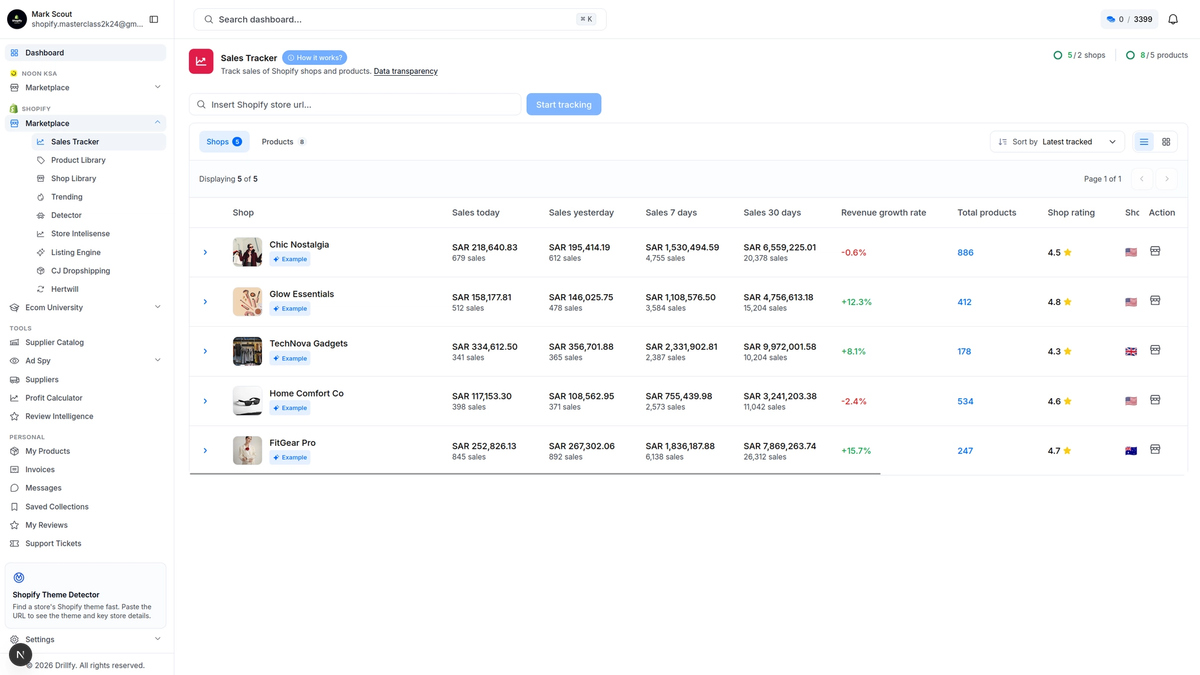
A single snapshot cannot show whether interest is rising, stable, or fading. Use Drilify Sales Tracking to review estimated sales and revenue across current and historical periods, growth, price movement, and update time. Compare today, yesterday, seven-day, and 30-day views where available. Treat these values as decision-support estimates and combine them with supplier, advertising, and test data.
Sales Tracking helps distinguish a temporary spike from more durable momentum and shows how price and performance change over time.
5. Inspect ad and advertiser evidence
Use Ad Spy to study Meta and TikTok creative patterns, active duration, messaging, markets, landing destinations, and advertiser context. Then use Advertiser Library to organize the brands and advertisers you are tracking. The goal is to understand which problems, demonstrations, and proof formats are being tested, not to copy another advertiser's creative or claims.
Longer-running ads can be a useful clue, but they are not proof of profit. An advertiser may be testing, retargeting, protecting a brand term, or running an offer with economics you cannot reproduce. Record the angle, audience, offer, creative format, and landing-page sequence, then decide how your own product and message will be meaningfully different.
6. Verify U.S. shipping, returns, and supplier fit
Before approving a candidate, ask the supplier for destination-specific delivery estimates, processing time, tracking availability, packaging details, defect handling, return address, and replacement policy. Test the route to the U.S. region you plan to target. A delivery promise that works for one state or warehouse may not apply everywhere.
The FTC's Mail, Internet, or Telephone Order Merchandise Rule guide explains that sellers need a reasonable basis for the shipping time they advertise. If no shipping time is stated, the seller needs a reasonable basis to ship within 30 days. If a delay occurs, the seller generally must seek the buyer's consent to the delay or provide a prompt refund. Build your promise around evidence you can maintain, not the fastest optimistic estimate.
Pro tip: place a sample order before scaling. Check the actual tracking flow, packaging, instructions, dimensions, product quality, delivery time, and whether the item matches the listing.
7. Model the complete unit economics
Use the Drilify Profitability Calculator to model product cost, shipping, selling price, advertising, fees, and return assumptions. Review expected net margin, break-even customer acquisition cost, break-even return on ad spend, and what-if scenarios. Use your own verified costs; calculator outputs are estimates, not a guarantee of actual profit.
Run at least three scenarios: expected, conservative, and stress case. The stress case should include a higher advertising cost, lower conversion rate, more refunds or replacements, and a price reduction. A product that only works in the optimistic case is not ready to scale.
8. Check product safety, restrictions, and claims
Research the rules that apply to the product, its materials, intended users, claims, labels, and destination. Higher-risk categories include children's products, ingestibles, cosmetics, electronics, protective equipment, and products that imply a medical outcome. This article is a research workflow, not legal advice.
Use the U.S. Consumer Product Safety Commission's small-business resources as a starting point for federal product-safety obligations, and obtain qualified advice when a product or claim falls into a regulated area. Ask suppliers for relevant documentation, but verify what the documents cover and whether they apply to the exact product you will sell.
9. Run a bounded market test before scaling
Create an original product page and a small set of creatives built around the buyer problem you identified. Define the test budget, duration, audience, and stop conditions before launch. Track click-through rate, landing-page conversion, customer acquisition cost, contribution margin, questions, cancellations, refunds, and delivery complaints. A strong ad metric cannot rescue weak fulfillment or negative contribution margin.
If the result is inconclusive, change one major variable at a time, such as the offer, creative angle, audience, price, or product page. If the product repeatedly misses its thresholds, archive the evidence and move to the next candidate. A disciplined rejection is a useful research result.
A winning-product decision should combine demand evidence, offer differentiation, economics, U.S. fulfillment, compliance, and a bounded market test.
How to use Noon and Daraz signals without confusing them with U.S. demand
Cross-market research can surface product formats, price anchors, review language, supplier patterns, and use cases that are less visible in your usual sources. Drilify's marketplace research can help you study supported platforms such as Noon and Daraz alongside Shopify and WooCommerce. That wider view is useful for generating hypotheses and noticing how an idea behaves in another market.
However, a product performing on Noon or Daraz is not proof that it will perform in the United States. Buyer expectations, climate, holidays, household needs, regulations, shipping routes, competition, and acceptable prices differ. Bring the idea back through the U.S. validation workflow: confirm U.S. demand, inspect Meta and TikTok advertising context, verify destination-specific fulfillment, model costs, check applicable rules, and run a controlled test.
A practical winning-product scorecard
Score each candidate from one to five on the six dimensions below. Write a short evidence note beside every score. The total helps you compare candidates, but a serious safety, compliance, fulfillment, or margin problem should still stop the product even if the overall score looks high.
Differentiation: a defensible audience, use case, bundle, product improvement, or presentation.
Economics: positive contribution margin under conservative cost and advertising assumptions.
Fulfillment: credible U.S. processing, tracking, delivery, replacement, and return handling.
Safety and claims: acceptable risk, suitable documentation, and marketing claims you can support.
Testability: a clear demonstration, reachable audience, measurable thresholds, and bounded test cost.
A useful operating rule is to advance only candidates that meet a minimum score in every category, not just a high total. This prevents strong demand from hiding a dangerous product, or an attractive margin from hiding unreliable shipping.
Common false positives to avoid
A viral video with no commercial evidence
Views may reflect entertainment rather than purchase intent. Check whether multiple advertisers, sellers, reviews, and recent sales signals support the idea, then test the offer yourself.
High sales with no room to differentiate
A crowded product can validate demand while leaving little room for a new seller. Identify the audience, problem, proof, bundle, service, or content advantage you will own before entering.
An attractive gross margin that ignores real costs
Gross margin can disappear after shipping, payment fees, ad spend, refunds, chargebacks, replacements, discounts, and support. Model contribution margin and a conservative case.
Fast delivery that was never tested
A supplier estimate is not the customer experience. Place a sample order to the intended region, inspect the tracking events, and leave room for normal variability in the promise.
Cross-market popularity treated as U.S. validation
Signals from another marketplace can inspire a test, but they do not replace U.S. demand, price, shipping, compliance, and creative validation.
Frequently asked questions
What is the best winning product for dropshipping in the USA?
There is no permanent best product. The strongest candidate is the one that currently combines a clear buyer problem, evidence of demand, manageable competition, dependable U.S. fulfillment, supportable claims, and positive unit economics under conservative assumptions.
How do I find winning products for dropshipping?
Start with a defined buyer and problem, build a candidate list, compare recent product and store signals, track momentum, inspect ads and advertisers, verify suppliers and U.S. shipping, model profitability, check safety and claims, then run a bounded test. Do not rely on one viral post or one sales estimate.
What selling-price range works best?
There is no universal range. The right price depends on perceived value, competition, shipping, product cost, fees, advertising, returns, and the buyer's alternatives. Model the complete economics at several prices and validate the actual offer with a controlled test.
How much profit margin should a dropshipping product have?
Use contribution margin after product cost, shipping, payment fees, advertising, expected refunds, replacements, discounts, and operating costs. Set a minimum that fits your business and test a conservative scenario. A healthy gross margin alone does not prove that a product will be profitable.
Can Noon or Daraz trends predict demand in the USA?
They can reveal product ideas, review language, price patterns, and market behavior, but they cannot prove U.S. demand. Validate the idea again using U.S.-relevant demand, competition, advertising, shipping, safety, seasonality, and test results.
How long should I test a dropshipping product?
Test until you have enough traffic and conversions to evaluate your predefined thresholds, or until the budget or stop condition is reached. The time varies by channel, price, traffic quality, and conversion rate. Do not extend a weak test indefinitely without a specific hypothesis.
Turn product ideas into evidence-backed decisions
A winning product is one your customers choose and your business can deliver profitably. Drilify gives you a connected way to discover candidates, compare product and store signals, check sales momentum, inspect ads, and model the economics. Use that evidence to choose a differentiated offer, verify U.S. fulfillment and product claims, and run a controlled test. Keep the results, including rejected ideas, so the next shortlist is stronger.