How to Validate a Dropshipping Product Before Launch: A Go/No-Go Checklist
A practical go/no-go checklist for one shortlisted dropshipping product. Check demand, competing offers, supplier quality, delivery, margin, and a small buyer test.
A practical go/no-go checklist for one shortlisted dropshipping product. Check demand, competing offers, supplier quality, delivery, margin, and a small buyer test.
You have a product candidate. Before building a campaign around it, check whether a real customer wants the offer, a supplier can deliver it, and the sale can leave enough money after fulfillment and acquisition costs. A popular-looking ad or a low supplier price answers none of those questions on its own.
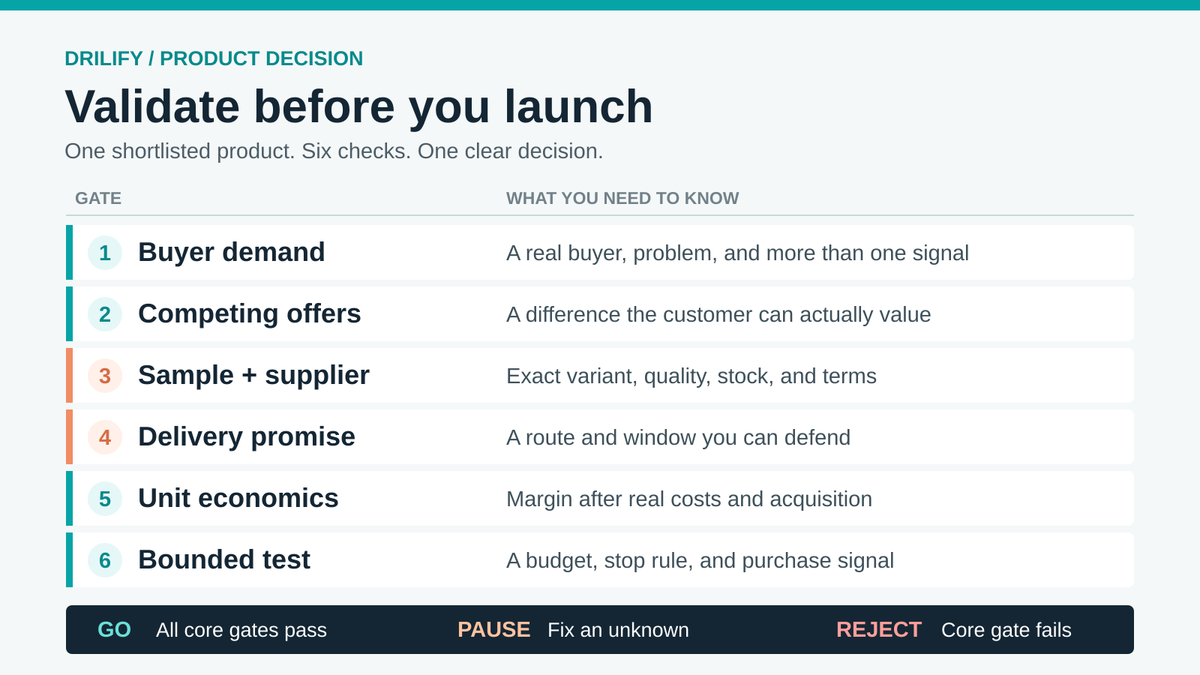
To validate a dropshipping product, put one candidate through six gates: buyer demand, competing offers, product and supplier quality, delivery promise, unit economics, and a small market test. Record the evidence and decide go, pause, or reject. Drilify helps connect product, store, ad, supplier, and profitability signals in that decision; the final proof still comes from the product you inspect and the buyers you serve.
This is a pre-launch check for one product you already shortlisted. If you are still choosing what to investigate, start with the dropshipping product research tools guide, then return with your strongest candidate.
The six-gate product validation checklist
For each gate, write down the evidence, the unresolved risk, and the next action. A green light on five gates does not cancel a serious failure on the sixth. A product with strong demand but no supplier who can meet your delivery promise is not ready to launch.
Buyer demand: Can you name the buyer, the problem, and evidence that people seek or purchase a solution in your target market?
Competing offers: Can you explain why someone would buy your version rather than a similar listing they can already find?
Product and supplier: Have you checked the exact variant, sample quality, stock, fees, and a backup source?
Can the supplier meet a delivery window you are willing to put on your product page?
LATEST POSTS
More from Drilify
Interviews, tips, guides, industry best practices, and news.
14 min read
11 Best Dropshipping Product Research Tools for 2026
Compare 11 dropshipping product research tools by workflow, current pricing, features, and limitations, including Drilify and useful free resources.
Unit economics: Does the margin still work after shipping, fees, expected returns, and the customer-acquisition cost you can afford?
Market test: Can a small, time-boxed test produce evidence about purchase intent without committing to an open-ended ad budget?
Go when the evidence supports all six gates and the remaining risks are manageable. Pause when a fixable unknown, such as an untested sample or missing shipping quote, could change the decision. Reject when a core requirement fails, such as unsafe quality, an undeliverable promise, or economics that cannot support acquisition. These are decision rules, not a numerical score that can hide a fatal flaw.
Use all six checks before you decide whether to launch, fix a blocker, or move on.
Gate 1: Verify demand for this buyer and market
Write a one-sentence buyer hypothesis: "[Customer] wants [outcome] but struggles with [specific problem]." Then collect two or three independent signals. These might include relevant search questions, customer reviews describing the problem, active competing listings, and actual conversations with potential buyers. Shopify distinguishes market validation, whether a need exists, from product validation, whether your specific offer meets it. Both matter here. Its market-validation guide recommends learning directly from the intended customer before investing heavily.
Use Drilify's Shopify Product Library to inspect products in the category, their prices, seller context, reviews, and recent sales signals. If a candidate has one impressive number but little supporting context, investigate further. Sales figures and trends shown by research tools are directional; they are not proof that your future store will get the same result.
Google Trends can add a useful sense of seasonality or relative interest, but it is not an order forecast. Its values are normalized to a 0-100 scale, and low-volume terms can appear as zero. Compare the right country and date range, then check a second source. Google's Trends guidance explains those limits.
Decision: Go forward if the problem and buyer are specific and supported by more than one signal. Pause if your only evidence is one viral video or a tool score. Reject if the supposed buyer cannot describe a meaningful need at the price you would charge.
Gate 2: Find your reason to win against existing offers
Search the exact product and its close substitutes in the market you plan to serve. Open several storefronts, not just the top ad. Compare the product promise, price, bundles, reviews, shipping terms, guarantee, and creative angle. Read negative reviews for missing features or recurring disappointments. Your opportunity may be a better variant, clearer sizing, a useful bundle, better demonstration, or a more reliable delivery promise. It should be visible to the customer, not merely different in your spreadsheet.
Drilify's Ad Spy lets you study Meta and TikTok creatives and advertiser activity, while its Shopify shop and product research views help you examine the offers behind the ads. Start with the buyer problem, then compare the message and landing page that each competitor uses. A long-running ad or multiple creative versions can justify a closer look, but an active ad is not evidence that it is profitable. Use ad research to find questions and angles to test, not to copy an unverified claim.
Write one sentence before continuing: "Our offer is more useful for [buyer] because [specific, supportable difference]." If you cannot make that sentence honest, the market may be too crowded for this version of the product.
Decision: Go if you have a defensible offer difference. Pause if the difference requires a supplier change or a better demonstration. Reject if you can only compete by selling an identical item for less than your economics allow.
Gate 3: Inspect the exact product and supplier
A listing image cannot tell you whether a hinge breaks, fabric feels cheap, sizes run small, or packaging survives delivery. Order the exact variant you intend to sell and inspect it as a customer would. Check dimensions, materials, finish, instructions, claims, packaging, and the experience of opening and using it. Take your own photos or video if the sample meets the standard; do not build a product page from supplier imagery alone.
Ask the supplier about stock for your chosen variants, order processing, shipping methods, tracking, returns, defects, and what happens when an item is unavailable. Compare at least one alternative source. Shopify's supplier guidance recommends test orders to assess fulfillment, packaging, tracking, and response quality.
Drilify's CJ Dropshipping and Hertwill sourcing areas can help you compare candidate products and supplier context before making a request. Use those views to narrow the options, then verify the actual quote and sample for the offer you will sell. A catalog estimate is not a supplier commitment.
Decision: Go when the sample and supplier terms meet your standard. Pause until an exact variant or backup source is checked. Reject when quality, safety, stock, or returns cannot support the customer promise.
Gate 4: Make the delivery promise believable
Choose the customer market and shipping method before writing "fast shipping" on a page. Get a destination-specific delivery estimate, processing time, tracking method, and total landed cost for the variant you tested. If possible, send a test order to the market you will advertise in and record the order date, dispatch date, first carrier scan, and arrival date.
The promise on your store should reflect the route you will actually use. A faster option may improve the offer, but only if the extra cost leaves a workable margin. If the only viable route takes longer than customers will reasonably accept, change the supplier or product before launch. Shopify's dropshipping fulfillment guide explains how supplier processing and delivery both shape the customer experience.
Decision: Go when you can explain the delivery window plainly and have evidence for it. Pause for a test order or updated quote. Reject if the supplier cannot give a credible route, tracking, or response when an order is delayed.
Gate 5: Calculate the margin before you buy traffic
Use the price you would actually show customers, then subtract every per-order cost you expect to pay. Include the product, shipping, payment and platform fees, discounts, expected returns or replacements, and customer support costs where material. The remaining contribution before advertising is the most you could spend to acquire an order and still break even. You need a lower acquisition cost if you want profit to remain.
Here is an illustration, not a forecast. Suppose a product sells for $40. The item costs $12, shipping is $6, fees are $2, and you reserve $2 for returns and replacements. That leaves $18 before advertising. Spending $18 to acquire one order would leave nothing from that order; spending $10 would leave $8 before fixed overhead and tax. If a faster shipping method adds $5, the same $10 acquisition cost leaves only $3. The faster route may still be worth offering, but you should make that decision deliberately.
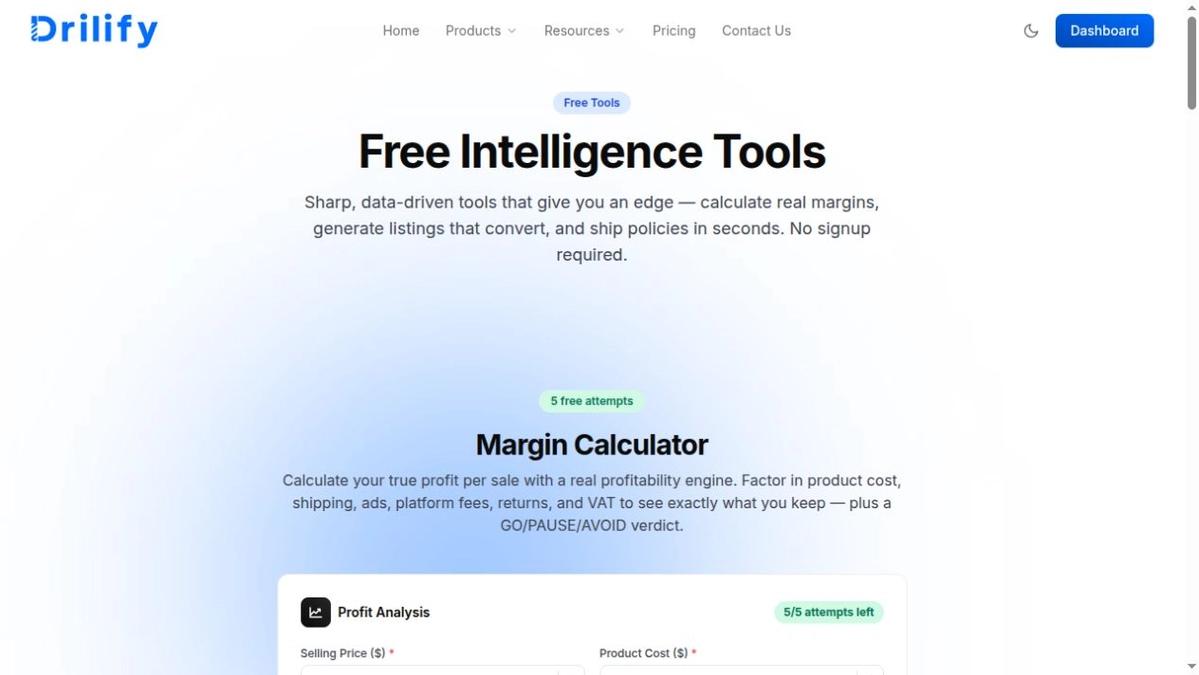
Enter the real price and cost scenarios into Drilify's profitability tools. Compare the standard and faster shipping options, a realistic discount, and an acquisition-cost range. Drilify helps you see how much room the offer has before you pay for traffic. It cannot turn an uncertain supplier price or assumed conversion rate into a guaranteed margin.
Model your real order costs and advertising allowance before paying for traffic.
Decision: Go if the margin survives plausible acquisition and fulfillment costs. Pause if key costs are still quotes rather than confirmed numbers. Reject if even a favorable scenario cannot fund the customer experience and marketing needed to sell it.
Gate 6: Run a bounded purchase-intent test
Only test after the first five gates are credible. Build a product page with accurate photos, a clear buyer benefit, verified specifications, delivery terms, and a straightforward returns policy. Choose one audience and one offer hypothesis. Define the budget, duration, and success or stop condition before the campaign starts. Otherwise, weak results can always be explained away by changing the goal afterward.
Track the path from ad impression or search visit to product-page engagement, add-to-cart, checkout, and completed order. Traffic and clicks show attention; purchases and post-purchase feedback provide stronger evidence. If visits arrive but the product page cannot explain the offer, improve the page before concluding that the product has no demand. If people add to cart but abandon after seeing shipping, revisit the delivery and economics gates. If your cost per order exceeds the ceiling you calculated, stop or change the offer rather than increasing spend indefinitely.
Shopify's product-validation guide describes small tests as a way to learn before a full launch. Treat any first test as a learning sample, not a guarantee of future conversion rates. Keep the initial budget small enough that a failed test is affordable for your business.
Decision: Go if buyers respond to the offer at an acquisition cost your margin can support and fulfillment performs as promised. Pause to fix a specific bottleneck and test again. Reject if repeated, well-formed tests fail the economics or reveal a product problem you cannot solve.
Put the decision on one page
For each candidate, keep a short decision record with the buyer and market, product variant, competing offers, supplier and backup, test-order result, delivery window, price, full per-order costs, maximum acquisition cost, test budget, observed orders, and unresolved risks. Date the evidence so you know when a supplier quote or ad signal needs refreshing. End with one of three actions: launch a controlled next test, fix a named blocker, or move to the next candidate.
This is where Drilify's connected workflow earns its place. Product and shop research helps you frame demand and competition; Ad Spy shows the creative approaches worth investigating; sourcing views help you compare supply options; and the Profitability Calculator forces the offer to survive real costs. You still make the final call from your sample, supplier terms, and customer response, but you do not have to make it from a single viral screenshot.
Frequently asked questions
How do I validate a dropshipping product before spending on ads?
Check the buyer problem, competing offers, exact sample, supplier terms, delivery promise, and full unit economics first. Then run a small, bounded campaign only if those checks pass. Paid traffic should test an offer, not substitute for basic product and supplier diligence.
How many competitors should I compare?
Look at enough close substitutes to understand the price and promise a buyer will see. Three to five relevant offers is a practical starting sample, not a required number. Include direct substitutes in your target market and note where their reviews reveal an unmet need.
Does an active competitor ad prove a product is winning?
It shows that an advertiser is running a creative. You usually cannot see that advertiser's actual margin, acquisition cost, or refund rate. Pair the ad with product, store, buyer, and supplier evidence before making a decision.
Should I order a sample if the supplier has good reviews?
Yes, especially when quality, fit, safety, packaging, or delivery is central to the offer. Reviews can help you choose whom to investigate, but they do not replace checking the exact variant and route you plan to sell.
What if the product has demand but little margin?
Try a legitimate offer improvement, different supplier, bundle, or shipping option and recalculate. Do not assume a higher selling price or cheaper acquisition will appear after launch. If the economics still fail, reject the product.
Can Drilify tell me whether a product will sell?
Drilify helps you compare Shopify product and store signals, investigate Meta and TikTok advertising, review sourcing options, and model profitability. But a sample and a controlled buyer test are still needed to validate your exact offer.
Make the call before you scale
The best product to launch is not simply the one with the most attention. It is one you can explain, source, deliver, and sell at a margin that survives a real test. Take your shortlisted product through the six gates, record the result, and use Drilify's research and profitability tools to make the next decision with evidence.