Free Dropshipping Profit Margin Calculator: Know Your True Profit
Calculate more realistic dropshipping profit after product cost, shipping, ads, and fees, then use break-even thresholds to make a clearer launch decision.
Calculate more realistic dropshipping profit after product cost, shipping, ads, and fees, then use break-even thresholds to make a clearer launch decision.
A product can look profitable in a supplier catalog and still lose money after the first real orders arrive. The usual mistake is simple: subtract product cost from selling price, call the remainder “profit,” and ignore the expenses between checkout and fulfillment.
That shortcut misses shipping, advertising, payment and platform fees, returns, tax treatment, and overhead. It can also confuse markup with margin. The result is a price that looks healthy before launch and feels painfully thin once cash starts leaving the account.
Drilify’s free dropshipping profit margin calculator turns those assumptions into one per-order model. You enter the commercial numbers you know, review the deductions together, and get a clearer view of modeled profit, margin, markup, and whether the economics deserve a GO, PAUSE, or AVOID decision.
The verdict is not a guarantee. It is a prompt to inspect the numbers before you spend more.
Why dropshipping profit is easy to overestimate
The attractive number is usually the gap between selling price and supplier cost. If a product costs $10 and sells for $35, the gap is $25. But that $25 is not automatically profit.
The order may also need to absorb:
shipping and fulfillment charges;
advertising cost per acquired sale;
platform and payment-processing fees;
refunds, replacements, chargebacks, and reshipments;
VAT, sales tax, duties, or tax-calculation fees, depending on the market and setup;
software, labor, support, creative production, and other overhead.
Some costs occur on every order. Others are uncertain or spread across many orders. A useful model converts each one into a consistent per-order assumption.
Gross profit and business net profit are not the same. Shopify defines gross margin around net sales and cost of goods sold, while broader operating expenses sit outside that narrower measure. Its also notes that net sales account for returns and discounts. Launch decisions need a variable per-order model followed by a separate check of fixed business costs.
LATEST POSTS
More from Drilify
Interviews, tips, guides, industry best practices, and news.
14 min read
11 Best Dropshipping Product Research Tools for 2026
Compare 11 dropshipping product research tools by workflow, current pricing, features, and limitations, including Drilify and useful free resources.
These three terms are related, but they answer different questions.
Modeled profit per sale is the amount left after subtracting the costs included in the model from the revenue basis used in that model.
Modeled profit per sale = revenue - modeled costs
Profit margin shows that remainder as a percentage of revenue.
Profit margin = modeled profit / revenue × 100
Markup compares the profit amount with a cost base, not with revenue.
Markup = modeled profit / modeled cost base × 100
That denominator difference is why a 40% markup is not a 40% margin. Shopify’s markup-versus-margin guide uses the same distinction and shows how confusing the two can lead to underpricing.
When you compare calculations, confirm which costs are included in “cost” and whether the percentage is margin or markup. A tool can calculate accurately and still produce a misleading decision if the inputs or definitions do not match your business.
What the Drilify profit margin calculator includes
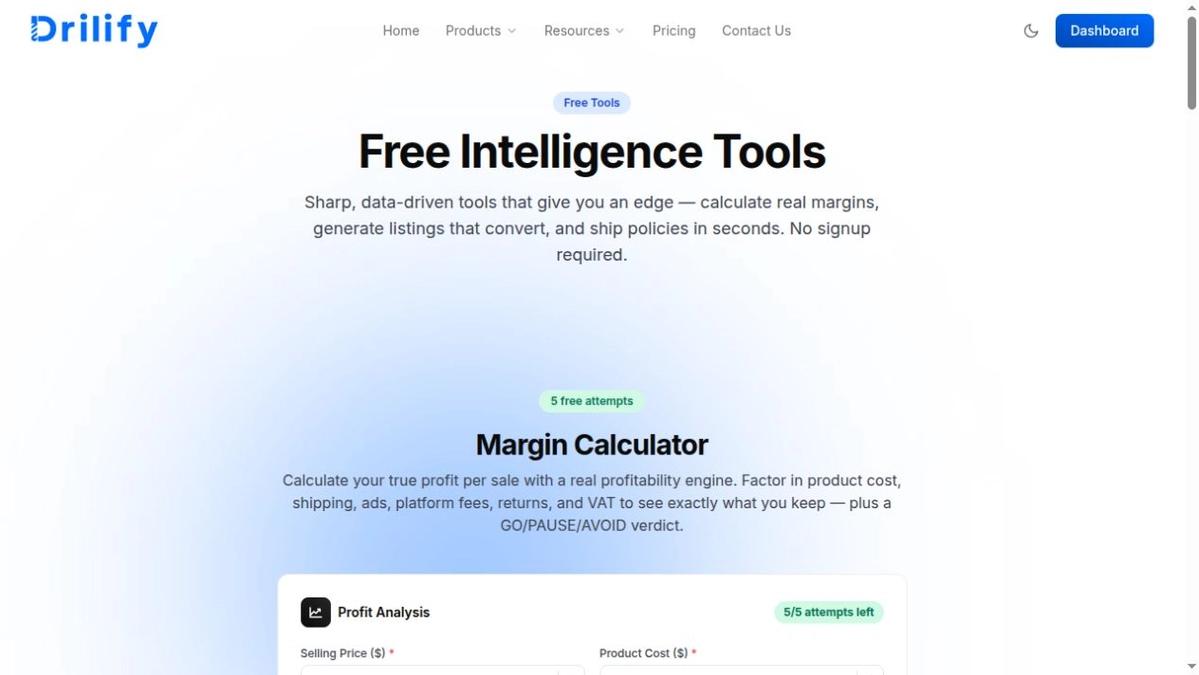
The free Margin Calculator is available on Drilify’s Free Intelligence Tools page. The visible quick calculation starts with five core fields:
selling price;
product cost;
shipping cost;
ad cost per sale;
platform fees.
The free Drilify Margin Calculator starts with five order-level inputs. The interface was inspected without running a calculation or using an attempt.
The page shows a five-attempt allowance and offers both a standard calculation and a deeper analysis path. You can inspect the form before using an attempt.
The broader Drilify profitability workflow can model more of the decision. Depending on the view and access level, that includes weight, advertising method, order volume, overhead, platform and fulfillment fees, return assumptions, and tax treatment. Its decision outputs can include modeled profit per sale, margin, markup, total deductions, break-even CPA, break-even ROAS, ad-cost headroom, launch cash, sensitivity, scenario comparisons, and the selling price needed for a target margin.
Those outputs serve different decisions:
Profit per sale shows the modeled dollar remainder.
Margin makes products with different selling prices easier to compare.
Markup helps explain how the price relates to the modeled cost base.
Break-even CPA estimates the maximum acquisition cost before the modeled remainder reaches zero.
Break-even ROAS translates that advertising threshold into a revenue-to-ad-spend ratio.
Sensitivity and scenarios show which uncertain input can damage the economics fastest.
Target-margin price works backward from the result you need.
The calculator does not know your true costs automatically. Its value comes from making assumptions visible and showing how they interact.
How to use the free dropshipping profit margin calculator
1. Choose one product, market, and currency
Start with one exact product variant and one destination market. Supplier cost and shipping can change by size, weight, warehouse, destination, or delivery method. Mixing several variants into one estimate can hide the least profitable case.
Use one currency throughout the calculation. If your supplier charges in another currency, convert the amount using a realistic rate and leave room for conversion fees or movement in the rate.
2. Enter the revenue you actually expect to collect
Use the expected selling price after normal discounts, not an inflated list price that customers rarely pay. If discount codes, bundles, or introductory offers are part of the launch, model those prices separately.
Also decide whether the entered price includes tax. Shopify explains that stores can display prices with tax included or add tax at checkout, depending on configuration and market. Its guidance on tax collection and displayed prices is a useful reminder that two stores with the same visible price may not have the same revenue basis.
3. Use the landed product cost
Product cost should reflect what it takes to make one sellable unit available for the order, not only the headline supplier price. Depending on the setup, that may include the variant cost, packaging, sourcing charges, inbound movement, or duties that the seller absorbs.
Shopify’s product-pricing guide recommends combining fixed and variable expenses into a cost-per-unit view before adding the desired margin. Use the same principle here: include a cost only once, but do not leave it outside the model simply because it arrives on a different invoice.
4. Enter destination-specific shipping
A supplier’s cheapest displayed shipping option may not match your market, promise, or tracking level. Use the cost for the actual destination and service. If shipping varies widely, calculate a common case and an expensive but plausible one.
5. Estimate advertising cost per sale
Ad cost per sale is your customer acquisition cost for the order under review. For a new product, it is an assumption, not a known result. Use a baseline that reflects similar campaigns, then test a worse case.
Do not choose a CPA merely because it makes the product look profitable. The calculation should answer whether the offer survives a realistic acquisition cost. Later, replace the assumption with campaign spend divided by attributable orders over a defined period.
6. Add platform and payment fees consistently
Enter the charges that apply to the order: ecommerce platform transaction fees, payment processing, marketplace commissions, or other per-order charges. Review current terms for the plan, payment method, market, and currency rather than copying an old percentage.
Confirm whether percentage fees apply to item revenue, shipping, tax, or the complete charged amount. Convert the relevant percentage and fixed fee into one order-level estimate when needed.
7. Calculate and read the deductions before the verdict
After entering the core fields, calculate the result and inspect the deduction breakdown first. This is where omitted costs and implausible assumptions become easier to spot.
Then read modeled profit, margin, and markup together. A positive profit amount may still leave too little room for overhead or volatility. A high markup on a low cost base can coexist with a modest margin after advertising and fulfillment.
Finally, review the GO, PAUSE, or AVOID verdict as a summary of the modeled economics:
GO means the current assumptions leave a healthier modeled result. Validate demand, supplier quality, delivery, and real campaign performance before scaling.
PAUSE means the result needs investigation or a stronger price, cost, or acquisition plan.
AVOID means the assumptions leave weak or negative economics. Change the offer materially or reject it.
8. Run a downside scenario
One baseline is not enough. Change the variables that can move quickly: CPA, shipping, selling price, and return losses.
For example, imagine a $35 sale with $10 product cost, $4 shipping, $7 advertising cost, and $3 in platform and payment fees. The five visible deductions total $24, leaving a modeled $11 before any omitted taxes, returns, or overhead. That is a 31.4% margin on the $35 revenue basis.
If CPA rises from $7 to $12, the modeled remainder falls to $6 and the margin to 17.1%. The product did not change; one acquisition assumption changed the decision. This is why sensitivity matters more than one attractive headline result.
The numbers above are a teaching example, not a Drilify forecast or a promise of performance.
Use break-even CPA and ROAS without fooling yourself
Break-even metrics are useful boundaries, but they are not targets.
If revenue is $35 and every modeled non-ad cost totals $17, then the break-even CPA is $18. Spending $18 to acquire the order would leave a modeled remainder of zero.
Break-even CPA = revenue - modeled non-ad costs
The corresponding break-even ROAS is revenue divided by break-even ad spend:
Break-even ROAS = revenue / break-even CPA
In that example, $35 / $18 is about 1.94x. But 1.94x is the point where this simplified model reaches zero, not where the business becomes attractive. If you need to retain $8 per order, the maximum CPA under the same assumptions is $10, not $18.
Keep a buffer for costs that are delayed or difficult to estimate. Returns, chargebacks, currency movement, creative production, software, support, and taxes can all consume the apparent headroom.
Costs dropshippers most often forget
Returns and replacements
A returned order can lose revenue while retaining processing fees, shipping expense, or replacement cost. Estimate the expected economic loss per affected order, then multiply it by the affected-order rate. Avoid subtracting the same loss twice.
Discounts and refunds
Model the amount customers are likely to pay after discounts. Reconcile refunded revenue separately when you review real performance.
VAT, sales tax, and duties
Tax treatment depends on jurisdiction and setup. Decide whether tax is included in the displayed price, added at checkout, remitted by a platform, or paid through import arrangements. Shopify’s markets guidance shows why duties and tax display can vary by market. Use professional tax advice for obligations; a margin calculator is not a tax determination tool.
Software and operating overhead
Allocate recurring costs over a realistic number of orders. A $200 monthly software and support budget adds $2 per order at 100 orders but $10 per order at 20 orders. Recalculate when volume changes.
Cash timing
A product can show a positive per-order result and still require more cash than expected. Suppliers, ads, refunds, and replacements may be paid before the store receives or can withdraw customer funds. That is why launch-cash estimates belong beside margin, not after it.
Common profit calculator mistakes
Using the cheapest supplier variant while planning to advertise a more expensive one.
Entering average shipping that excludes the target country.
Treating a guessed CPA as a fact.
Comparing tax-inclusive revenue with tax-exclusive costs.
Calling contribution profit “net profit” without listing omitted business expenses.
Confusing markup with margin.
Ignoring refunds, discounts, chargebacks, and replacements.
Trusting a GO verdict without testing product demand or supplier reliability.
Scaling from one calculation instead of replacing estimates with fulfilled-order data.
Use a dated model with explicit assumptions, several scenarios, and a routine for replacing estimates with actual numbers.
Turn the estimate into a decision
Use the result to choose a next action, not to decorate a product idea.
If the product looks healthy, set a maximum CPA below break-even, define the profit you want to retain, and run a controlled test. If the result is marginal, identify the biggest lever: price, product cost, shipping, advertising, or loss rate. If the result is weak even under favorable assumptions, stop before sunk cost makes the decision harder.
After launch, recalculate with collected revenue, fulfilled-order costs, campaign spend, fees, discounts, and refund outcomes. Compare the model with reality and record where it was wrong. That feedback improves the next product decision.
Try the free Drilify Profit Margin Calculator to put product cost, shipping, ads, and platform fees into one decision model. Use the quick result to identify the economics worth testing, then use Drilify’s deeper profitability metrics to explore break-even CPA, ROAS, ad headroom, scenarios, and launch cash when available.
Frequently asked questions
What is a dropshipping profit margin calculator?
A dropshipping profit margin calculator estimates the amount and percentage left from an order after subtracting the costs included in the model. A useful calculator includes more than supplier cost, because shipping, advertising, fees, returns, tax treatment, and overhead can change the decision.
How do I calculate dropshipping profit margin?
Subtract modeled costs from the revenue basis to find modeled profit, divide that result by revenue, and multiply by 100. List every included cost and keep the tax and currency basis consistent. Do not describe the result as final business net profit if overhead, refunds, taxes, or other expenses remain outside the calculation.
What is the difference between margin and markup?
Margin divides profit by revenue. Markup divides profit by a cost base. Because the denominators differ, the percentages are not interchangeable. Margin is useful for comparing profitability against sales; markup is useful when building a price from cost.
What is a good profit margin for dropshipping?
There is no universal percentage that makes a product safe. The required margin depends on acquisition volatility, return risk, overhead, cash needs, and the amount of profit the seller needs to retain. Test a baseline and downside scenario instead of relying on a generic benchmark.
Does the Drilify calculator guarantee profit?
Drilify calculates from the inputs and assumptions supplied to it. The result does verify demand, supplier quality, attribution, delivery performance, tax obligations, or future advertising costs. Treat the verdict as decision support and replace estimates with actual fulfilled-order data.
What is break-even CPA?
Break-even CPA is the maximum modeled acquisition cost before the included per-order profit reaches zero. A safer operating target sits below break-even by the amount of profit and risk buffer you want to preserve.
Can I use the calculator before I have sales data?
Yes, as a planning model. Label uncertain inputs, use credible ranges, and run adverse scenarios. Once orders arrive, update the calculation with actual selling prices, shipping, fees, campaign spend, refunds, and replacement costs.