Dropship.io Extension Alternative: Why Drilify Goes Beyond the Browser
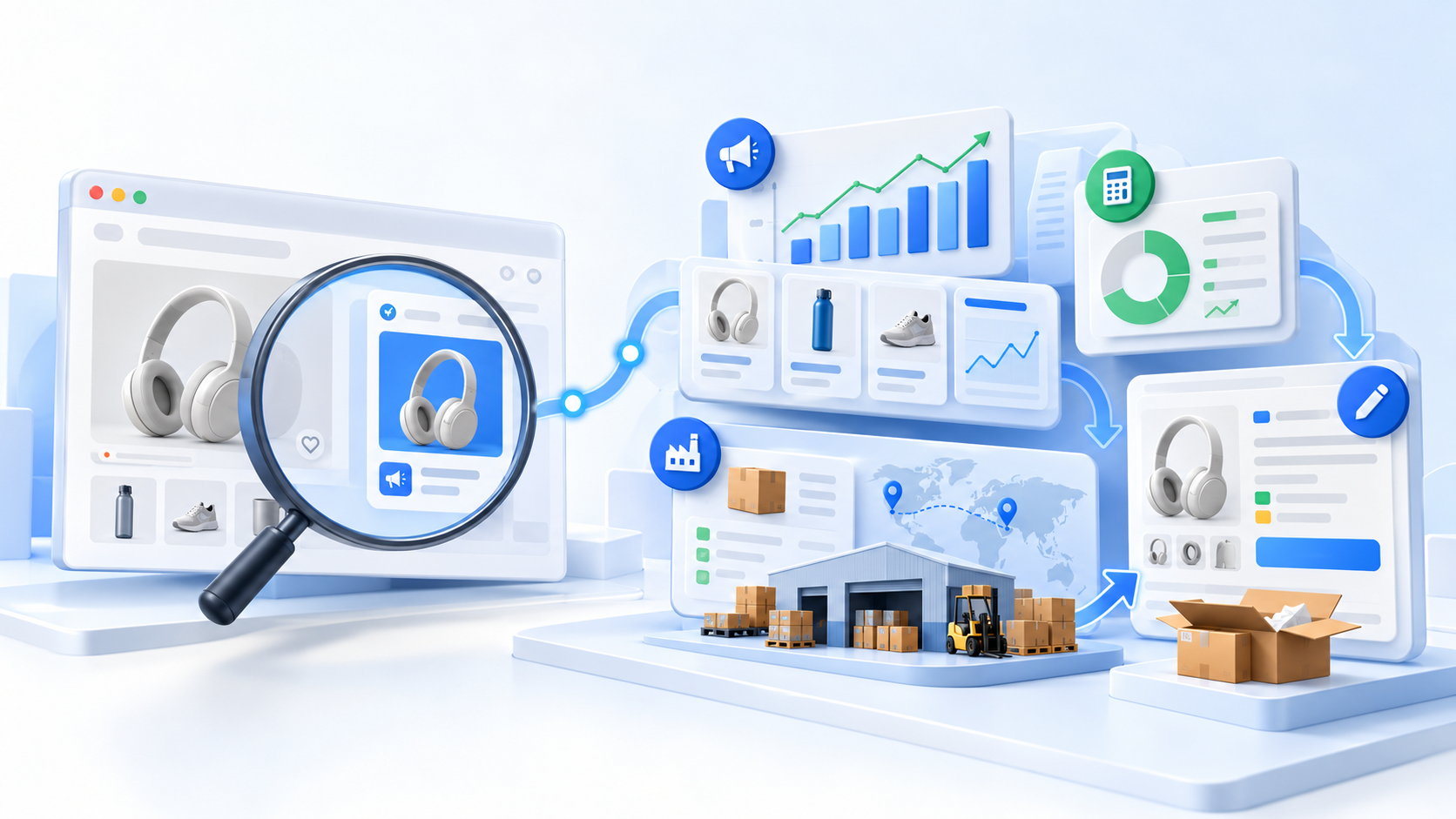
The Dropship.io extension brings quick research into the browser. Drilify covers the same product, store, and ad-research decisions, then carries the workflow into sales tracking, sourcing, profitability checks, and listing preparation.
The Dropship.io extension brings quick research into the browser. Drilify covers the same product, store, and ad-research decisions, then carries the workflow into sales tracking, sourcing, profitability checks, and listing preparation.
If you are searching for a Dropship.io extension alternative, the useful question is not simply which tool adds more information to a browser tab. The better question is: which workflow helps you move from spotting a product to deciding whether it is worth testing?
Dropship.io's Chrome extension is built for speed while browsing. Its official page highlights Shopify store analysis, Facebook ad-spend data, best-selling products, app-stack discovery, niche research, and one-click product imports. That is convenient when you want research to appear on the store or advertiser page already open in Chrome.
Drilify covers those core research decisions through its product libraries, shop libraries, Meta and TikTok Ad Spy, Advertiser Library, Store Intelisense, Theme Detector, and Shopify-connected workflows. It then goes further with sales tracking, supplier economics, a profitability calculator, listing generation, store optimization, and flexible credit transfers. In other words, Dropship.io helps you inspect what is in front of you; Drilify helps you investigate it, validate it, source it, price it, and prepare it for sale.
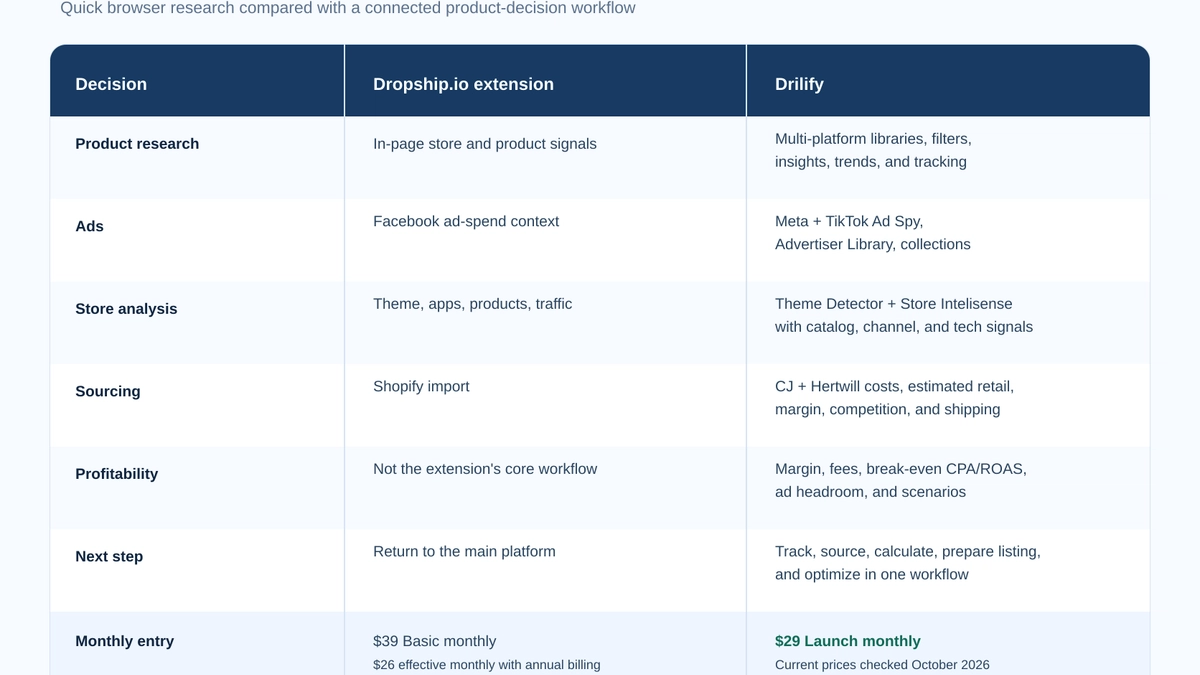
Dropship.io extension vs Drilify at a glance
Dropship.io emphasizes in-browser convenience, while Drilify connects research to validation and launch decisions. Pricing and features were checked October 15, 2026.
Comparison in text
Research products while browsing: Dropship.io: Browser overlay on Shopify stores and Facebook advertisers Drilify: Product and shop libraries with filters, product insights, price dynamics, and multi-platform coverage Practical difference: Dropship.io keeps the task inside the current tab; Drilify gives the research more depth and a reusable workspace
LATEST POSTS
More from Drilify
Interviews, tips, guides, industry best practices, and news.
14 min read
11 Best Dropshipping Product Research Tools for 2026
Compare 11 dropshipping product research tools by workflow, current pricing, features, and limitations, including Drilify and useful free resources.
Find best sellers and recent products: Dropship.io: Surfaces store best sellers and latest additions Drilify: Product Library, Shop Library, Trending, and Sales Tracker compare sales, revenue, growth, price, ratings, and freshness where available Practical difference: Drilify carries a quick discovery into trend and momentum checks
Analyze ads and advertisers: Dropship.io: Facebook ad-spend visibility from the extension Drilify: Meta and TikTok Ad Spy plus Advertiser Library, creative context, activity signals, advertiser history, and saved collections Practical difference: Drilify connects the ad to the advertiser and a broader research trail
Inspect a Shopify store: Dropship.io: Store analysis, theme, product count, traffic signals, and app stack Drilify: Store Intelisense, Theme Detector, Shop Library, traffic and catalog signals, technology, advertising context, keywords, and coverage notes Practical difference: Drilify provides a fuller decision report instead of a single browser snapshot
Import or prepare a product: Dropship.io: One-click import to Shopify Drilify: CJ Dropshipping and Hertwill sourcing paths, Shopify-connected workflows, and Listing Engine for editable SEO-ready copy Practical difference: Drilify adds supplier economics and listing preparation before publishing
Test profitability: Dropship.io: Not the extension's central job Drilify: Profitability Calculator models costs, fees, ads, returns, margin, break-even CPA, ROAS, and scenarios Practical difference: Drilify helps decide whether the product can survive real operating costs
Continue after research: Dropship.io: Return to the main Dropship.io platform for additional tools Drilify: Track sales, compare suppliers, calculate economics, prepare listings, optimize a connected store, and organize saved ads Practical difference: Drilify keeps more of the validation-to-launch process in one account
Entry price: Dropship.io: From $39 monthly, or $26 per month billed annually for Basic Drilify: From $29 monthly for Launch Practical difference: Drilify has the lower month-to-month starting price at the time checked
Pricing and features can change. Dropship.io pricing was checked against its official pricing and help pages, while Drilify pricing was checked against its current development pricing page.
What the Dropship.io Chrome extension does well
The strongest reason to use the Dropship.io extension is convenience. You can visit a Shopify store or Facebook advertiser and open research without first rebuilding the context in another tool. That can make repetitive competitor checks feel faster.
According to the official Dropship.io extension page, the extension can show live and historical sales data, reveal best-selling and recently added products, identify a store's apps, surface Facebook ad-spend data, and import a product to Shopify. Dropship.io also describes a niche finder and a portable toolkit that reduces tab switching.
The tradeoff is scope. A browser extension is excellent at making the current page more informative, but a winning-product decision rarely ends on that page. You still need to compare demand over time, review the advertiser, check competition, understand sourcing cost and shipping, model profit after fees and ads, and prepare a listing that can actually convert.
That is where Drilify's broader workflow becomes the stronger alternative.
How Drilify covers the same research job, then goes further
Drilify does not stop at showing more information around the page you are browsing. It turns product, store, and ad signals into a sequence of decisions.
1. Product and store research becomes a reusable library
Drilify's Shopify Product Library can show sold count, price or price range, rating, reviews, seller, category, and seven- and thirty-day sales or revenue where available. The Shop Library adds top products, thirty-day sales or revenue, growth rate, average product price, catalog size, rating, region, creation date, and source freshness.
That matters because a seller can compare several candidates rather than judging one store in isolation. The same account also covers WooCommerce and regional marketplaces such as Daraz and Noon, subject to country and plan access. The result is a research system that can follow different commerce models without forcing every decision into a Shopify-only lens.
2. Ad research connects the creative to the advertiser
The Dropship.io extension makes Facebook ad spend easier to see while browsing. Drilify covers the same core need through Meta and TikTok Ad Spy and the Advertiser Library.
Ad Spy lets sellers compare creative, activity duration, country, industry, store or landing-page context, advertiser activity, and other available performance signals. Advertiser Library then groups the advertiser-level picture: platform, top ads, active and unique ad counts, countries, first-seen and latest-ad dates, and an Ad Spy handoff.
The important difference is continuity. Instead of seeing one useful overlay and moving on, you can follow a promising creative back to the advertiser, compare its activity, save it to a collection, and use that evidence in the rest of the product-validation process.
3. Store analysis becomes a fuller business report
Dropship.io's extension can reveal a Shopify store's theme, product count, traffic signals, and app stack. Drilify covers that job with both the Shopify Theme Detector and Store Intelisense.
Theme Detector identifies the store's visible design foundation and related store details. Store Intelisense goes further by organizing estimated revenue, visits, average order value, active products, catalog and pricing mix, geography, traffic sources, technology, ad signals, top products, growth context, keywords, and data-source coverage into one report.
These are not guaranteed business results. Some values are estimates, so the seller should read the coverage notes and verify important numbers. Still, the report supports a better decision than a theme or app list alone: Is the competitor growing? How broad is the catalog? Which channels appear important? Where might there be a positioning or assortment gap?
4. Product discovery continues into sourcing economics
Finding a product is not the same as finding a product you can sell profitably. Drilify's connected CJ Dropshipping catalog brings decision data into the sourcing stage: supplier cost, estimated retail price, estimated margin, competition, category, shipping type and destination, supplier context, and creation date. Hertwill provides a comparable sourcing workflow for its catalog and integration path.
This helps a seller ask better questions before importing anything:
Is there enough pricing room between supplier cost and an estimated retail range?
Is the product already crowded?
Does the shipping method fit the target market?
Is the supplier and destination combination practical?
Estimated retail and margin values are screening signals, not promises. Their purpose is to narrow the list before money is spent on samples, ads, or inventory.
5. Profitability is tested before launch
Drilify's Profitability Calculator turns a product idea into a unit-economics test. It can account for product cost, selling price, shipping, advertising, platform and fulfillment fees, returns, overhead, and order volume.
The outputs include net margin, profit per sale, markup, break-even CPA, break-even ROAS, ad-cost headroom, fee breakdown, sensitivity by cost lever, and pessimistic, baseline, and optimistic scenarios. This is the difference between saying a product looks popular and asking whether the economics still work after customer acquisition and operating costs.
6. Research becomes an editable listing workflow
The Listing Engine can turn a product URL, supplier product, Shopify item, or image into an editable listing draft. Its outputs include title variants, description, bullet points, specifications, SEO title and description, handle, image alt text, keyword coverage, FAQs, structured data, and indicative pricing or margin fields.
This is where Drilify moves beyond a browser-inspection tool. The product does not remain a saved research result. It can move toward a listing that a seller reviews, edits, and publishes through the appropriate connected workflow.
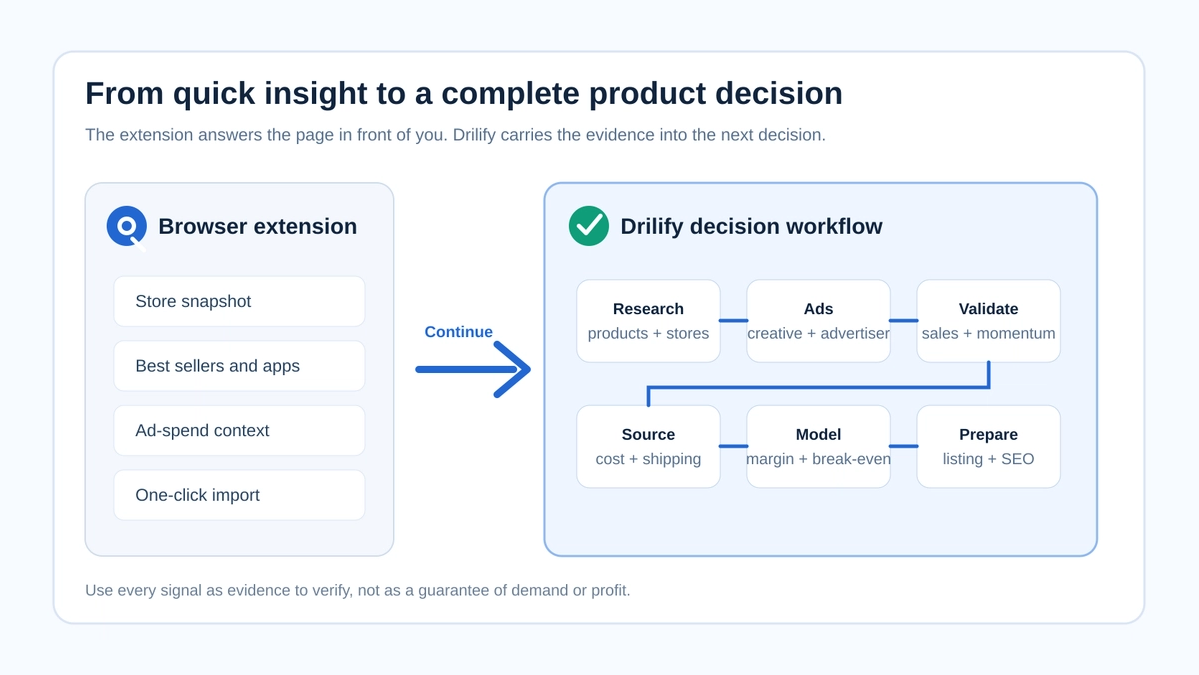
Original visual: extension insight vs full workflow
The first diagram compares the point-in-time convenience of an extension with Drilify's connected decision path.
A browser overlay can speed up inspection; Drilify carries the evidence into a broader decision workflow.
Pros and cons
Dropship.io Chrome extension pros
Fast access while browsing Shopify stores or Facebook advertisers.
Useful store, product, app-stack, and ad-spend context in the current tab.
One-click Shopify import is convenient for sellers already committed to the Dropship.io workflow.
A clear fit for researchers who value browser overlays and minimal context switching.
Dropship.io Chrome extension cons
The extension is an entry point, not the complete validation and launch process.
The official subscription has a short three-day trial, and monthly Basic starts at $39.
The most useful research still needs to be connected to sourcing, margin, and listing decisions.
Another browser extension adds permissions, updates, and interface overhead to the browser.
Drilify pros
Covers product, store, ad, and advertiser research, then extends into sales tracking, sourcing, profitability, and listing preparation.
Supports Shopify, WooCommerce, Daraz, and Noon workflows, subject to regional and plan availability.
Meta and TikTok research sit alongside advertiser-level analysis and saved collections.
Credit transfers let eligible users move unused allowance from tools they do not need toward tools they use more during the billing cycle.
Monthly pricing starts at $29, below Dropship.io's $39 monthly Basic plan at the time checked.
Drilify cons
A structured dashboard takes more deliberate setup than opening an extension over the current page.
Some advanced reports and AI outputs require higher plans.
Marketplace access and available features can vary by region, plan, and connected integrations.
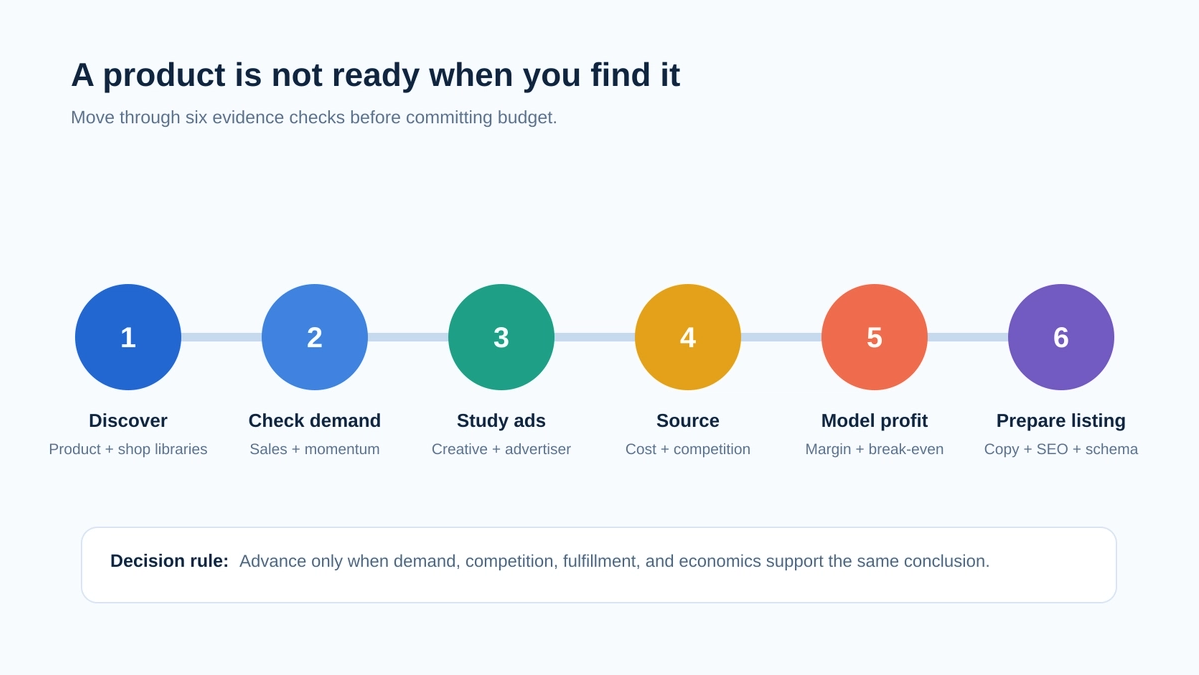
Original visual: the Drilify decision path
The second diagram shows how a product moves from discovery to a decision-ready launch plan.
Drilify connects discovery to the decisions required before a product is ready to test.
Pricing comparison
Dropship.io currently lists three monthly plans: Basic at $39, Standard at $59, and Premium at $99. Annual billing reduces the effective monthly prices to $26, $34, and $49, paid as yearly totals. Its official help center also describes a three-day trial and a temporary card authorization during signup.
Drilify's monthly plans currently start with Launch at $29, followed by Scale at $49 and Dominate at $89. Launch includes the core product and shop libraries, Sales Tracker, Ad Spy and Advertiser Library, Listing Engine, CJ Dropshipping and Hertwill, supplier workflows, and related business tools. Higher plans add deeper store and review intelligence, bulk or image-based listing generation, advanced reporting, and larger credit allowances.
The fair comparison depends on billing preference. Dropship.io's annual Basic rate is lower on an effective monthly basis, but it requires a yearly payment. Drilify has the lower entry price for month-to-month access and includes a broader research-to-listing workflow in the same product family.
When to choose Dropship.io
Choose the Dropship.io Chrome extension when your highest-priority requirement is an overlay inside the Shopify stores and Facebook advertiser pages you already browse. It is also a sensible choice if your team already uses Dropship.io, understands its credit model, and mainly wants to reduce tab switching.
When to choose Drilify
Choose Drilify when the extension's research features are only the beginning of your process. Drilify is the stronger choice when you want to:
compare products and stores across more than one commerce platform;
connect Meta and TikTok ad research to advertiser analysis;
move from product discovery into supplier cost, competition, shipping, and estimated pricing room;
calculate margin and break-even advertising thresholds before testing;
prepare editable, SEO-ready listing content;
track sales and price movement over time; and
reallocate eligible credits toward the tools you actually use.
The simplest summary is this: Dropship.io puts research into the browser. Drilify turns research into a connected decision workflow.
Frequently asked questions
What is the best Dropship.io extension alternative?
Drilify is a strong Dropship.io extension alternative for sellers who want the same core product, store, and ad-research decisions plus sales tracking, sourcing insights, profitability testing, and listing preparation. Dropship.io remains appealing when an in-browser overlay is the main requirement.
Does Drilify cover the same jobs as the Dropship.io Chrome extension?
Yes, Drilify covers product research, store analysis, ad and advertiser research, theme and technology discovery, and Shopify-connected product workflows. It also extends those jobs into multi-platform libraries, supplier economics, profitability scenarios, listing generation, and store optimization.
Is the Dropship.io extension free?
Dropship.io currently offers a three-day trial rather than a permanent free plan. Its help center says signup may include a temporary $1 card authorization that is refunded. Check the current trial and billing terms before starting because offers can change.
Which option costs less?
Drilify currently starts at $29 per month. Dropship.io Basic starts at $39 on monthly billing or an effective $26 per month when the $312 annual plan is paid upfront. Compare total commitment, included limits, and the tools you will actually use.
Can Drilify help after I find a product?
Yes. Drilify can carry the workflow into Sales Tracker, CJ Dropshipping or Hertwill sourcing, supplier requests, profitability calculations, listing generation, and connected-store optimization. That continuation is one of its clearest advantages over a research-only browser workflow.
Move from browsing to a decision
A browser extension can make competitor research faster. A connected workspace can make the result more useful.
With Drilify, the same product idea can move from product and ad research to store analysis, supplier economics, profitability scenarios, and a listing draft without assembling a separate stack for every step.
Start with Drilify at $29/month and turn research into a complete product decision.