Break-Even ROAS for Dropshipping: Find Your Ad-Spend Limit
Calculate your break-even ROAS and maximum ad spend per order with a clear dropshipping example, then set a profit-aware target before scaling ads.
Calculate your break-even ROAS and maximum ad spend per order with a clear dropshipping example, then set a profit-aware target before scaling ads.
Break-even ROAS is the return on ad spend at which an order covers its product, shipping, fees, expected losses, and advertising costs, but leaves no profit. For a dropshipping seller, the useful calculation starts with one order: subtract every non-ad cost from the revenue you keep, then divide that revenue by the maximum ad spend left. That gives you a threshold you can use before raising a campaign budget.
Drilify helps you make this decision from actual order economics, not a generic ROAS target. Start with the free Profit Margin Calculator to model your selling price, product cost, shipping, ad cost, and fees. Then use the break-even formula below to translate the remaining margin into an advertising limit. The free result shows modeled profit and margin; deeper break-even CPA and ROAS figures are part of Drilify's expanded profitability view.
The break-even ROAS formula
ROAS is attributed sales revenue divided by ad spend. A 2.5x ROAS means $2.50 of attributed revenue for each $1 spent on ads. It does not mean $1.50 of profit, because the order still has product and operating costs. Google Ads defines ROAS as conversion value divided by spend.
For one order, use these three steps:
Contribution before ads = revenue kept per order - non-ad costs per order. Non-ad costs can include product cost, inbound and customer shipping, transaction fees, fulfillment fees, expected return or replacement costs, and an appropriate share of fixed overhead.
Break-even CPA = contribution before ads. This is the most you can spend to acquire one sale before modeled profit reaches zero.
Break-even ROAS = revenue used in your ROAS report / break-even CPA. If break-even CPA is zero or negative, paid acquisition cannot break even under those assumptions.
LATEST POSTS
More from Drilify
Interviews, tips, guides, industry best practices, and news.
14 min read
11 Best Dropshipping Product Research Tools for 2026
Compare 11 dropshipping product research tools by workflow, current pricing, features, and limitations, including Drilify and useful free resources.
Use the same revenue basis in the numerator and your ad-platform comparison. If the platform reports conversion value including tax or shipping but your unit economics exclude them, reconcile those amounts first. Otherwise a campaign may appear to clear the threshold when the cash economics do not.
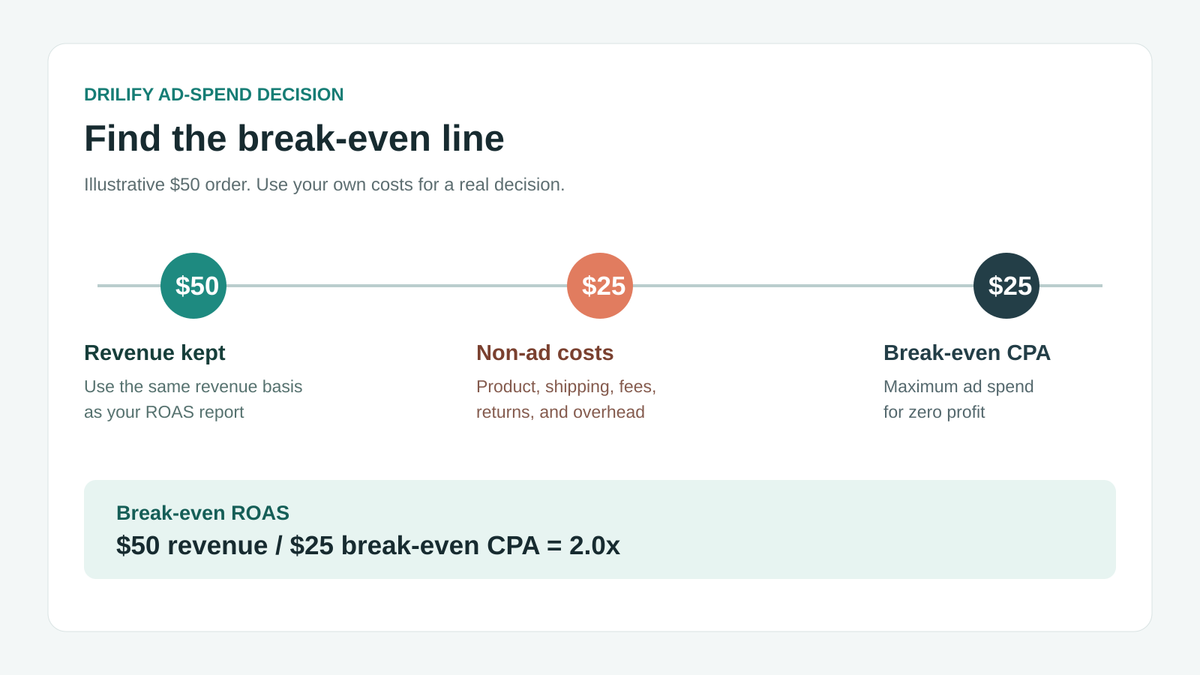
A $50 order with $25 in non-ad costs leaves $25 for ads and a 2.0x break-even ROAS.
A worked dropshipping example
Assume a seller receives $50 of revenue per order. Product cost is $14, shipping is $5, platform and payment fees are $3, expected returns and replacements average $2, and allocated overhead is $1. These are illustrative numbers, not a market benchmark.
The per-order breakdown is:
Revenue kept: $50
Product cost: $14
Shipping: $5
Platform and payment fees: $3
Expected returns and replacements: $2
Allocated overhead: $1
Contribution before ads: $25
The non-ad costs total $25. The order can therefore carry up to $25 of ad spend before profit reaches zero. Break-even CPA is $25, and break-even ROAS is $50 / $25 = 2.0x.
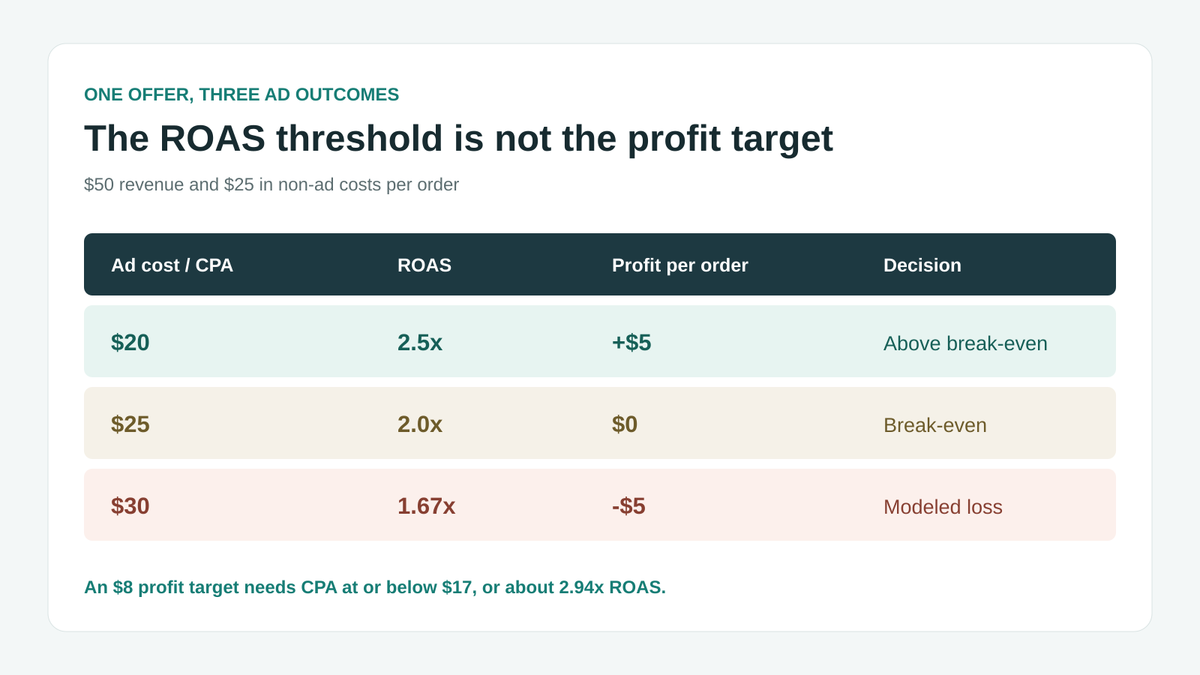
If the campaign acquires the order for $20, its ROAS is $50 / $20 = 2.5x, and modeled profit is $5. At a $25 CPA, ROAS is 2.0x and modeled profit is $0. At a $30 CPA, ROAS falls to about 1.67x and modeled profit is -$5. The threshold is a floor, not an attractive performance goal.
This is where Drilify is more useful than a bare ROAS number. Model the product's costs and ad cost together in the Profit Margin Calculator, then inspect modeled profit and margin rather than treating any positive ROAS as success. For a broader order model, Drilify's expanded profitability view includes break-even CPA, break-even ROAS, and ad headroom.
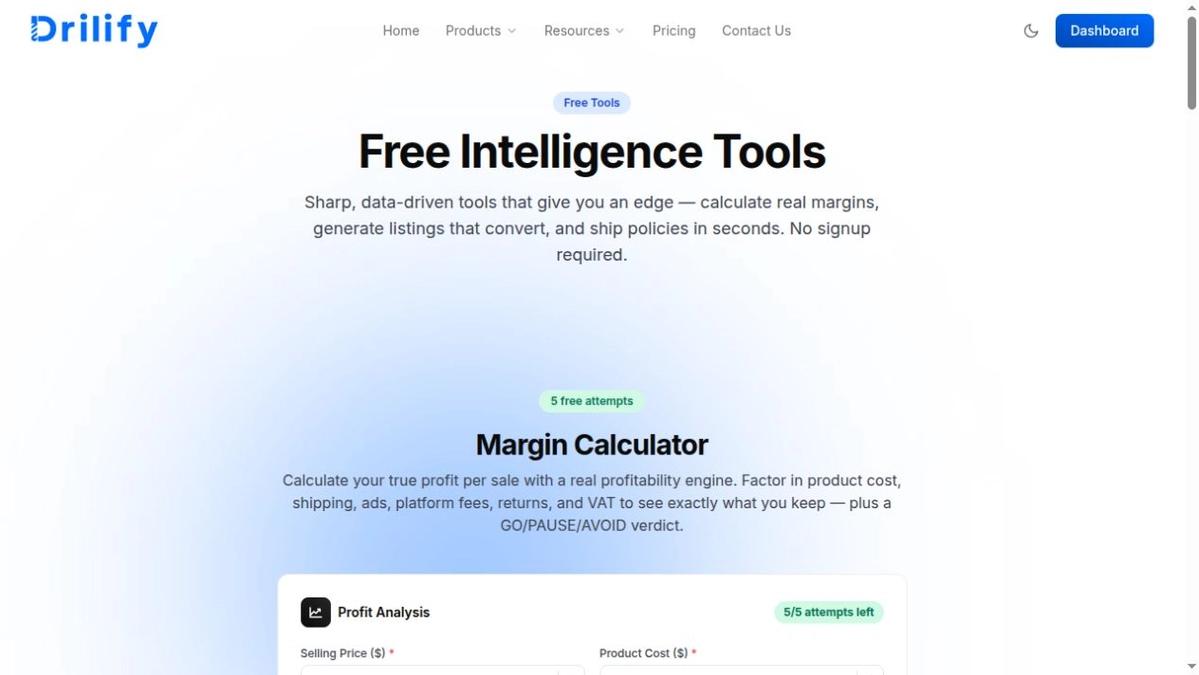
Model selling price, costs, shipping, fees, and ad spend in Drilify's free Profit Margin Calculator.
Break-even ROAS versus the ROAS you should target
At break-even, the order makes no modeled profit. A seller usually needs room for forecast error, volatility, and actual profit. Choose a target profit per order and subtract it from the break-even CPA:
Maximum CPA for target profit = contribution before ads - target profit per order
Target ROAS = revenue used in your ROAS report / maximum CPA for target profit
In the $50 example, a target of $8 profit per order leaves $25 - $8 = $17 for ads. The corresponding target ROAS is $50 / $17 = about 2.94x. A campaign at 2.5x ROAS is above break-even, but it still misses that $8 target. The same offer can be viable as a test and still not be ready to scale.
Do not set the target by copying another store's number. Its product cost, delivery promise, return rate, average order value, and reporting setup may differ. Your threshold belongs to your offer and market. Shopify's break-even analysis guide also starts from contribution margin, the amount left after variable costs to cover remaining costs and profit.
For the same $50 order, $20 CPA leaves $5 modeled profit, $25 breaks even, and $30 produces a $5 loss.
How to use the threshold before scaling ads
Start with one product and one market
A blended store-wide ROAS can hide a losing product. Calculate the threshold for the exact product, selling price, destination, and delivery method you plan to advertise. If shipping or payment fees differ by country, make separate models. An average across unlike offers is not a reliable bid guardrail.
Enter costs you expect to pay, not the costs you wish you had
Supplier price is only the beginning. Include inbound freight if relevant, customer delivery, platform and payment fees, likely replacements, and a realistic share of recurring costs. For a new product with little return history, run more than one return-cost assumption. If non-ad costs rise from $25 to $28 in the example, break-even CPA falls to $22 and break-even ROAS rises to about 2.27x. That is a materially harder campaign.
Compare like with like in the ad account
ROAS in an ad dashboard uses attributed conversion value, not necessarily the money that has settled in your account. Check whether discounts, refunds, taxes, shipping charges, and attribution windows make reported value differ from revenue kept. Google Ads explains conversion values and how they feed value-based bidding. Apply the same idea when you review any ad platform: align its reported revenue with your order model before comparing ratios.
Look at CPA and profit together
For a mostly single-product offer, CPA is often the clearest operational guardrail. In the example, $25 is break-even CPA and $17 is the CPA that would leave $8 profit. If CPA rises from $17 to $22, do not call the campaign a winner solely because ROAS still exceeds 2.0x. It is now below the target profit. When order values vary, also inspect the mix of products and each order's contribution.
Stress-test before increasing spend
Model a discount, a shipping increase, and a higher return cost. A $5 price reduction, with non-ad costs unchanged at $25, cuts break-even CPA from $25 to $20 and raises break-even ROAS from 2.0x to 2.25x. The same campaign can cross from profitable to unprofitable without any change in ad performance. Re-run the model whenever the offer changes.
The free Drilify calculator makes it easy to test different price, shipping, fee, and ad-cost inputs. Its verdict and modeled net profit can help you decide whether to continue investigating an offer. The calculation is a planning aid; the campaign and actual order records still determine the outcome.
When break-even ROAS is not enough
ROAS is useful, but it is a ratio. It can hide small order volumes, high refund exposure, cash-flow pressure, or profit concentrated in a few large orders. Look at total spend, attributed revenue, orders, CPA, contribution, and realized refunds over the same period. A 3x ROAS on two orders does not provide the same evidence as sustained performance across a much larger, stable sample.
Also separate first-order economics from customer lifetime value. Repeat purchases may justify a different acquisition strategy, but do not use hoped-for repeat revenue to excuse a first-order loss unless you have credible retention data and enough cash to fund the gap. For a new dropshipping offer, a first-order break-even model is the more defensible starting line.
Finally, distinguish reporting from causation. An attributed sale may have happened without the ad. Break-even ROAS tells you whether the attributed order economics can carry the spend; it does not prove the ad created every sale. Google's Conversion Lift explanation separates attributed ROAS from incremental ROAS. You do not need a lift study to calculate a first threshold, but you should avoid treating platform attribution as the full profit picture.
A simple decision rule
Below break-even ROAS: Pause scaling and investigate the offer, costs, conversion value, and attribution. Every comparable order is modeled to lose money at that CPA.
Above break-even but below target ROAS: Keep the test bounded. Work on price, conversion rate, creative, delivery cost, or supplier terms before adding significant spend.
At or above target ROAS: Check volume, refund timing, and consistency before scaling. Recalculate if costs or average order value change.
Drilify supports that sequence: use its Profit Margin Calculator to put product and ad assumptions into one model, then use its product and store research tools to check whether the offer merits a controlled test. The point is not to chase the highest ROAS screenshot. It is to know what a sale can afford and act before ad spend outruns that amount.
Frequently asked questions
What is a good break-even ROAS for dropshipping?
There is no universal number. Break-even ROAS depends on your revenue basis and contribution before ads. In the example above it is 2.0x; a higher cost structure would raise the threshold. Calculate it for your product and market rather than borrowing a benchmark.
Is 2x ROAS profitable?
It can be profitable, break-even, or unprofitable. If your break-even threshold is 2.0x, 2x leaves roughly no modeled profit. If your threshold is 2.5x, 2x loses money. If your threshold is 1.5x, 2x may leave a margin before any omitted costs.
What is the difference between break-even ROAS and target ROAS?
Break-even ROAS covers modeled costs with zero profit. Target ROAS is higher when you require profit per order or a safety buffer. In the $50 example, the break-even threshold is 2.0x, while an $8 profit target requires about 2.94x.
Can I calculate break-even ROAS before running ads?
Yes. Use a forecast selling price and non-ad costs to estimate the maximum affordable CPA, then divide revenue by that amount. Recalculate with actual ad costs, refunds, and fees once orders arrive.
Does the Drilify free calculator show break-even ROAS?
The free result shows modeled profit, margins, deductions, and a decision verdict from the inputs you enter. Break-even CPA, break-even ROAS, and ad headroom are shown as part of the expanded profitability view. You can still use the formula in this guide to work out a threshold from your order numbers.
What if my contribution before ads is zero or negative?
There is no positive ad budget that makes that order break even. Fix the price or non-ad costs first, or reject the offer. Adding paid traffic to a structurally unprofitable order increases the loss.
Know your limit before your campaign tests it
Break-even ROAS is most valuable before you spend more. Calculate the contribution available for ads, set a profit-aware target above the break-even floor, and compare real CPA and revenue on the same basis. Try Drilify's Profit Margin Calculator with your own price, supplier cost, shipping, fees, and ad estimate to turn a ROAS number into a product decision.