11 Best Dropshipping Product Research Tools for 2026
Compare 11 dropshipping product research tools by workflow, current pricing, features, and limitations, including Drilify and useful free resources.
Compare 11 dropshipping product research tools by workflow, current pricing, features, and limitations, including Drilify and useful free resources.
The best dropshipping product research tool depends on the evidence you need: product and store data, competitor ads, or search demand. Drilify and Dropship.io combine several research tasks; PiPiADS emphasizes ad intelligence; Google Trends helps check seasonality. Use the comparison below to choose a workflow, then validate suppliers, costs, and customer demand before testing.
Which dropshipping product research tools should you compare?
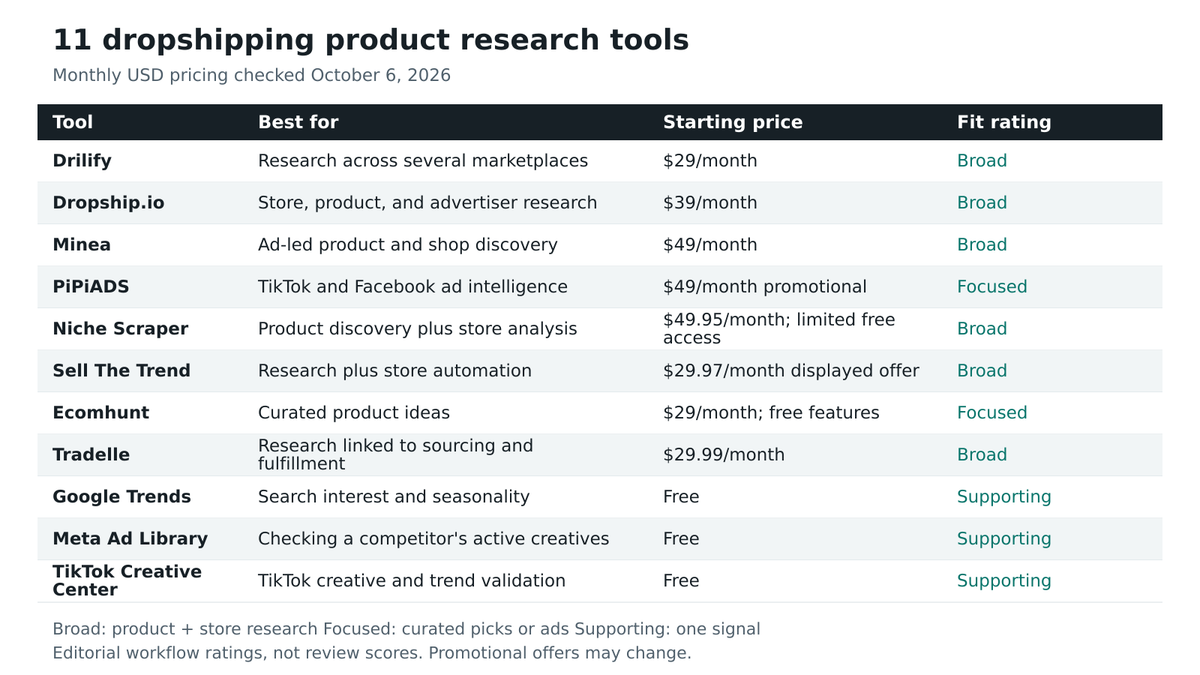
Prices below are USD monthly subscriptions checked on October 6, 2026, unless marked free or promotional. Annual billing can reduce the monthly equivalent but requires a longer commitment. Verify the checkout price, taxes, renewal terms, and access limits before subscribing.
Monthly prices checked October 6, 2026. PiPiADS and Sell The Trend display promotional offers. Broad, Focused, and Supporting are workflow ratings, not customer scores.
Comparison in text
Drilify: Research across several marketplaces; $29/month; editorial fit rating: Broad.
Dropship.io: Store, product, and advertiser research; $39/month; editorial fit rating: Broad.
Minea: Ad-led product and shop discovery; $49/month; editorial fit rating: Broad.
PiPiADS: TikTok and Facebook ad intelligence; $49/month promotional; editorial fit rating: Focused.
Niche Scraper: Product discovery plus store analysis; $49.95/month; limited free access; editorial fit rating: Broad.
LATEST POSTS
More from Drilify
Interviews, tips, guides, industry best practices, and news.
Sell The Trend: Research plus store automation; $29.97/month displayed offer; editorial fit rating: Broad.
Tradelle: Research linked to sourcing and fulfillment; $29.99/month; editorial fit rating: Broad.
Google Trends: Search interest and seasonality; Free; editorial fit rating: Supporting.
Meta Ad Library: Checking a competitor's active creatives; Free; editorial fit rating: Supporting.
TikTok Creative Center: TikTok creative and trend validation; Free; editorial fit rating: Supporting.
How the ratings work: Broad means documented product discovery plus store or competitor research. Focused means an emphasis on curated picks or dedicated ad intelligence. Supporting means a native resource for checking a specific signal. These are editorial workflow ratings, not customer review scores, performance grades, or a ranking of data accuracy.
This comparison is published by Drilify. It is based on vendor documentation and public pages, not hands-on testing of paid accounts. Recommendations reflect the documented workflow and limitations. No subscription guarantees a profitable product, and the order below is not a league table.
1. Drilify: Best for research across several marketplaces
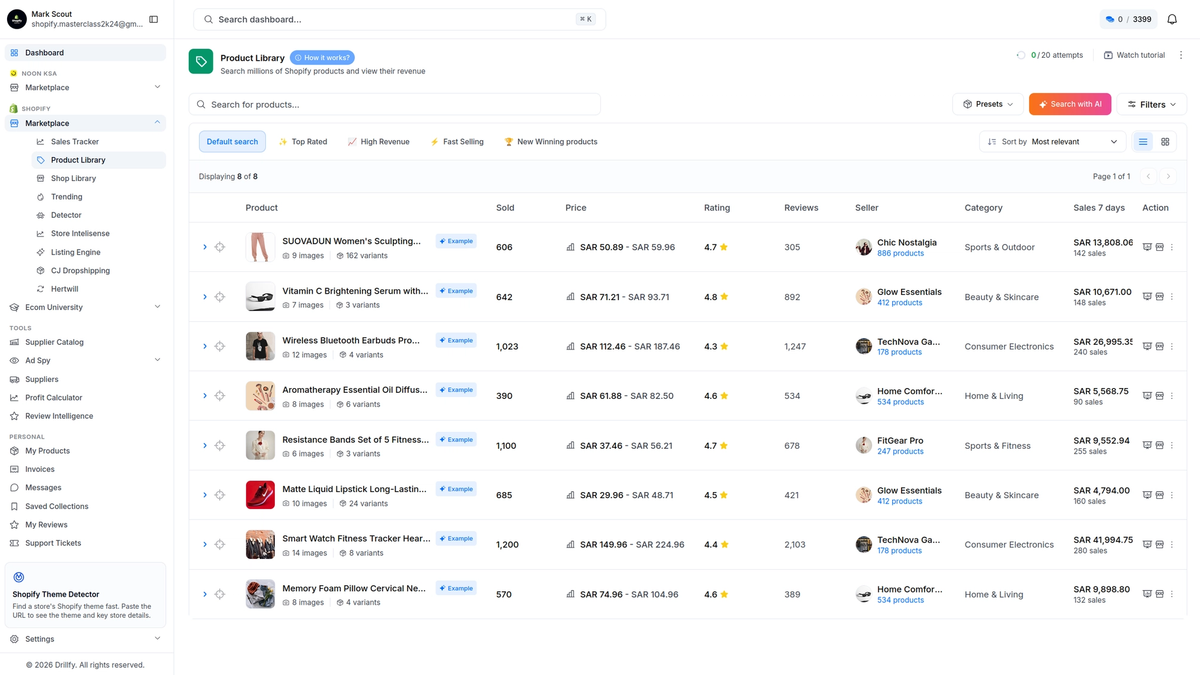
Drilify's Product Library covers Shopify, WooCommerce, Noon, and Daraz. Drilify suits sellers who want to browse products, investigate ads, follow selected products or shops, and prepare listings within one platform. Marketplace coverage does not mean every feature works identically on every marketplace.
Official Drilify Product Library product-page example. Illustrative interface; not live seller data.
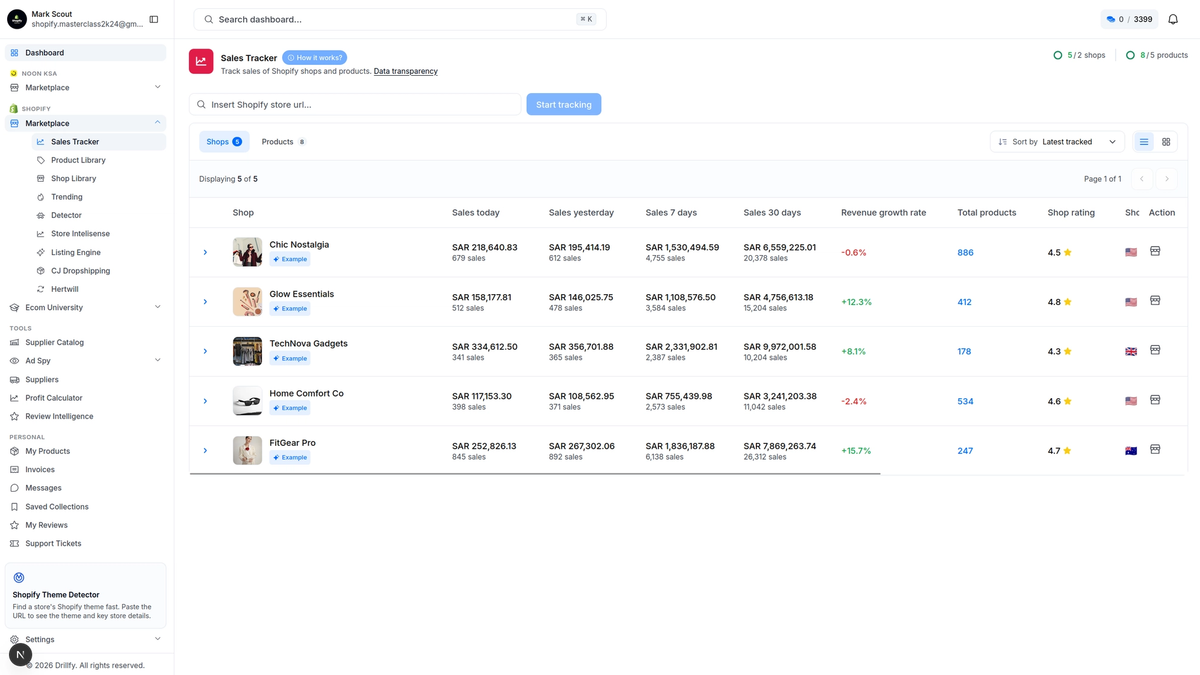
Key features: Product filters and saved discoveries; Ad Spy for Meta and TikTok ads; Sales Tracking for products and stores; and a Listing Engine that creates editable product listings from supported sources.
Pricing:Launch is $29/month, Scale $49, and Dominate $89. Feature access and allowances depend on the plan. The pricing page advertises a three-day limited free trial with no credit card required. Use it to check the available workflow; it does not provide unrestricted access to every paid operation.
Pros: Several marketplace research areas; research and listing preparation in one account; a $29 monthly entry plan.
Cons: Credit and feature limits need budgeting. Data age and availability vary, and sales or revenue estimates should not be treated as a competitor's verified orders. A public feature page alone cannot establish forecasting accuracy.
Best for: Sellers who research across marketplaces and want to move from a shortlist to listing preparation.
2. Dropship.io: Best for product, store, and advertiser research
Dropship.io combines product discovery, sales tracking, competitor research, and advertising tools. Its current offering includes Shopify and TikTok Shop research, so describing Dropship.io as Shopify-only would miss part of the product.
Key features: Product and Shop Libraries, Sales Tracker, Facebook Ad Library, advertiser tracking, creator research, a product portfolio, and AI search. Basic includes separate allowances for several tools rather than unlimited use across the suite.
Pricing: Basic is $39/month, Standard $59, and Premium $99. The annual Basic plan is $312 per year, equivalent to $26/month. A free trial is advertised; check its current conditions when signing up.
Pros: Product, shop, and advertiser information can be considered together. Tiered tracking allowances make it possible to choose a plan around research volume.
Cons: Credits and tracking caps differ by tool. Revenue and ad information still need context; spending on an ad does not prove a seller made a profit.
Best for: Sellers who want to compare stores and products with advertiser activity. For a related Drilify workflow, review the Shop Library.
3. Minea: Best for ad-led product discovery
Minea is a candidate when competitor advertising is your starting point. Its current pages describe product and shop listings alongside ad research, brand tracking, niche lists, and AI-assisted analysis.
Key features: Meta ad listings, product discovery, shop research, brand tracking, ad analysis, transcription, and Magic Search. The homepage also lists TikTok ads, while parts of the pricing page contain older channel language. Confirm the precise channel access in your selected plan.
Pros: A useful documented path from an ad to its product and shop. Search and analysis tools help organize a creative shortlist.
Cons: Some public channel descriptions are inconsistent. Ad popularity and longevity are research signals, not verified conversion or margin figures.
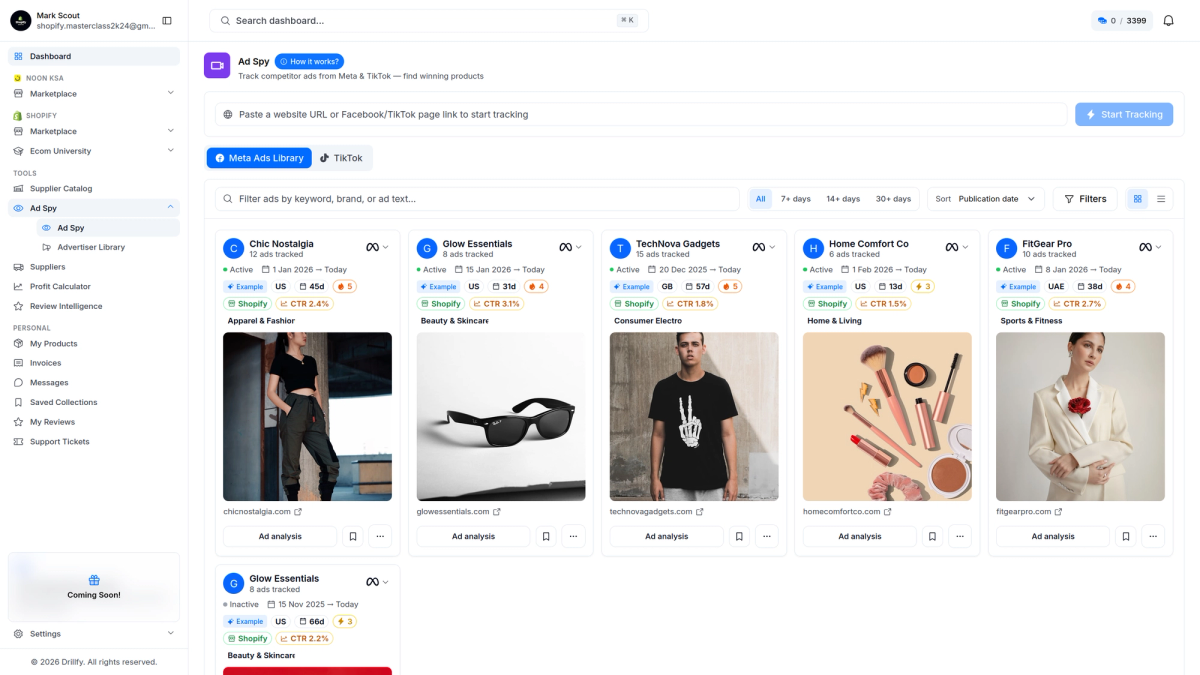
Best for: Sellers who first identify products through advertising. Compare that workflow with Drilify Ad Spy, checking coverage rather than assuming either library is complete.
Official Drilify Ad Spy product-page example. Illustrative interface; not live ad results.
4. PiPiADS: Best for dedicated ad intelligence
PiPiADS focuses on advertising research, including TikTok and Facebook, with product, advertiser, and TikTok Shop research surfaces. It is useful when creative examples and advertiser activity matter more than listing or fulfillment tools.
Key features: Ad search and filtering, product and advertiser rankings, TikTok Shop research, saved collections, and ad tracking. New subscribers use its 2.0 credit-based membership; older Starter, VIP, and PRO memberships are legacy plans.
Pricing: The live monthly page displayed Basic at a promotional $49, reduced from $69, with 30,000 credits and one user. Advanced displayed $99, reduced from $159, with 100,000 credits. These are sale prices, not a promise of future pricing.
Pros: Dedicated advertising research with several search surfaces. The pricing page explains how listing results and detail views use credits.
Cons: Detail views consume more credits than listing results. Free trial access is limited, and the subscription is not a complete sourcing or fulfillment workflow.
Best for: Sellers who conduct frequent ad research. Drilify's Advertiser Library is a related feature to inspect when comparing options.
5. Niche Scraper: Best for product discovery and store analysis
Niche Scraper combines automated product discovery with hand-picked ideas, store analysis, ad examples, and a video maker. Its product research pages emphasize AliExpress and Shopify opportunities.
Key features: Product Scraper, daily curated products with supplier and advertising information, store analysis with sales estimates, Facebook and TikTok ad browsing, and product-video creation.
Pricing: The official FAQ lists membership at $49.95/month. A free account provides a few searches in each category; PRO expands access. The FAQ says subscriptions are non-refundable after access to the digital service, so read the terms before paying.
Pros: Curated ideas and store research offer two routes into a shortlist. Limited free searches help you inspect the interface before subscribing.
Cons: Store sales figures are estimates. Suggested targeting and product picks still require independent testing; the vendor's strong sales language should not be read as a guarantee.
Best for: Sellers who want structured product suggestions alongside store analysis. Explore Drilify's Product Library for a related discovery workflow.
6. Sell The Trend: Best for research plus automation
Sell The Trend connects product discovery with store operations. Its NEXUS research tool sits alongside product importing, supplier discovery, order fulfillment, store intelligence, and advertising research, with access varying by tier.
Key features: NEXUS AI Product Discovery, store connections, product monitoring, supplier tools, product imports, and automated order fulfillment. Higher plans add more curated selections and broader advertising tools.
Pricing: The page displayed monthly offers of $29.97 for Lite, $49.97 for Essential, and $99.97 for Pro, alongside higher crossed-out prices. Lite's yearly offer was $19.97/month billed yearly. Treat these as current displayed offers and check renewal terms.
Pros: Research and operational tools are available together. Lite provides a lower-cost way to inspect the research workflow.
Cons: Lite has usage and store limits. More extensive ad research and importing can require a higher plan; the entry price does not represent the full suite's unrestricted cost.
Best for: Sellers who also need importing and fulfillment automation. For listing preparation within Drilify, inspect the Listing Engine.
7. Ecomhunt: Best for curated product ideas
Ecomhunt is an option for sellers who prefer a structured idea feed to an open-ended ad search. Ecomhunt combines curated product entries with trends, product analytics, AliExpress tracking, and research tools.
Key features: Ecomhunt Classic, Live trends, Adam product research, Lucky discovery, alerts, and product tracking. The pricing comparison shows different history windows and tracking allowances across tiers.
Pricing: Monthly Basic is $29, Pro $49, and Suite displayed $69. Basic includes two years of the curated database, 50 live trending products, and 10 tracker sessions. The page references free features, but their access is narrower than paid plans.
Pros: Curated entries give beginners a manageable starting point. Tracking tools let users revisit an idea rather than rely only on its discovery date.
Cons: A shared product feed is not an exclusive opportunity. History and tracking limits vary, and listed products still need current supplier and competition checks.
Best for: Beginners who want a shortlist to investigate. Use Drilify Sales Tracking as a related workflow when comparing ongoing monitoring.
8. Tradelle: Best for connecting research with sourcing
Tradelle links product research to sourcing, imports, and fulfillment. Its offering includes product picks, trend information, a Store Explorer, competitor research, and store automation.
Key features: Product discovery, seasonality and geographic analysis, store research, sales tracking, Shopify imports, and fulfillment services. Research depth, connected stores, and operational limits depend on the tier.
Pricing: Monthly Lite is $29.99, Starter $49.99, and Pro $79.99. Annual Lite is $239.88, equivalent to $19.99/month. All subscription plans advertise a seven-day trial for $1, followed by the selected plan. That is a paid introductory trial.
Pros: Product investigation and supplier operations can stay within one service. The pricing page separates basic research from more extensive competitor tools.
Cons: Lite has limited advanced research. Some product-import allowances differ between the headline cards and detailed comparison, so confirm the allowance before purchasing. Fulfillment quality must be checked separately from research features.
Best for: Shopify sellers considering a combined research and fulfillment service. Drilify's Shop Library provides a related store-research area to compare.
9. Google Trends: Best for seasonality checks
Google Trends helps check whether search interest is rising, falling, or seasonal. For US dropshipping product research, compare relevant terms or topics using the same country and time window.
Key features: Interest over time, regional comparisons, related searches, and comparisons between terms or topics. Looking at several years can reveal whether an apparent breakout repeats each season.
Pricing: Free.
Pros: Direct access to Google's search-interest resource. It is useful for challenging an exciting short-term spike before you commit to a test.
Cons:Google explains that values are normalized from 0 to 100. They are not monthly sales or absolute search volumes. Low-volume terms can show zero, and a spike alone does not prove purchase intent.
Best for: A second check on demand direction and timing. Pair it with product-level investigation, such as Drilify's Product Library, rather than choosing a product from a search chart alone.
10. Meta Ad Library: Best for checking active creatives
Meta Ad Library lets you search ads by advertiser or keyword. It is useful for checking how a competitor presents a product, where the ad leads, and which offers or formats appear in its current advertising.
Key features: Advertiser and keyword searches, country selection, ad creatives, ad details, and landing-page links where available. Meta also retains certain categories of ads beyond their active period, with different rules by category and region.
Pricing: Free public browsing.
Pros: A direct source for checking whether a particular creative appears in Meta's library. It is a practical starting point when you already know the advertiser.
Cons: An active ad does not establish profitable sales. Information differs by ad category and jurisdiction; do not assume ordinary US commercial ads disclose return on ad spend or exact revenue.
Best for: Manual competitor checks and creative research. Drilify Ad Spy offers a related research workspace to evaluate.
11. TikTok Creative Center: Best for TikTok creative validation
TikTok Creative Center is a free public resource for discovering advertising examples and trends. Use it to examine product demonstrations, hooks, and creative patterns relevant to the country and audience you plan to reach.
Key features: Top Ads, trending hashtags, creative inspiration, and performance analysis for selected ads. Top Ads supports filters including region, industry, objective, and time frame.
Pricing: Free. TikTok says visitors who are not logged in see only five Top Ads; login expands access to its features and insights.
Pros: A native source of creative examples with relative performance information. Region and objective filters help narrow the examples you study.
Cons: Top Ads is a selected collection, not every competitor campaign. Creative performance does not establish supplier quality, delivered product costs, or store profit.
Best for: Sellers preparing TikTok product tests. Compare the research workflow with Drilify Ad Spy, using each resource's actual coverage.
How should you use dropshipping product research tools?
Start with the decision you need to make. A product database helps build a shortlist; an ad library helps investigate positioning; a search-interest tool helps check timing. Buying several subscriptions does not automatically give you better evidence.
Define the market. Choose a country, customer problem, selling price range, and delivery promise before searching.
Collect independent signals. Combine product or store research with ads and search interest. Two tools repeating the same information are not two independent confirmations.
Official Drilify Sales Tracking product-page example. Illustrative interface; not verified sales data.
Inspect the product and supplier. Check current availability, reviews, delivery estimates, variants, and the quality of a sample. A tool's product ranking cannot answer all these questions.
Calculate a realistic test budget. Allow for product and shipping costs, transaction fees, returns, discounts, and advertising. Estimated competitor revenue is not your expected margin.
Run a bounded test. Set a spending limit and decision criteria before launch. Use actual store results to decide whether to continue, change the offer, or stop.
Choose one main paid workflow only when it saves research time or adds evidence you cannot readily obtain with free resources.
Frequently asked questions
What is the best dropshipping product research tool for beginners?
Choose the workflow you can use consistently. Ecomhunt suits a curated shortlist, Niche Scraper combines suggestions with store analysis, and Drilify brings several research tasks together. Begin with free access or a limited trial, inspect the relevant limits, and choose a monthly plan only after checking the workflow.
Can you do dropshipping product research for free?
Yes. Google Trends, Meta Ad Library, and TikTok Creative Center help investigate demand direction and advertising. You will do more manual comparison and still need to check suppliers, delivery, and costs. Limited free access to a paid tool is different from unrestricted access to its entire database.
Are product research sales estimates accurate?
Treat estimates as directional information unless a tool identifies a figure as verified transaction data. Check the date, marketplace, coverage, and any estimate label. A competitor's revenue estimate does not tell you its costs, returns, advertising efficiency, or net profit.
Which tool should I use for TikTok products?
Start with TikTok Creative Center for creative examples. PiPiADS offers dedicated advertising research, while Dropship.io includes TikTok Shop research. These answer different questions: an engaging ad, a shop's sales activity, and the economics of your own offer should be assessed separately.
Does a long-running ad prove a product is profitable?
No. Longevity shows continued advertising activity, but the advertiser's budget, goals, and costs remain relevant. Use it to prioritize further investigation. Confirm supplier reliability and your own margins, then test the offer within a budget you can afford to lose.
Is Drilify free, and which plan should I start with?
Drilify advertises a three-day limited free trial with no credit card required. Paid plans start at $29/month for Launch. Review Drilify's current plan comparison for feature access and allowances; select the plan that covers your intended research rather than assuming every feature is available on Launch.
Choose the tool that supports your next decision
Shortlist a tool around your market, evidence needs, and budget. For research across supported marketplaces, ad investigation, sales estimates, and listing preparation, inspect Drilify's available workflow and plan limits before subscribing.