Best Dropshipping Niches in 2026: How to Choose One for Your Market
Find a dropshipping niche for your market with a practical demand, competition, supplier, and margin scorecard, plus a small-offer validation plan.
Find a dropshipping niche for your market with a practical demand, competition, supplier, and margin scorecard, plus a small-offer validation plan.
The best dropshipping niche is not the category with the longest viral-products list. It is a specific customer and problem in a market where demand, a credible offer, workable fulfillment, and enough margin come together. A niche that works in one country may fail in another because shipping, purchasing power, regulation, or advertising costs differ.
If you are choosing a niche in 2026, start with three to five hypotheses, test each against the same evidence, and run a small real-world offer test before committing to a full catalog. This guide gives you that process. The niche examples below are candidates to investigate, not claims that any category is currently profitable.
What counts as a dropshipping niche?
"Home goods" is a category. "Compact storage for renters in small UK flats" is a niche: it names a buyer, a use case, and a market. That specificity helps you choose relevant products, write an honest offer, identify competitors, and judge whether suppliers can deliver the experience customers expect.
Write your niche hypothesis in one sentence: We serve [customer] in [country or region] who need [outcome] and currently struggle with [constraint]. If you cannot complete it, the idea is probably too broad to evaluate. Shopify's dropshipping guide likewise recommends choosing a target audience, then checking demand through keyword and product research rather than relying on enthusiasm alone. Source: Shopify.
Product selection comes after this decision. One product may perform well while the surrounding niche is too narrow for repeat purchases, cross-sells, or a coherent store. Conversely, a promising audience does not rescue poor unit economics or unreliable shipping.
Six filters for choosing a niche
1. Name the market and buyer before reading trend charts
LATEST POSTS
More from Drilify
Interviews, tips, guides, industry best practices, and news.
14 min read
11 Best Dropshipping Product Research Tools for 2026
Compare 11 dropshipping product research tools by workflow, current pricing, features, and limitations, including Drilify and useful free resources.
Choose a target country, a primary buyer, and the problem they are trying to solve. A niche aimed at US apartment renters differs from one aimed at families buying for large homes. Search language, preferred price points, delivery expectations, and competing stores may all change.
Make a short evidence sheet for each idea: buyer, job to be done, target country, likely products, expected price band, and reasons the existing choices disappoint buyers. This makes competing ideas comparable. Avoid labels such as "viral accessories" that tell you little about who buys or why.
2. Look for repeated demand, not one exciting spike
Search for the customer problem, product type, and purchase-intent phrases. Review several years of interest alongside the last 12 months, then compare the same terms in your target geography. Pair search data with marketplace listings, product reviews, and the questions buyers ask. Shopify recommends combining keyword research and product research because consumer habits change; neither data source alone gives the whole picture. Source: Shopify.
Google Trends is useful for seasonality and relative direction, but its values are normalized. A score of 100 is not a count of searches, and a smaller region may look strong on relative interest without having a large absolute audience. Compare terms using the same location and time window, then check a separate volume source where possible. Source: Google Trends Help.
Demand can be steady, seasonal, or emerging. Any of those can work if you plan stock, creative, and cash flow around the pattern. A single week of social attention is not enough evidence for a year-round store.
3. Study competition for an opening you can explain
Competition is evidence that buyers may exist. The question is whether you can offer something meaningfully better to a defined audience. Inspect the search results and at least five relevant stores or advertisers in your chosen country. Record the products they emphasize, price and shipping promises, customer objections, and the messages repeated in ads. Do not treat an active ad as proof of profitable sales.
Look for an opening that you can actually fulfill: clearer sizing, a better bundle, faster local delivery, a more specific audience, stronger instructions, or a product variation that addresses a common complaint. "Fewer competitors" is not an advantage if few customers want the product. Shopify's product-research guide recommends examining market demand, the competitive landscape, and the target customer together. Source: Shopify.
Drilify's Ad Spy and Advertiser Library can help compare Meta and TikTok creative and advertiser activity; Store Intelisense can add estimated store context where your plan allows it. Use those signals as leads for deeper checks, not as verified competitor revenue. Explore Ad Spy.
4. Check suppliers and fulfillment before deciding a niche is viable
List three plausible products and at least two credible sourcing paths. Ask whether they can be shipped to your target market at a cost and speed your offer can honestly promise. Check product specifications, packaging, variants, tracking, returns, damaged-item handling, and whether a sample matches the listing. A supplier's catalog availability is not the same as reliable stock or delivery performance.
This step can overturn a seemingly excellent demand signal. Fragile, oversized, highly regulated, or size-sensitive products can create costs and service work that a generic "best niches" list hides. Shopify's help center advises researching trends when choosing a dropshipping product line; in practice, that should be paired with supplier and delivery checks before listing. Source: Shopify Help Center.
Do not assume a category is lawful or suitable to advertise everywhere. Check the applicable product rules, marketplace policies, and claims requirements for your actual market and product before launching.
5. Model the full order, not the supplier-price gap
For each candidate, estimate the selling price and subtract product cost, shipping, payment and platform fees, likely returns or replacements, taxes as applicable, and customer-acquisition cost. Model a cautious case as well as your optimistic case. Margin is what remains relative to the selling price; markup compares the gain with cost. Confusing those figures can make a thin offer appear healthy.
If you have a $40 selling price, a $12 product cost, and $6 shipping, the remaining $22 is not profit. Ads, fees, returns, and service still have to be paid. Calculate your maximum affordable acquisition cost before you assume you can scale paid traffic. Drilify's Profitability Calculator can model these assumptions, but a calculated result is only as reliable as the inputs.
6. Test the offer and listen to buyer objections
Before building a large catalog, validate a small offer. Get a sample, write a clear product page, test one or two differentiated messages, and record the objections people raise. A pre-launch survey, small campaign, or conversations with potential buyers may reveal a flaw that desk research missed. Keep the test proportionate to your budget and do not read a handful of clicks as proof of long-term demand.
If complaints concern a feature you cannot fix through sourcing or clearer expectations, reject the niche or narrow it further. Drilify's Review Intelligence, where available on your plan, can organize review themes and complaints for investigation; verify the underlying reviews before repeating any claim publicly.
A niche scorecard you can actually use
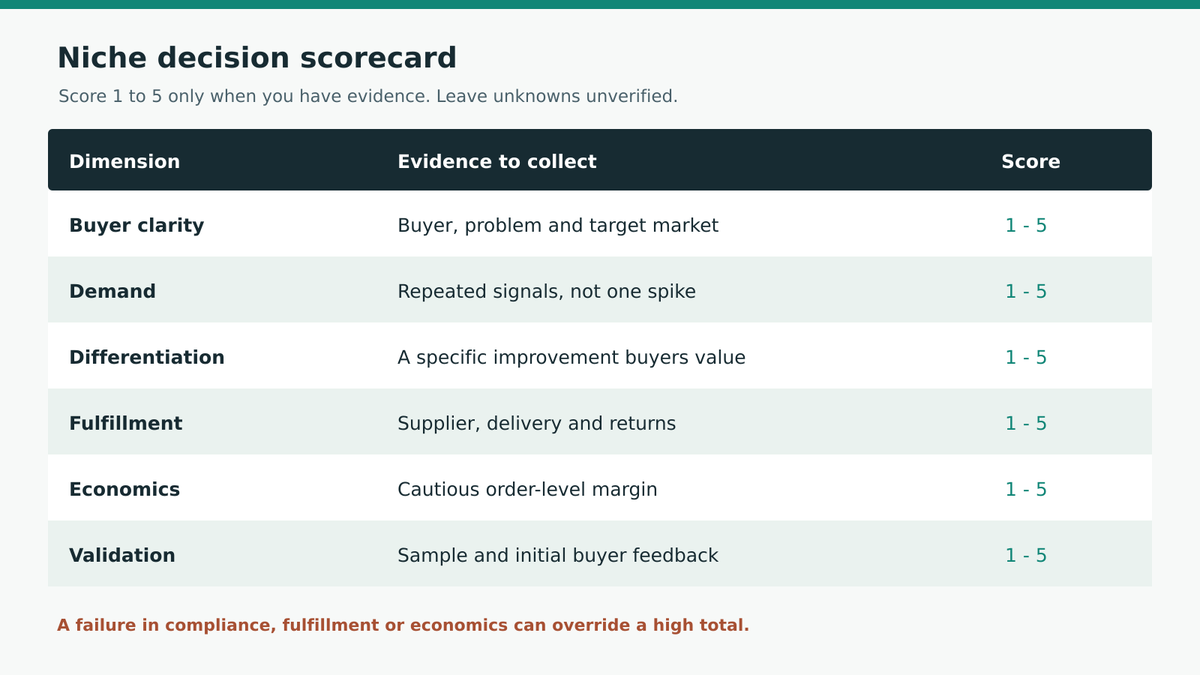
Score each candidate from 1 (weak or unverified) to 5 (strong and supported) on the same six dimensions. Write the evidence beside the number. An unknown should be marked unverified, not automatically given a middle score.
Use this scorecard as a comparison aid, not a promise of sales. A critical failure can override a high total.
Scorecard in text
Buyer clarity: Strong evidence: Specific buyer, problem, and market. Warning sign: Broad category with no clear use case.
Demand: Strong evidence: Multiple, consistent signals in the target market. Warning sign: One short-lived trend or no purchase intent.
Differentiation: Strong evidence: Specific improvement buyers value. Warning sign: Identical offer and claims to incumbents.
Fulfillment: Strong evidence: Verified supplier options and realistic delivery. Warning sign: Unclear stock, shipping, or returns.
Economics: Strong evidence: Margin remains plausible in a cautious case. Warning sign: Profit depends on unrealistically cheap ads.
Validation: Strong evidence: Sample and initial buyer feedback support the offer. Warning sign: No product or customer reality check.
Treat the score as a decision aid, not a mathematical prediction. A serious failure in fulfillment, compliance, or economics is a stop sign even if the other numbers are high. Revisit the score when new evidence arrives.
For example, "small-space organization for renters" might have a clearly defined buyer and several product ideas, but bulky shipping or weak differentiation could still make it unsuitable. "Specialty accessories for a hobby" might have strong buyer identity yet limited supplier reliability in your country. The framework forces the uncomfortable questions before you build the store.
Niche directions worth investigating, not blindly copying
The examples below illustrate different ways to define a market. They are research prompts, not ranked winners or verified profit opportunities:
Small-space living: choose a specific room, housing type, and buyer; confirm dimensions, durability, and shipping cost.
Hobby maintenance and organization: start with a recurring task and check whether accessories solve a real pain rather than merely looking novel.
Travel convenience for a defined traveler: distinguish commuters, families, and long-stay travelers; examine seasonality and carrier restrictions.
Home-office comfort: separate genuine ergonomic needs from unsupported health claims; verify fit, materials, and return risk.
Pet travel or enrichment: identify the pet, setting, and safety expectations; do not make health or safety claims without evidence.
Kitchen routines for a specific diet or space: validate food-contact requirements, cleaning, and actual repeat use.
The right answer may be a narrow slice of one of these or a different audience entirely. A list cannot tell you whether customers in your country will accept the shipping time, price, or product quality.
A one-week research sequence
Day 1: Frame three hypotheses. For each, write the buyer-market-problem sentence and three potential products. Drop any idea you cannot explain without buzzwords.
Day 2: Check demand. Compare search interest over time and in your target geography. Look for buyer questions, reviews, and multiple products that serve the same use case. Note contradictory signals rather than hiding them.
Day 3: Map competitors. Inspect relevant stores and ads. Record their promises, prices, delivery terms, and customer objections. Drilify's Product Library can help shortlist products from tracked shops; its Ad Spy provides creative context. Neither screen alone proves a sale or net profit. Product Library guide.
Product Library research controls. The example rows and figures shown here are illustrative, not evidence of current sales in a niche.
Day 4: Contact or inspect suppliers. Compare landed cost, delivery, variants, returns, and sample availability. Reject a candidate if a credible fulfillment path cannot be established.
Day 5: Model economics. Calculate a base and cautious scenario. Set a break-even acquisition limit and identify which assumptions need real quotes or tests.
Days 6-7: Test the smallest honest offer. Review a sample if possible, show the offer to target buyers, then decide: pursue, revise, or pause. Write down what evidence would change your mind. That gives you a defensible decision, not a permanent bet on a trend.
The sequence is a planning template, not a claim that every niche can be fully validated in seven days. Supplier samples, legal checks, and buyer research may take longer.
Common niche-selection mistakes
Calling a product a niche. A product is one possible solution; a niche includes the buyer, situation, and market. Without that context, your store may become a collection of unrelated items.
Confusing visible ads with profit. Ad activity tells you what someone is testing or promoting, not their return on ad spend, refunds, or net margin.
Treating Google Trends as absolute market size. Its index is relative. Cross-check it with volume and customer evidence.
Ignoring fulfillment until after the site is built. Late discovery of shipping, quality, or returns problems can undo the whole offer.
Choosing a niche only because it is "low competition." A thin market may have low competition for a reason. Seek an underserved need supported by demand, not merely an empty search page.
Frequently asked questions
What are the best dropshipping niches for beginners?
There is no universal top niche for beginners. A manageable starting point has a definable buyer, products you can assess, several credible suppliers, reasonable service complexity, and economics that survive a cautious cost model. Test one market and use case before expanding.
Should I pick a niche I am passionate about?
Knowledge can help you recognize buyer problems and communicate well. It is not proof that people will buy. Combine familiarity with demand, competition, fulfillment, and margin checks.
How narrow should a dropshipping niche be?
Narrow enough to make the customer and problem obvious, but broad enough to support several complementary products and a sustainable acquisition path. Start with a specific audience and use case, then widen only if evidence supports it.
Is a trending niche better than an evergreen one?
Neither is automatically better. Trends can create rapid attention but may fade or attract expensive competition. Evergreen needs may be steadier but crowded. Compare the demand pattern with your sourcing, marketing, and cash-flow capacity.
Can I sell products from more than one niche?
You can, but a new store usually benefits from a coherent promise. If the same buyer would reasonably want the products for a related problem, they may fit together. If not, test separate offers rather than forcing unrelated categories into one brand.
How do I know when to abandon a niche idea?
Pause when you cannot find a viable supplier, cannot make the cautious economics work, face restrictions you cannot meet, or cannot explain why buyers would choose your offer. A weak initial ad test alone is not conclusive; review the product, message, and audience before deciding.
Choose with evidence, then stay willing to revise
The best dropshipping niches are found by narrowing a real customer problem, checking demand in a specific market, understanding the competitors, confirming fulfillment, and modeling the whole order. Keep your assumptions visible and update them as you learn.
To build your shortlist, start in Drilify's Product Library, compare the relevant stores and creatives, and model the economics before choosing what to test. Feature access and credits depend on your plan; the research signals support a decision but do not guarantee a winning niche.