Compare Minea and Drilify for ad discovery, advertiser research, seller decision data, plan access and price. See where their workflows overlap and differ.
Compare Minea and Drilify for ad discovery, advertiser research, seller decision data, plan access and price. See where their workflows overlap and differ.
Minea and Drilify both help sellers research competitor ads, advertisers, products, and stores. Minea offers basic creative discovery and Magic Search; Drilify's observed Meta and TikTok ad views connect to advertiser activity, product and sales signals, sourcing estimates, and profitability checks. The better choice depends on the decisions you need to make after finding an ad.
Drilify vs Minea at a glance
Feature comparison in text
Which ads and creative angles merit review?: Minea: Searchable ad research, activity and spend signals ( mostly old cache data), creative analysis; Drilify: Meta and TikTok ad cards with creative, active dates, duration, country, advertiser, and other available signals; What to check before deciding: Compare the exact ad, market, time window, and source freshness.
Is an advertiser worth following?: Minea: Brand tracker and store research; Drilify: Advertiser Library shows total, unique and active ads, countries, first/last seen dates, and a handoff to Ad Spy; What to check before deciding: Look at sustained activity and creative variety, not a single score.
Is the product gaining traction?: Minea: Product and store listings, trends, and Shopify store research; Drilify: Product Library and Sales Tracker expose price, reviews, estimated sales and revenue, growth, and price history; What to check before deciding: Separate estimates from measured sales and inspect update dates.
Can a seller source and price it?: Minea: Supplier finder and product research are advertised; Drilify: CJ sourcing displays supplier cost, estimated retail and margin, competition, and shipping context; Hertwill workflow provides the same data; What to check before deciding: Verify actual quote, destination, delivery, and realistic selling price.
Does the unit economics case work?: Minea: Use Minea's research with your own cost model; Drilify: Drilify's Profit Calculator, listed under Scale on the development pricing page, tests costs, fees, ad spend, margin, and break-even thresholds; What to check before deciding: Enter your own numbers.
LATEST POSTS
More from Drilify
Interviews, tips, guides, industry best practices, and news.
14 min read
11 Best Dropshipping Product Research Tools for 2026
Compare 11 dropshipping product research tools by workflow, current pricing, features, and limitations, including Drilify and useful free resources.
What happens after selection?: Minea: Minea advertises product import and creative tools; Drilify: Drilify's Listing Engine prepares editable listing copy and SEO fields; What to check before deciding: Check plan access and review every generated claim.
Which ad channels are documented?: Minea: Minea markets Meta, TikTok and Pinterest research, subject to plan access; Drilify: This comparison uses Drilify's observed Meta and TikTok views; What to check before deciding: Confirm the channel and plan you actually need.
Entry price checked October 9, 2026: Minea: Starter $49/month; Premium $99/month; Drilify: Launch starts at $29/month in Drilify's current plan; What to check before deciding: Recheck checkout terms and available credits.
Original editorial comparison summary. Feature access and prices should be checked against current plan terms.
How to read this table: The rows compare documented workflows and visible fields, not equal coverage or proven accuracy. Sources include Minea's pricing and ad spy pages and Drilify's signed-in feature audit. Availability depends on the plan.
What both tools help you do
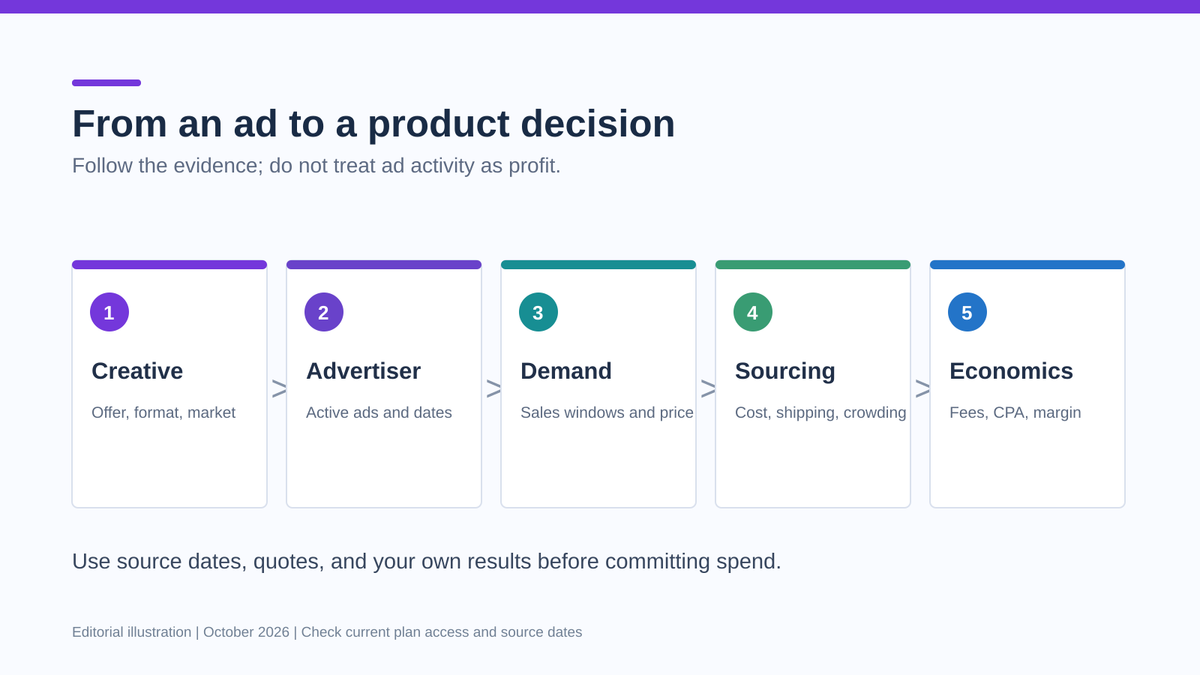
The shared starting point is straightforward: find an ad, identify the advertiser and product, study the creative and its timing, then investigate whether the idea deserves a test. Minea describes searchable ads, platform filters, engagement and spend signals, creative analysis, and competitor store research. Drilify's Ad Spy presents Meta and TikTok tabs with searchable ad cards, activity duration, creative text or media when available, market context, advertiser information, and saved research paths.
Both can answer "who advertises this product, and how?" Ad duration may merit attention but does not establish revenue or profit.
Minea's marketing includes Magic Search and image-based discovery across several documented channels. Check channel access by plan. Drilify's observed workflow covers Meta and TikTok research, including TikTok advertiser and shop-related investigation within Ad Spy and Advertiser Library. The tools need not use identical screen names or metrics to address a shared job.
Pro tip: Save a candidate ad with its first-seen date, current activity, target country, advertiser, product URL and your own creative-angle note. Revisit it later. A single impressive thumbnail is weak evidence without product and seller context.
How the ad research actually differs
Finding a creative worth studying
Minea's ad spy overview emphasizes searchable ads, filters, estimated spend signals and creative discovery. Its performing ads page connects ads to products and stores. These help build a shortlist. Vendor claims about database size or performance are not an independent quality test.
Drilify's signed-in Ad Spy shows Meta and TikTok creative cards with active state and dates, days active, score, country, industry, destination when available, advertiser identity, and advertiser ad count. Search and duration filters help narrow a broad field. The practical question is whether a brand repeats a problem statement, offer, or demonstration across creatives and markets. When a TikTok card lacks playable media, CTR, or a destination, treat that field as unavailable; do not convert missing data into a claim that the ad or brand has no activity.
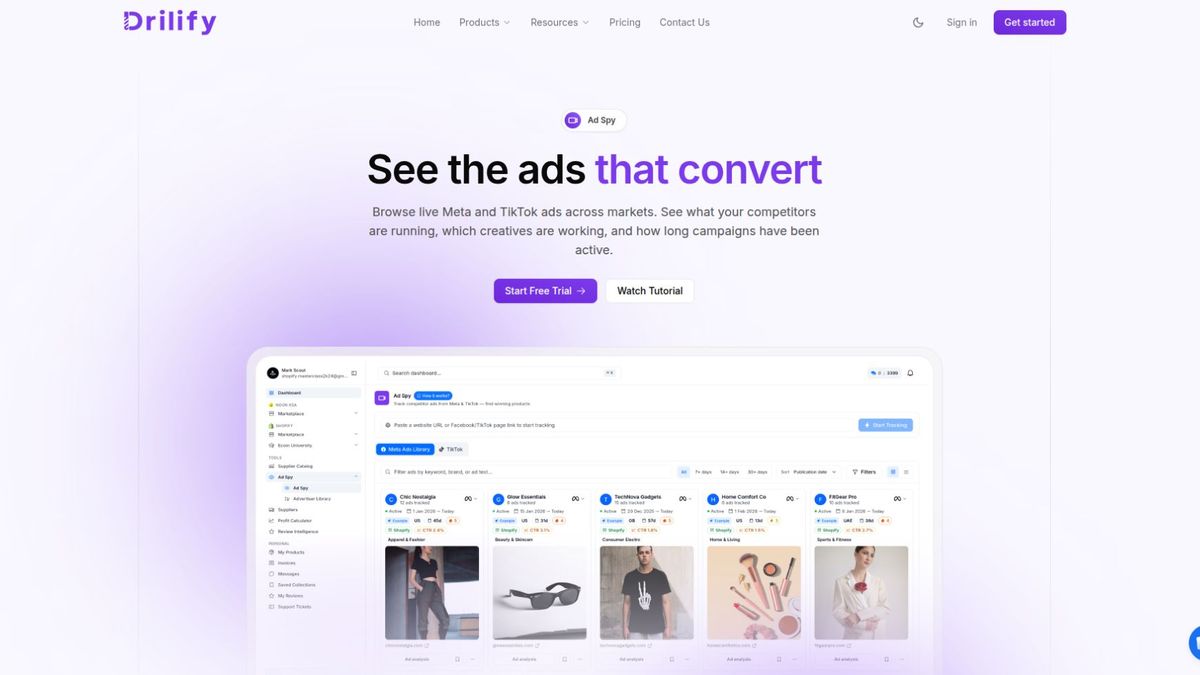
Drilify development product-page capture, October 9, 2026. Marketing illustration, not a fresh signed-in ad lookup or a production screenshot.
Drilify product-page illustration, captured October 9, 2026. Illustrative cards; no fresh ad lookup was run.
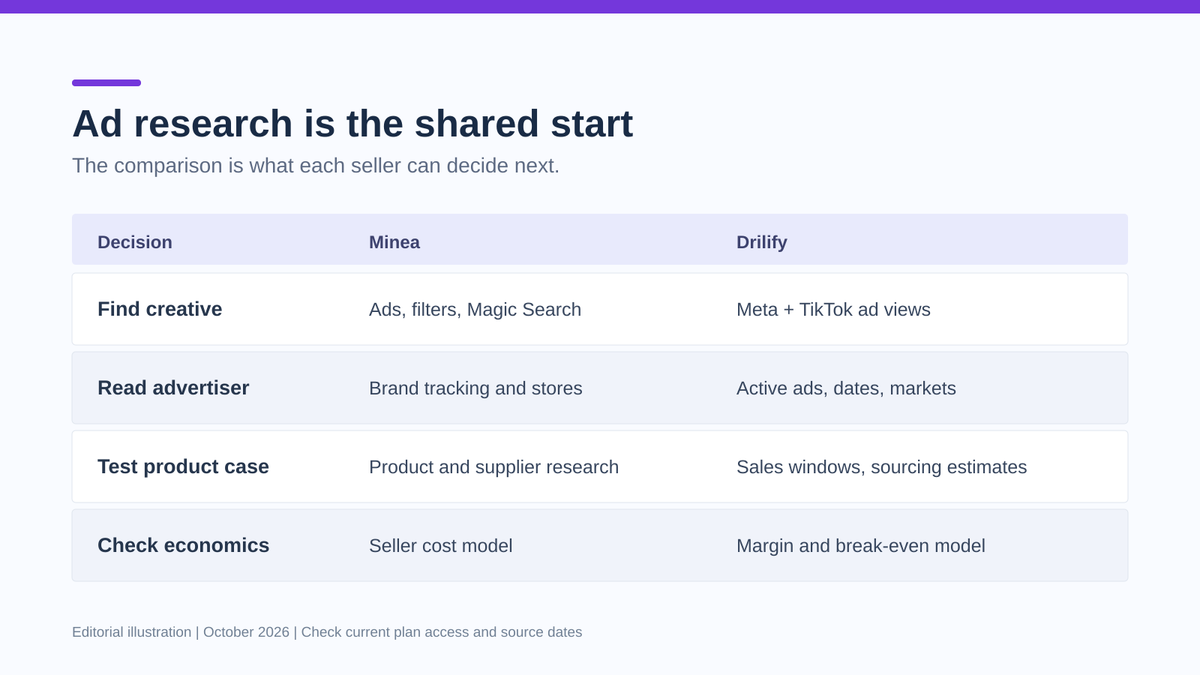
Original illustration of ad research followed by seller decisions, not a product interface.
Reading the advertiser behind the ad
Minea advertises a brand tracker and store listings; its current Starter and Premium descriptions set different allowances for analysis and notifications. That is valuable for sellers whose work centers on competitor campaigns and creative patterns.
Drilify's Advertiser Library builds on ad tracking. The observed table shows platform, top ad previews, total, unique and active ad counts, days, country, first and latest seen dates, and a route back to the ads. These fields answer a different question from "does one ad look good?": how consistently is this advertiser active, and which of its creatives should I compare? A TikTok filter is present. The fields do not by themselves prove TikTok Shop sales or disclose a brand's actual ad budget.
Minea's Shopify research page also discusses store tracking and product trends. Drilify's added decision path is clearest when the ad leads into observed sales, sourcing and margin views.
Checking whether the product case survives scrutiny
After identifying a promising ad, a Drilify seller can investigate a product through Product Library fields such as price, seller, category, reviews, and seven- or thirty-day sales and revenue where available. Shop Library adds catalog size, average price, revenue growth, top products, region and source freshness. Sales Tracking provides today, yesterday, seven-day and thirty-day windows, plus growth and price history for selected tracked shops or products. These time views help ask whether demand appears to persist or a brief spike is fading.
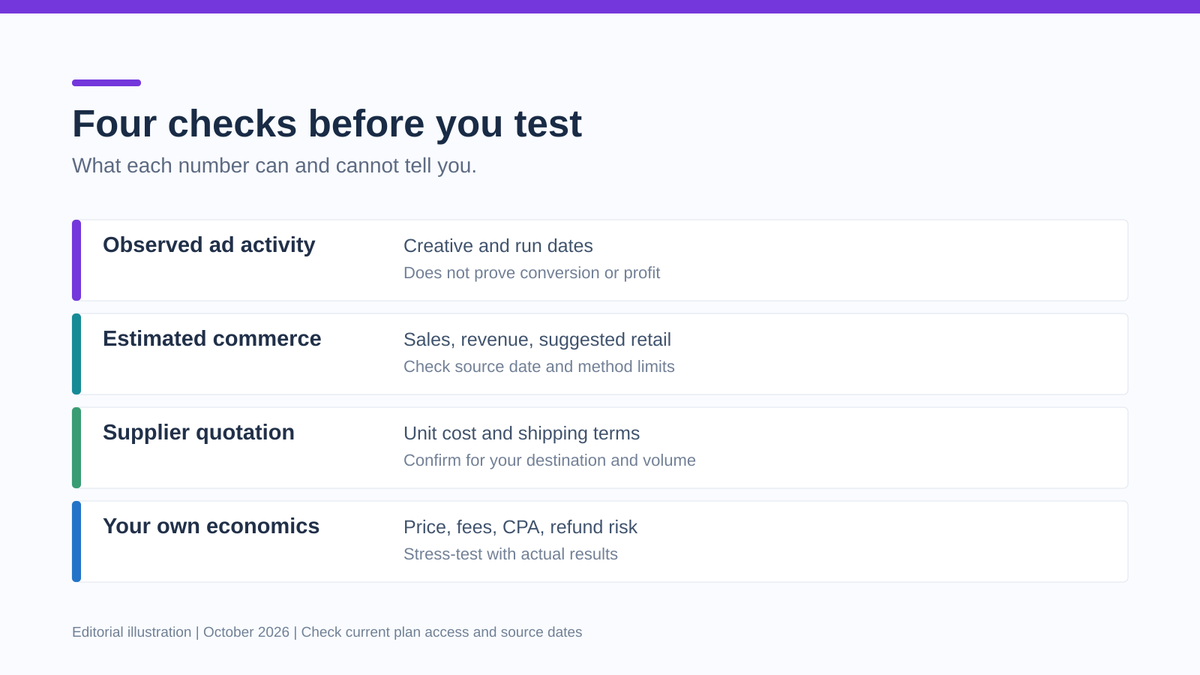
These signals have limits. Some values are estimates, some are missing, and a last-updated date matters. A competitor's reported sales estimate cannot be used as your own forecast. Check the underlying product, store, market and date before treating any row as a candidate.
The sourcing step tests a different risk. In Drilify's connected CJ catalog, sellers can compare supplier cost, estimated retail and margin, competition, category, shipping type and destination before moving toward import. The owner confirms a comparable Hertwill sourcing workflow. Minea also advertises supplier finding; the distinction here is the concrete Drilify fields and how they inform a decision, not an unsupported claim that Minea has no sourcing.
Finally, Drilify's Profit Calculator, listed under Scale on its pricing page, models product cost, shipping, fees, ads, returns, overhead, break-even CPA and margin sensitivity. The Listing Engine prepares editable titles, descriptions and search fields. Generated copy still needs human review. Minea may also be used alongside a spreadsheet or listing workflow.
Original evidence checklist; estimated fields and seller-entered assumptions are distinguished.
Pro tip: Before paying for a test, write a one-page hypothesis: the product, target market, offer, supplier quote, delivery time, break-even ad cost and reason the creative angle could work. Revisit that page after real results arrive.
Drilify and Minea: honest pros and cons
Minea strengths
A strong creative-discovery workflow with ad filters, Magic Search, brand tracking, product/store investigation and access to several documented social channels.
Official pages describe spend and engagement signals that can help prioritize ads for closer review.
Useful for a team whose immediate job is finding concepts, monitoring competitors and studying how offers are presented.
Minea trade-offs
The $49/month Starter price is higher than Drilify's $29/month Launch price in the current Drilify plan; more advanced Minea allowances and channel access may require a higher tier. Check the live checkout before subscribing.
Ads, engagement and store estimates still need validation against supplier costs and your own conversion economics. Minea also offers sourcing and store tools, so this is a workflow discipline issue rather than a missing-feature claim.
Minea's public pages use different feature and plan descriptions in places. Confirm the exact TikTok, Pinterest, AI and tracking allowances for the plan you will purchase.
Drilify strengths
Its observed Meta and TikTok ad research can continue into advertiser activity, product and store signals, sales time windows, sourcing economics, a profitability model and editable listing preparation.
Specific fields help sellers decide what to inspect next: ad duration and market, advertiser activity, product and shop momentum, estimated retail and margin, shipping, and break-even ad cost.
The current plan starts at $29/month, and the dashboard includes a credit-transfer control for moving eligible unused allowances toward tools a seller uses more, subject to plan rules.
Drilify trade-offs
Some workflows and report sections are plan-gated. Check the plan for the task you intend to perform.
Tracked values can be estimated or dated; actual customer demand and profitability only emerge from your own store results.
This comparison has a documented signed-in feature audit, but it is not a side-by-side paid-account performance test against Minea. Do not read its table as a measured accuracy ranking.
Pricing: what does each plan buy?
As checked on October 9, 2026, Minea's official pricing page lists Starter at $49 per month, Premium at $99 per month, and Business at $199 per month on monthly billing. It shows quarterly billing prices of $39, $79 and $158 per month respectively, paid on a different cadence. Its plan table and other marketing pages vary in how channel entitlements are described. Confirm exact access and any promotion at checkout.
Drilify lists Launch at $29 per month, Scale at $49 and Dominate at $89. Ad Spy and Advertiser Library appear in Launch; the Profit Calculator appears under Scale. Allowances differ by feature. Drilify also lets eligible users transfer unused feature credits toward another eligible tool for the current billing cycle, subject to plan rules.
Choose Minea when your team's main need is ad and creative discovery, you want to explore Minea's documented Meta, TikTok and Pinterest research, and the relevant plan gives you the Magic Search, analysis or tracking allowance you need. Use its store and supplier research as part of your shortlist, then calculate the economics with your own verified inputs.
Choose Drilify when you want the ad to start a broader seller decision: inspect advertiser activity, check product and shop momentum, compare sourcing cost and shipping fit, model margin and break-even CPA, then prepare a listing for review. The strength of this path is the decision-making detail in each step. It still depends on source freshness, plan access and the quality of your own assumptions.
For either tool, run the same test on a few products. Record which ads you found, which fields were available, how recent they were, what supplier quotes you obtained, and whether the resulting margin permits a sensible test. That exercise will tell you more than a blanket "winner" label.
Frequently asked questions
Is Drilify an alternative to Minea for ad research?
Yes, for the shared job of researching Meta and TikTok ads and advertisers. Drilify's observed views support creative, activity and advertiser analysis, then connect that research to product, sourcing and profitability decisions. Compare the exact fields and plan access you need.
Does Minea offer product and store research too?
Yes. Minea's own site describes product listings, shop research, a brand tracker and supplier finding. This comparison does not treat those jobs as exclusive to Drilify. The difference described here is Drilify's observed field-level path from ad signals to sales windows, sourcing estimates and cost modeling.
Does either platform prove that an ad is profitable?
Ad duration, engagement, spend signals and scores are clues. Supplier cost, selling price, fees, acquisition cost, refund risk and actual conversions determine whether your own offer works.
How does Drilify handle TikTok research?
The signed-in Drilify audit found a TikTok tab in Ad Spy and a TikTok filter in Advertiser Library. Sellers can inspect ads and advertiser activity there. Do not assume those screens report every TikTok Shop sales metric simply because another vendor names a separate TikTok Shop product view.
What should I check before moving from an ad to a product test?
Check the ad's market and age, the advertiser's broader activity, product demand and price signals, data freshness, supplier quote and shipping destination, then a margin calculation with a maximum affordable acquisition cost. Test a small batch and update the decision with actual results.
Start with a seller decision, not an ad score
An ad can point you toward an opportunity. The useful next step is to test whether that opportunity still makes sense after product, supplier, delivery and acquisition costs are known. Start with Drilify at $29/mo and use Ad Spy to build a shortlist you can challenge with the rest of the seller workflow.