Is Dropship.io Legit? An Honest 2026 Review and Alternative
Is Dropship.io legitimate? A balanced look at its research tools, three-day trial, cancellation terms, pricing, and how it compares with Drilify.
Is Dropship.io legitimate? A balanced look at its research tools, three-day trial, cancellation terms, pricing, and how it compares with Drilify.
Yes, Dropship.io is a real paid product-research platform with published pricing, product documentation, support articles, and a stated operating company. That does not mean every sales estimate is accurate or that its three-day trial is risk-free. This review separates what its public materials verify from what a seller still needs to test, then compares it fairly with Drilify.
Public pages checked October 7, 2026. Plan allowances vary.
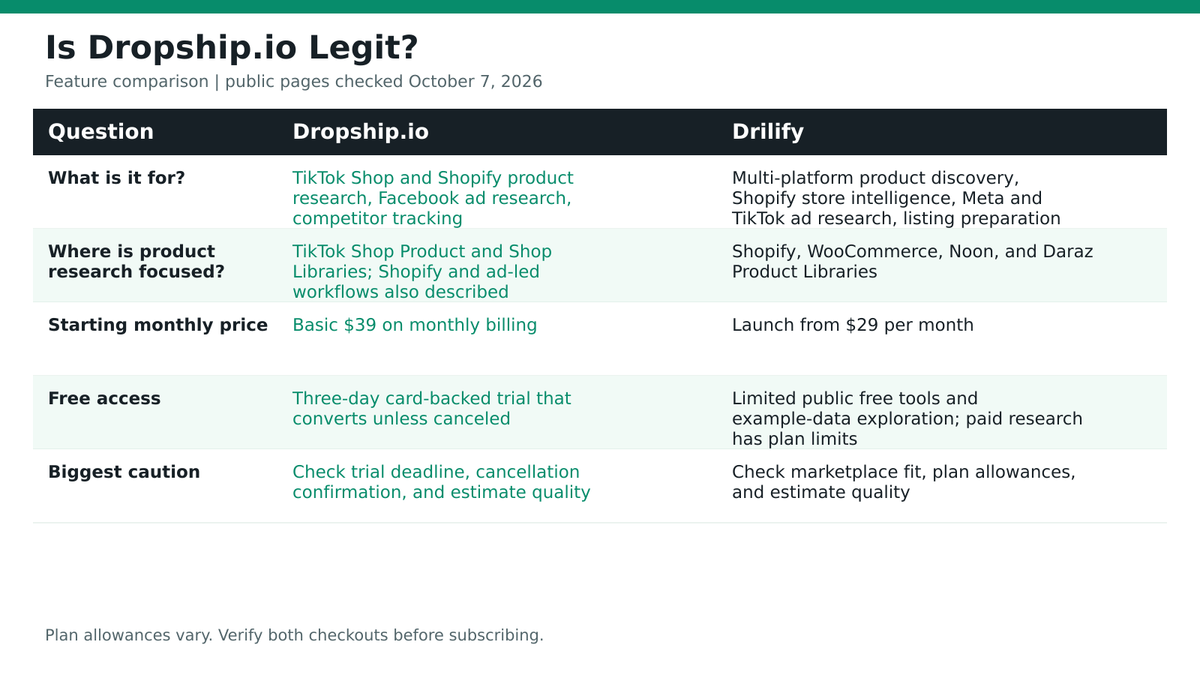
Comparison in text
What is it for?: Both: product, shop, competitor, and ad research. Drilify goes further with multi-marketplace sales and price signals, CJ and Hertwill sourcing economics, profitability testing, and editable listing preparation.
Where is product research focused?: Dropship.io: TikTok Shop Product and Shop Libraries; Shopify and ad-led workflows also described; Drilify: Shopify, WooCommerce, Noon, and Daraz Product Libraries.
Starting monthly price: Dropship.io: Basic $39 on monthly billing; Drilify: Launch from $29 per month.
Free access: Dropship.io: three-day card-backed trial that converts unless canceled; Drilify: limited public free tools and trial access, with paid research subject to plan allowances. Check current terms.
Biggest caution: Dropship.io: Check trial deadline, cancellation confirmation, and estimate quality; Drilify: Check marketplace fit, plan allowances, and estimate quality.
Based on current vendor pages, Drilify's signed-in dashboard, and product-owner guidance for Hertwill. This is not an independent audit of company finances, data accuracy, or customer support. Prices and limits can change.
LATEST POSTS
More from Drilify
Interviews, tips, guides, industry best practices, and news.
14 min read
11 Best Dropshipping Product Research Tools for 2026
Compare 11 dropshipping product research tools by workflow, current pricing, features, and limitations, including Drilify and useful free resources.
The short answer: legitimate product, real buying questions
The word “legit” can mean several things. If you mean “Does Dropship.io offer an identifiable product and documented way to subscribe and cancel?”, its official site and help center say yes. The company identifies itself as Dropship FZCO on its About page, describes its research products, publishes pricing, and documents cancellation. Those are concrete signs of an operating service, although this review has not independently audited the business.
If you mean “Will its data reliably find a profitable product for me?”, no public feature list can prove that. A research dashboard can help you form hypotheses, but it cannot verify a supplier's reliability, your ad cost, your returns, or future customer demand. If you mean “Can I test it without an unexpected bill?”, the trial terms deserve close attention: a card is required, the trial is three days, and an uncanceled trial becomes paid. Check the current checkout terms yourself before entering payment details.
What Dropship.io actually offers in 2026
Dropship.io's current Product Library highlights TikTok Shop products with filters for sales, revenue, price, images, and variants. Its Shop Library lets sellers inspect TikTok Shops using growth and sales signals. The pricing page also lists Facebook Ad Library access, advertiser research, competitor tracking, Shopify import, and an AI store-building workflow. These are product claims from Dropship.io's own pages, not results of an independent hands-on benchmark.
An older review might describe Dropship.io as only a Shopify product database. That is no longer a complete description of its public offering. The company's current help center also describes Shopify product discovery and TikTok Shop tools. A seller choosing today should ask whether the relevant data source is their target market, rather than assume every library covers the same platforms.
For example, a TikTok Shop seller may care most about rising shops, recent sales signals, and creative trends. A Shopify seller might prioritize competitor storefronts, ad history, and import workflow. Those are different research questions. A subscription is useful only if the tool gives enough evidence for the questions you actually ask each week.
Is the free trial genuinely free?
Dropship.io's help center calls it a three-day free trial and says you may see a temporary $1 card authorization. The same support material says the amount is refunded. That is a verification hold, not the listed monthly subscription price. Nevertheless, the presence of a card means you should read the exact payment screen carefully and save a record of the trial end time.
Its trial guide says to cancel before the three days end if you do not want to be charged. Its refund article says it does not refund a trial that was not canceled before expiry. This is the most important practical caveat for someone asking whether the offer is trustworthy. The terms are publicly documented, but they are strict. A free trial is not a permanently free plan.
The company says you can cancel anytime during a trial or a paid plan. Its cancellation instructions point to Account settings, Plan, the current plan menu, and Cancel. If the interface does not show a successful cancellation, the guide says to contact support. Keep a screenshot or confirmation email for your records. This is ordinary subscription hygiene, not an allegation that billing is improper.
There is also a distinction between a published cancellation policy and an individual cancellation actually taking effect. Some firsthand public complaints allege billing after a cancellation attempt, but those posts are not independently verified and cannot establish how often it happens or why. If you cancel, confirm the account shows a canceled or nonrenewing status, check the date shown for future billing, retain the confirmation, and review your card statement afterward. If a charge appears contrary to your confirmation, contact support with the dated evidence and ask your card provider about dispute options. Do not assume that a support message alone changed your billing status.
How much does Dropship.io cost?
On October 7, 2026, Dropship.io pricing listed Basic at $39 per month, Standard at $59, and Premium at $99 when billed monthly. It displayed lower monthly equivalents of $26, $34, and $49 for annual billing. An annual equivalent is not a month-to-month commitment: check the total charged upfront, renewal date, taxes, and feature allowances before comparing prices.
The right question is not simply whether $39 is expensive. List your regular research tasks, then check whether Basic supplies enough credits or searches for them. A lower-tier plan that forces frequent upgrades may cost more than expected; a higher-tier plan that you barely use is also wasteful. Prices are snapshots and should be verified at checkout, especially if the site localizes currency.
Can you trust its product and revenue data?
Treat any third-party sales, revenue, or ad-spend estimate as a signal to investigate, not a guarantee. Dropship.io's public pages explain the kinds of filters and estimates it offers, but we did not find a controlled, independent accuracy study that establishes how closely every estimate matches merchant records. That limitation also applies to comparable research tools, including Drilify's estimated store signals.
To test a research platform, start with products or stores whose real-world details you can independently check. Record the estimated sales trend, visible product price, advertising activity, and timestamp. Then compare the conclusion with a second source: your own store data, a supplier quote, a marketplace listing, or a documented seller conversation. Do not buy inventory because one dashboard labels a product a winner. Profit depends on landed cost, payment fees, returns, customer-acquisition cost, and how well your offer fits a particular audience.
The word “spy” in a tool name should not imply access to private merchant books. Publicly described store and ad research is valuable because it organizes signals; it does not give you audited access to a competitor's true profit. Read every estimate with that distinction in mind.
Feature-by-feature: where Drilify differs
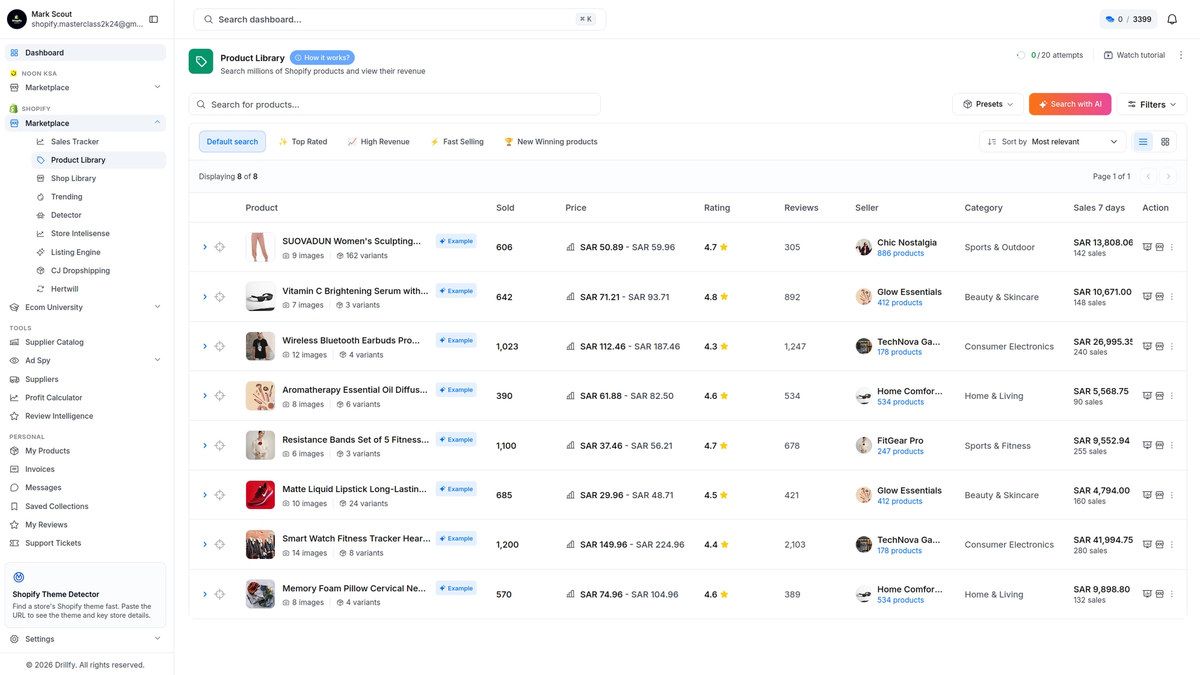
Both platforms help sellers research products, shops, competitors, and ads. Drilify's signed-in dashboard adds a practical decision path: compare recent sales, revenue, price movement, ratings, reviews, and store momentum; examine sourcing cost, estimated retail, margin, competition, and shipping through CJ and Hertwill; then test profitability and prepare a listing. Its Product Library spans Shopify, WooCommerce, Noon, and Daraz research alongside Meta and TikTok ad workflows. Dropship.io documents TikTok Shop Product and Shop Libraries and Facebook ad research. Compare the same research task and current plan limits; estimates still need validation before buying inventory.
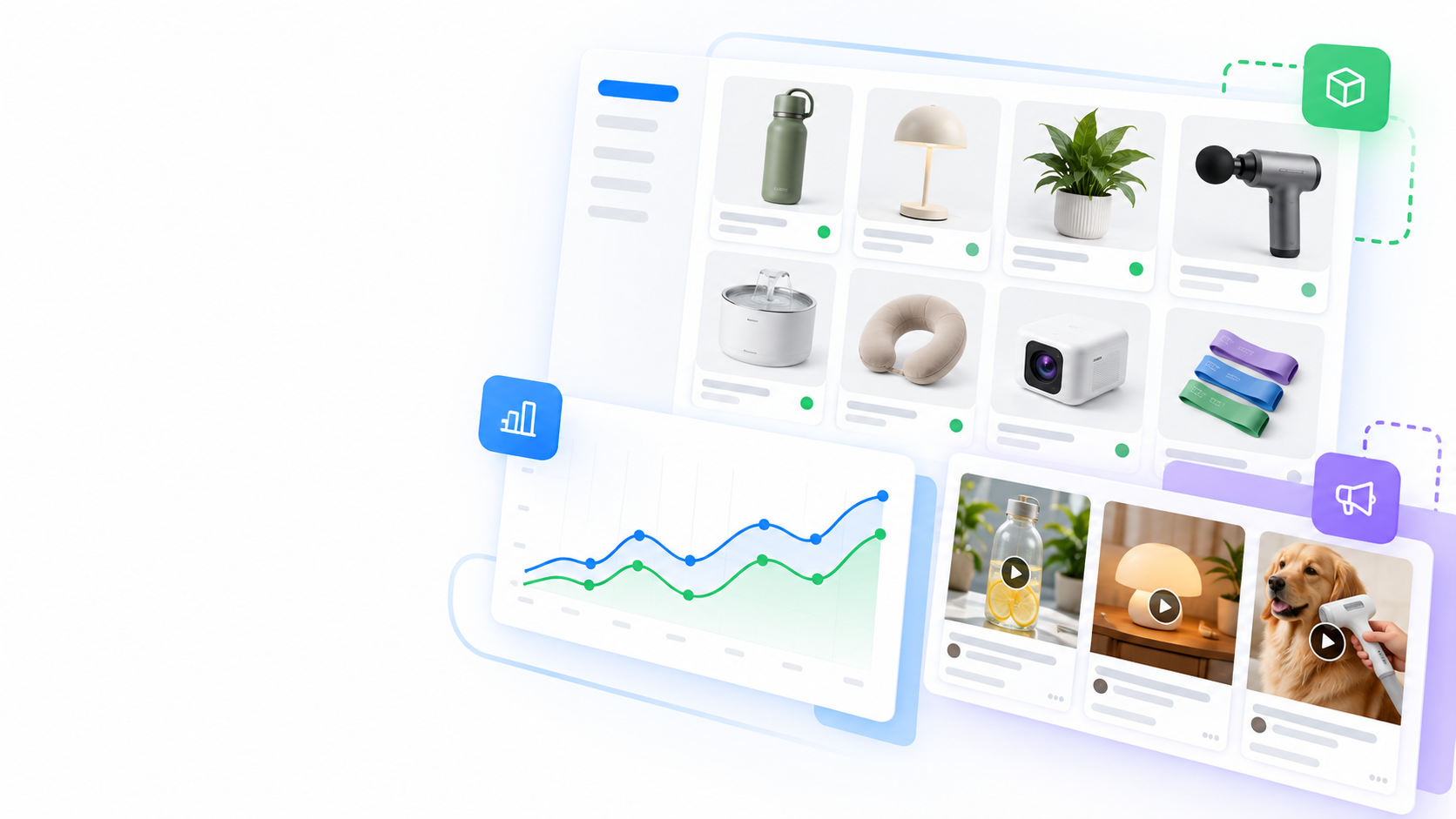
Official Drilify Product Library page art, not a signed-in app screenshot. The product page uses a green visual identity; check the live interface for current details.
Drilify's Store Intelligence accepts a Shopify store URL and displays product, tech-stack, and estimated business signals. Dropship.io publishes its own competitor and TikTok Shop tracking features. The overlap is real, but the platforms and outputs are not identical. Ask which competitor you want to study and which decision the result must support.
Official Drilify Store Intelligence page art. Revenue and traffic values shown in product marketing should not be treated as verified merchant results.
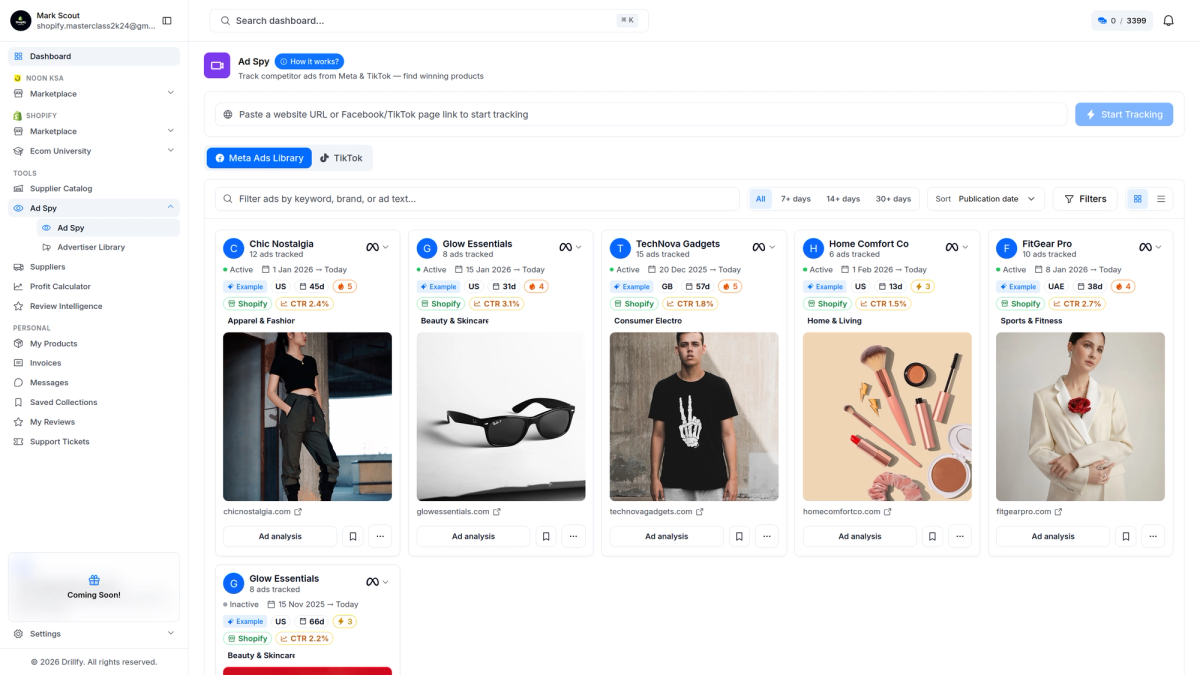
Dropship.io's pricing page emphasizes Facebook ad and advertiser research. Drilify's Ad Spy supports that Meta creative-research job and publicly adds TikTok ad browsing, so Drilify's broader channel coverage matters if you test both. Neither product can prove profit from an active ad. Drilify also has an AI Listing Engine, while Dropship.io lists Shopify import and AI store-building tools. Those launch aids are not interchangeable; compare the exact steps you need after research.
Official Drilify Ad Spy page art, using the purple visual treatment of that product page. It is not a live ad-results screenshot.
Dropship.io pros and cons
Pros. The current public product pages give TikTok Shop-focused product and shop filters, Facebook ad research, competitor tracking, and other launch aids. Pricing, trial management, cancellation, and refund guidance are published rather than hidden behind a sales call. For a seller whose routine centers on TikTok Shop, that specific focus could be useful.
Cons. The trial is short, card-backed, and converts unless canceled; the refund guidance is strict if you forget. Public complaints also make post-cancellation status verification especially prudent, though individual allegations are not proof of a systemic billing problem. Basic costs $39 per month on monthly billing, and the annual prices require an annual commitment. TikTok Shop signals will not by themselves answer a Noon or Daraz research question. Estimates need independent validation, and feature allowances vary by plan.
Drilify pros and cons
Pros. Drilify's dashboard shows recent product sales and revenue, price movement, ratings, reviews, store context, and Meta and TikTok ad research. Its CJ and Hertwill sourcing workflows add cost, estimated retail, margin, competition, and shipping information before import. Profitability Calculator tests ad-cost and fee assumptions; Listing Engine carries a product toward an editable listing. Its public tools page offers limited no-signup tools such as a Margin Calculator and Shopify Theme Detector, so you can inspect some useful workflows before buying. Its Launch tier was advertised from $29 per month when checked.
Cons. Drilify's broader documented feature set does not mean every feature or lookup volume is included in its entry plan. Its estimated store signals should be tested against other evidence, and its free tools are not an unlimited free version of paid research products.
When to choose Dropship.io, and when to choose Drilify
Consider Dropship.io if its specific TikTok Shop product, shop, and Facebook ad views fit your routine. Drilify covers the shared research jobs and adds more ways to decide: recent product and store signals, multi-marketplace research, CJ and Hertwill sourcing economics, break-even analysis, and listing preparation. Compare the data each plan gives you on a concrete task. Before starting Dropship.io's trial, note when it ends and test products you already understand.
Choose Drilify when you want product, shop, competitor, and ad research to lead into a sourcing and launch decision. Its dashboard combines sales, revenue, price, customer-response, and store-momentum signals with Meta and TikTok research. CJ and Hertwill add supplier cost, estimated retail, margin, competition, and shipping context; the Profitability Calculator and Listing Engine carry the idea further. Drilify also serves Shopify, WooCommerce, Noon, and Daraz workflows. Check the current plan's allowances for your markets and workload.
Choose neither yet if you have not settled on a marketplace, cannot explain what data would change your next decision, or have not calculated product margins. A spreadsheet, supplier quote, and a small test can be more valuable than another subscription at that stage.
Frequently asked questions
Is Dropship.io a scam?
Its official pages document a real research product, named company, pricing, trial terms, cancellation steps, and support materials. That supports calling it an operating paid service. We have not independently audited the company or verified every estimate and customer experience, so do not treat this as a blanket endorsement.
Is Dropship.io free after the trial?
No. Its help center describes a three-day trial, and says an uncanceled trial becomes a paid subscription. Review your checkout screen for the exact plan, deadline, and renewal amount.
Can you cancel Dropship.io before you are charged?
The company's help center says you can cancel during the trial through account settings. Do it before the trial expires and keep confirmation. If the status is unclear, contact its support team promptly.
What if Dropship.io charges me after I cancel?
Compare the charge date with your cancellation confirmation and the displayed billing terms. Ask Dropship.io support to explain or reverse a charge that appears inconsistent with the confirmation. Save your messages, account-status screenshots, and statement; your card provider can explain its dispute process if the issue remains unresolved. A public complaint alone does not verify what happened to a specific account.
Does Dropship.io refund an uncanceled trial?
Its current refund article says no. That policy is a reason to set a reminder and make a deliberate decision before the trial ends, not a reason to assume the product itself is fake.
Is Dropship.io only for Shopify?
No. Its current public product pages include TikTok Shop Product and Shop Libraries, and its help center also mentions Shopify workflows. Check the specific library you need rather than relying on an older description.
Is Drilify cheaper than Dropship.io?
At the October 7 check, Drilify advertised a $29 monthly starting tier and Dropship.io listed $39 monthly for Basic. Different allowances and market coverage make sticker price an incomplete comparison. Verify both checkouts and plan details before subscribing.
Verdict
Dropship.io appears to be a legitimate paid product-research service, with a meaningful TikTok Shop and Facebook ad offering. The strongest caution is commercial, not sensational: understand the three-day card-backed trial and its cancellation and refund terms, and validate estimated data yourself. If your research spans Shopify, WooCommerce, Noon, and Daraz, start with Drilify at $29 per month after checking the current plan limits and checkout terms.