Drilify vs Dropship.io: Which Product Research Tool Is Better in 2026?
A current, balanced comparison of Drilify and Dropship.io: product and store research, ad channels, pricing, trial terms, strengths, and tradeoffs.
A current, balanced comparison of Drilify and Dropship.io: product and store research, ad channels, pricing, trial terms, strengths, and tradeoffs.
Drilify and Dropship.io both help sellers research products, competitors, shops, and ads. Drilify takes that shared job further: its dashboard brings sales and revenue trends, price movement, ratings, reviews, and store context into the research process, while its CJ and Hertwill sourcing workflows help compare supplier cost, estimated retail price, margin, competition, and fulfillment fit. Drilify then connects research to listing preparation across multiple marketplaces. Compare current plan limits for your intended workflow.
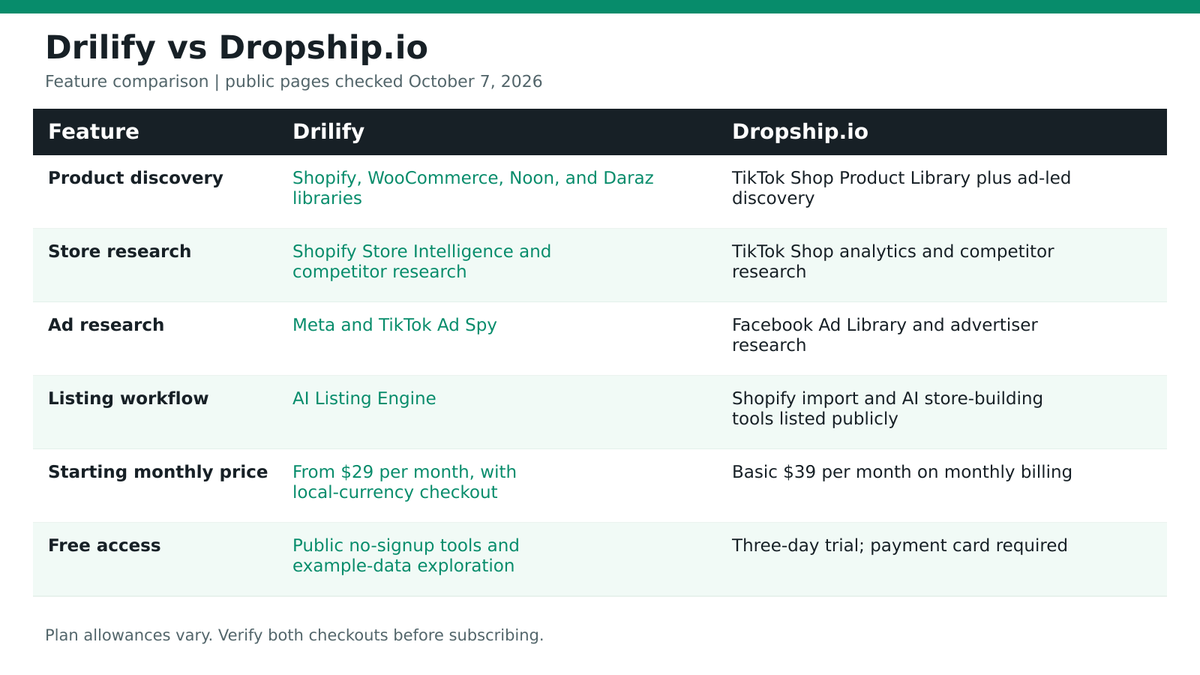
Public pages checked October 7, 2026. Plan allowances vary.
Comparison in text
Product discovery: Both support product and shop research, including TikTok-oriented research. Drilify adds Shopify, WooCommerce, Noon, and Daraz coverage and connects discovery to sourcing economics and listing preparation.
Store research: Both provide shop and competitor research. Drilify adds recent sales and revenue, growth, top products, catalog size, rating, region, and source freshness in its Shop Library, plus Store Intelligence context.
Ad research: Drilify: Meta and TikTok Ad Spy; Dropship.io: Facebook Ad Library and advertiser research.
Listing workflow: Drilify: AI Listing Engine; Dropship.io: Shopify import and AI store-building tools listed publicly.
Starting monthly price: Drilify: From $29 per month, with local-currency checkout; Dropship.io: Basic $39 per month on monthly billing.
Drilify: limited public no-signup tools and limited trial access; Dropship.io: three-day card-backed trial. Check current terms for both.
LATEST POSTS
More from Drilify
Interviews, tips, guides, industry best practices, and news.
14 min read
11 Best Dropshipping Product Research Tools for 2026
Compare 11 dropshipping product research tools by workflow, current pricing, features, and limitations, including Drilify and useful free resources.
Comparison draws on current vendor pages, Drilify's signed-in dashboard, and product-owner guidance for Hertwill. Estimates are directional and feature allowances vary by plan. Check current checkout terms.
The short answer: match the tool to the marketplace
Both platforms support product, competitor, shop, and ad research. Drilify adds a longer decision path: compare demand and store momentum through sales, revenue, rating, review, and price signals; assess sourcing through CJ and Hertwill cost, estimated retail, margin, competition, and shipping context; then prepare a listing. It also spans Shopify, WooCommerce, Noon, and Daraz workflows alongside Meta and TikTok ad research. Dropship.io has TikTok Shop and Facebook-ad research too, but the useful question is which tool carries your research further toward a sound sourcing and listing decision. Estimates still need validation before you invest.
This comparison uses Dropship.io's current public documentation, Drilify's signed-in dashboard, and Drilify product-owner guidance for the unconnected Hertwill workflow. It is not an independent benchmark of data accuracy. Features, estimates, and allowances can change; test a real research task and check the plan limits before subscribing.
Product discovery: which signals lead to a better decision?
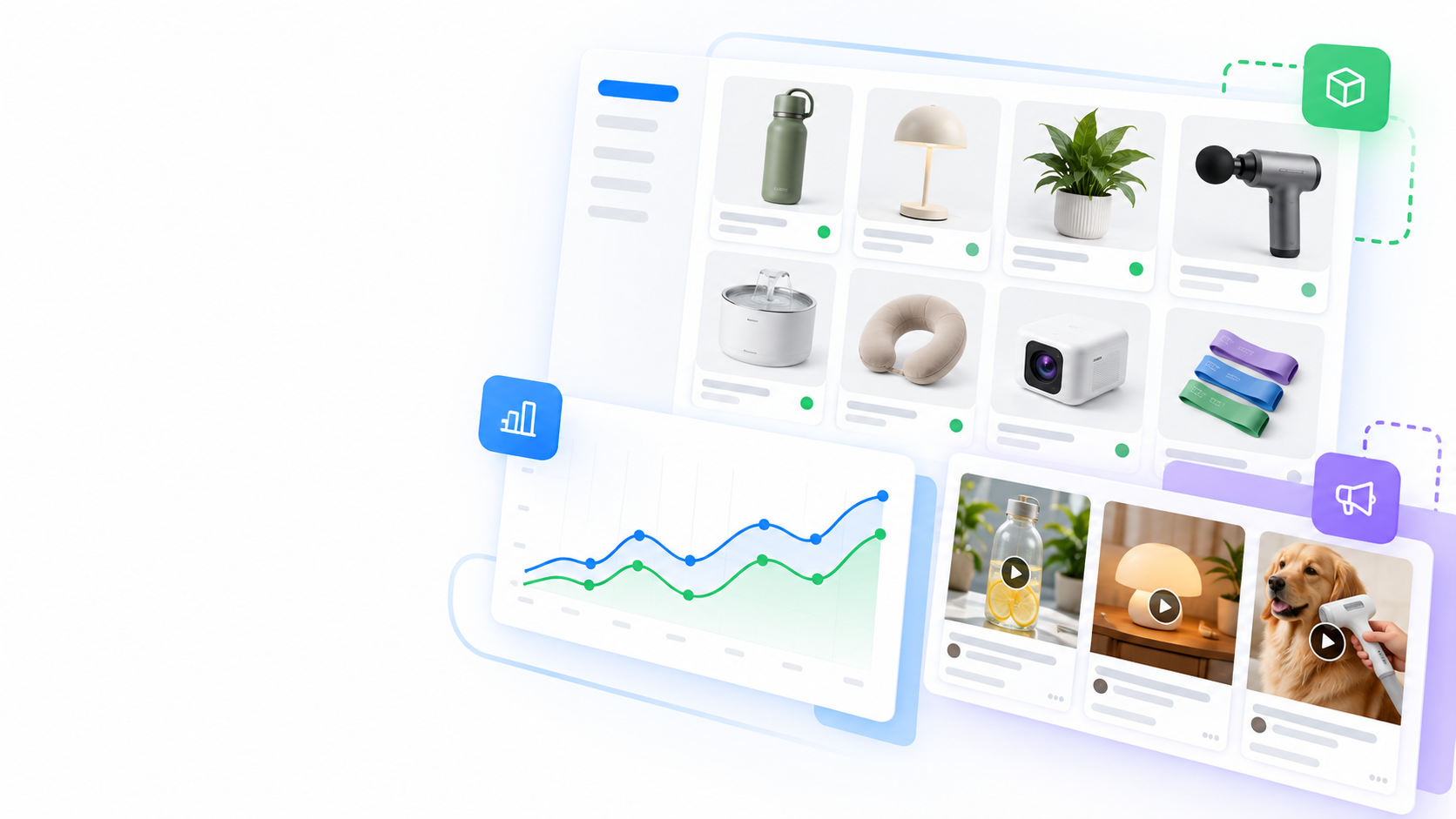
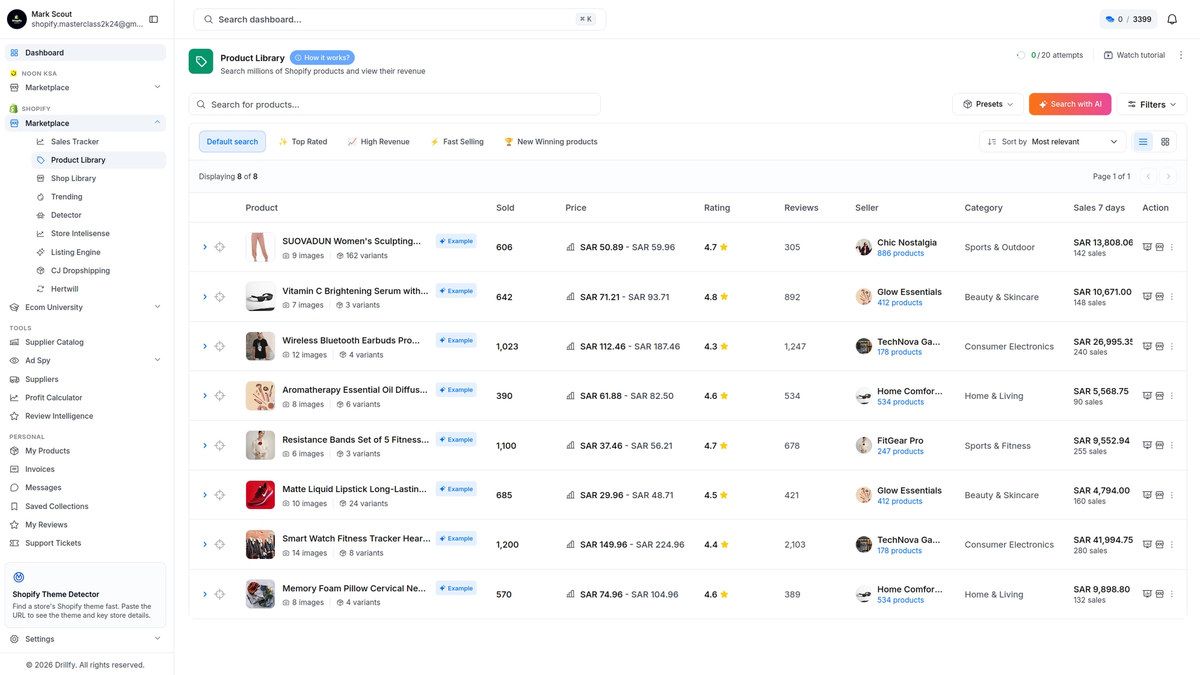
Drilify's Product Library supports Shopify, WooCommerce, Noon, and Daraz research. In the signed-in product, the Shopify view displays units sold, recent sales and revenue, price range, rating, reviews, seller, category, and source context; Shop Library adds top products, growth, average price, catalog size, and region. These fields help a seller compare demand and store momentum, not just browse a list. CJ and Hertwill sourcing then add cost, estimated retail, margin, competition, and shipping context before import.
Official Drilify Product Library product-page illustration, checked October 7, 2026. It represents the public marketing page; verify the current signed-in interface before treating it as a live screenshot.
Dropship.io's current Product Library focuses on TikTok Shop products. Its public description includes filters for price, sales, revenue, images, and variants, with historical product and shop views. Dropship.io also offers a Shop Library for finding growing TikTok Shops. Drilify covers the shared product, shop, competitor, and ad research jobs, then carries findings into additional marketplace views, sourcing economics, profitability testing, and listing preparation.
The older description of Dropship.io as a Shopify-only research tool is outdated. Its public site now describes TikTok Shop libraries alongside Facebook ad and competitor tools. Read the current product pages, not an old review, before choosing between the platforms.
Store and competitor intelligence
Drilify's Store Intelligence invites you to paste a Shopify store URL for a profile that includes product count, price range, tech stack, social links, and estimated revenue, traffic, and growth signals. This is useful for generating questions: Which products anchor a store? How broad is its catalog? What customer-acquisition channels might be worth investigating? An estimate is directional research, not a merchant's audited financial statement.
Official Drilify Store Intelligence product-page illustration, checked October 7, 2026. The pictured interface is public marketing material, not evidence of a particular store's results.
Dropship.io's pricing page lists competitor research and TikTok Shop tracking, and its Shop Library highlights revenue, sales, growth-rate, and product filters. Drilify supports the same kind of shop and competitor investigation, then adds more decision context: store momentum, product response, supplier economics through CJ and Hertwill, and a path into profitability testing and listings. Compare the actual fields and plan allowances on the same business question.
Ad research: compare channels, not slogans
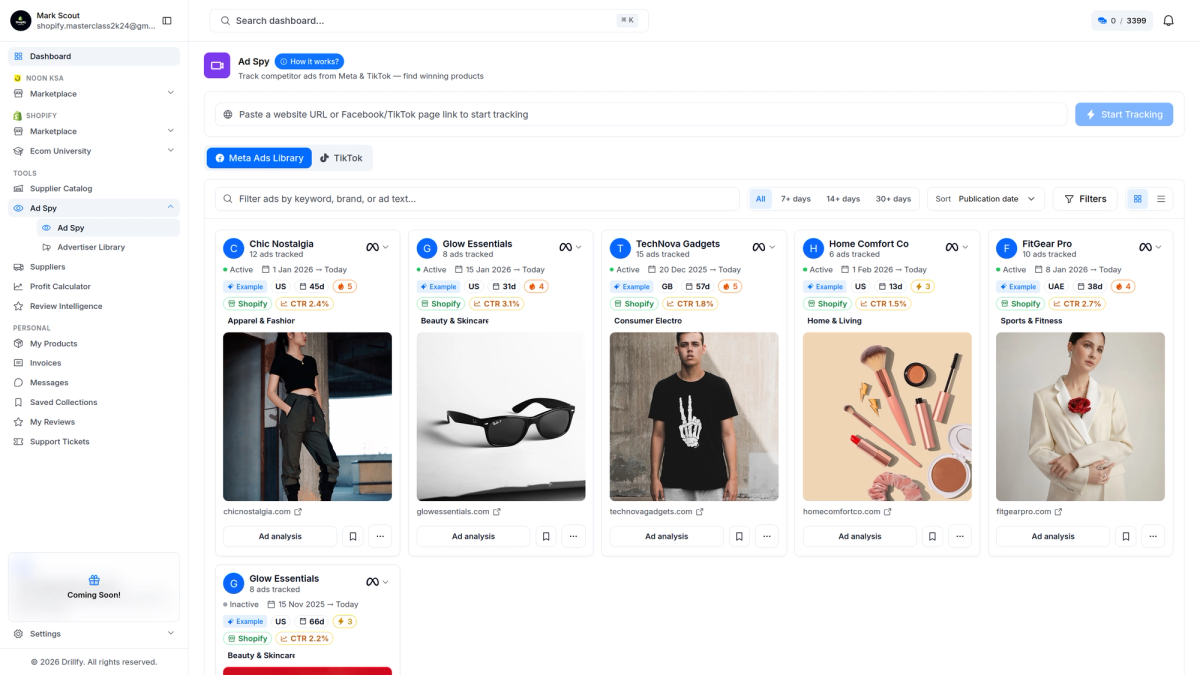
Drilify's Ad Spy publicly describes Meta and TikTok ad browsing, with filtering and advertiser views. That can help a seller study creative angles in two different ad ecosystems. An active ad or a long-running campaign can suggest a hypothesis, but it does not reveal the advertiser's profit. Creative research is a starting point for your own testing, not proof that an item is a winner.
Official Drilify Ad Spy product-page illustration, checked October 7, 2026. The purple visual treatment belongs to Ad Spy; it is not the Product Library's green style.
Dropship.io's pricing and feature comparison documents a Facebook Ad Library and advertiser research, including filters and historical ad views. Drilify covers that Meta research job too, then adds TikTok ads within its public Ad Spy offering. Compare the specific filters, markets, history, and plan allowances you need; sharing a feature category does not mean the products return identical data or permit the same number of lookups.
Listings and the path from research to launch
Drilify includes a separate AI Listing Engine for preparing listings from product inputs. This matters when your research workflow continues into merchandising. But a generated description needs human review for accuracy, claims, product attributes, and marketplace rules. It cannot replace a supplier specification sheet or a compliance check.
Dropship.io's public materials list Shopify import and an AI store-building workflow. Those are meaningful launch aids, though they are not the same product as Drilify's Listing Engine. Compare the exact steps you need: finding a candidate, checking demand, preparing a compliant listing, and publishing it on your store. A tool can be strong at discovery but less aligned with your downstream workflow.
Pricing: compare monthly costs and trial terms
On October 7, Drilify's pricing page advertised Launch from $29 per month; it showed local-currency amounts view. The page also listed higher Scale and Dominate tiers with different allowances. Confirm the currency, payment interval, taxes, access limits, and renewal amount shown to you before purchasing. Drilify's public free tools can be used without signup, but they do not provide unlimited access to the paid research platform.
Dropship.io's current pricing page lists Basic at $39 per month on monthly billing, Standard at $59, and Premium at $99. It also shows lower monthly equivalents when paid yearly; annual billing means a larger upfront commitment. Its help center describes a three-day trial and a possible temporary $1 card authorization. The trial guide says you must cancel before it ends to avoid a charge. The refund guidance says an uncanceled trial is not refunded. Check those terms yourself at checkout; they matter more than a headline trial badge.
A lower entry price alone should not decide the purchase. Calculate the tools and allowances you will actually use, the markets you research, and the cost of any extra subscriptions needed to complete the workflow.
Drilify: honest pros and cons
Pros. Drilify's dashboard presents product sales and revenue over recent periods, price movement, ratings, reviews, store context, and ad research across Meta and TikTok. Its CJ and Hertwill sourcing workflows add estimated retail price, margin, competition, and shipping context before import. The Profitability Calculator tests costs, fees, ad spend, and break-even, while Listing Engine carries a shortlisted item toward an editable product listing. Coverage and allowances depend on the current plan.
Cons. Some advanced capabilities and usage levels vary by plan. Public marketing pages do not establish independent accuracy of revenue or sales estimates. Their documentation claims that inorder to get access to this data and much more features users need to access the dashboard and in some cases should have an active plans.
Dropship.io: honest pros and cons
Pros. Dropship.io documents TikTok Shop product and shop filters, sales and growth views, Facebook ad and advertiser research, tracking, curated product drops, and competitor tools. Drilify addresses those core research jobs too, then extends the workflow into broader marketplace analysis, sourcing economics, profitability testing, and listing preparation. Dropship.io may suit a seller who wants to center a routine on its particular TikTok and Facebook views.
Cons. The monthly Basic price is higher than Drilify's advertised Launch entry price. The three-day trial requires attention to the cancellation date and card terms. TikTok Shop coverage does not by itself answer a Noon, Daraz, or WooCommerce research question. As with any research platform, estimated revenue and ad signals should be independently tested before spending on stock or ads.
When to choose Dropship.io and when to choose Drilify
Consider Dropship.io if its particular TikTok Shop product, shop, and Facebook ad views fit your daily routine. Drilify covers the shared research jobs and goes further with marketplace breadth, supplier-cost and margin context through CJ and Hertwill, profitability testing, and listing preparation. Compare the actual fields and plan allowances on the same research task; review Dropship.io's trial terms before paying.
Choose Drilify when you want product, shop, competitor, and ad research to lead to a better sourcing decision. Its dashboard shows recent sales and revenue, price movement, customer-response signals, and Meta and TikTok creative; CJ and Hertwill add supplier cost, estimated retail, margin, competition, and shipping context. You can then test the economics and prepare a listing. Drilify also serves Shopify, WooCommerce, Noon, and Daraz workflows. Check the current plan's allowances for the markets you use.
For either product, write down a test checklist before paying: one market, one category, five candidate products, one competitor, and one ad angle. Record what each platform can and cannot verify. That turns a broad product tour into a decision you can defend.
Frequently asked questions
Is Dropship.io only for Shopify?
No. Its current public Product Library and Shop Library describe TikTok Shop research. It also lists Shopify import and other competitor workflows. An older Shopify-only summary would miss that newer TikTok coverage.
Does Drilify have a free option?
Drilify's public free-tools page offers limited no-signup tools, while paid research has plan-based allowances. The dashboard shows the kinds of product and shop data available when those workflows are used. Check current trial and plan terms for the research task you need.
Which tool has better sales estimates?
The public pages do not provide a controlled, independent accuracy study. Both tools display research signals and estimates. Compare a sample of products against your own order history, supplier information, or other reliable evidence before relying on either estimate.
Can I use both tools?
Yes, if each answers a distinct question and the combined subscription cost is justified. Compare the signed-in workflows first; do not assume a capability is absent from Drilify just because its public marketing pages do not list it. Avoid paying twice for overlapping features you rarely use.
Which one is better for a beginner?
The better beginner tool is the one that fits the marketplace you will actually sell in and lets you understand the evidence without overspending. Start with a concrete research task, inspect free or trial access, and confirm cancellation and renewal terms before adding another monthly bill.
Bottom line
Dropship.io is a serious TikTok Shop and Facebook ad research option. Drilify is a broader product-research workflow for sellers comparing multiple commerce platforms and linking research to store and listing work. Neither platform removes the need to verify suppliers, margins, and demand. If Drilify's market coverage fits your plan, start with Drilify at $29 per month after confirming the current checkout terms.