How to Find Dropshipping Products with High Profit Margins
Find dropshipping products with room for profit: verify demand and sourcing costs, calculate margins after fees and ads, and stress-test the offer with Drilify.
Find dropshipping products with room for profit: verify demand and sourcing costs, calculate margins after fees and ads, and stress-test the offer with Drilify.
To find dropshipping products with high profit margin, start with a price customers might actually pay, subtract every cost of completing the sale, and test the remaining margin against worse conditions. Drilify helps connect product demand, sourcing economics, and profitability calculations so you can shortlist products with a defensible testing budget.
A cheap supplier listing is only the beginning. A product can have an attractive selling-price spread and still lose money after shipping, payment fees, customer acquisition, refunds, and subscriptions. The useful question is: how much room remains when those costs rise or the selling price falls?
This guide takes you through eight steps, from choosing a market to reviewing a small launch. You will build an explicit cost model, calculate the maximum acquisition cost your offer can support, and use Drilify's visible research and sourcing fields to make better decisions. The worked numbers are hypothetical assumptions, not product forecasts or promised returns.
1. Define what a high profit margin means for your store
Start with three figures that answer different questions.
Gross margin shows what remains after the product's cost of goods sold. Contribution margin subtracts the variable costs of making and fulfilling an order. A fuller planning margin also deducts an allocated share of fixed expenses. Actual net profit requires the business's complete accounts, including relevant taxes and financing costs.
Use margin percentages consistently: divide the profit figure by the revenue used in that calculation. Markup instead divides the price increase by cost. A $40 item bought for $10 has a 75% product-only margin and a 300% markup; neither accounts for shipping or advertising. Shopify explains the margin and markup distinction.
LATEST POSTS
More from Drilify
Interviews, tips, guides, industry best practices, and news.
14 min read
11 Best Dropshipping Product Research Tools for 2026
Compare 11 dropshipping product research tools by workflow, current pricing, features, and limitations, including Drilify and useful free resources.
Write down a minimum profit per order and a minimum planning margin before searching. These are your thresholds, based on your costs and risk tolerance. A percentage alone can hide a weak offer: 30% of a $10 order leaves just $3 before any costs omitted from the model.
For this walkthrough, suppose you require at least $8 per order after the costs you have modeled. Keep that requirement beside every candidate. If a plausible adverse scenario pushes the remainder below it, investigate the weak assumption before spending more.
Choose one destination market, one currency, and one sales channel for the first calculation. Use the price after a planned discount, exclude sales tax collected for remittance from your revenue model, and include any shipping revenue customers pay. Keep the fee base consistent with your processor's actual rules.
Pro tip: Name the margin you are looking at. A supplier's product-cost margin, a calculator's projected margin, and your realized business net margin are different measures.
2. Build a shortlist around demand and a credible selling price
Look for a specific customer problem you can explain clearly. Compact organization accessories, a practical hobby attachment, or a useful travel product can be starting hypotheses. Their category does not establish profitability. Each exact variant still needs demand, quality, delivery, and price checks.
Prefer candidates with a visible benefit and manageable fulfillment requirements. Check dimensions, packed weight, materials, variants, and likely reasons for returns. A product that looks small in a photograph might require expensive packaging; an accessory might create support work if buyers cannot tell which devices it fits.
In Drilify Product Library, compare price or price range, category, rating, review count, seller context, and available seven- and thirty-day sales or revenue signals. Those fields help answer separate questions: is there activity, what do shoppers encounter, and where could your offer fit?
Record the observation date and whether a value is estimated. Missing data is an unknown, not zero demand. A strong thirty-day figure does not prove that you can acquire customers profitably, and review counts reflect customer history rather than your future conversion rate.
Use Drilify Shop Library to add context: top products, catalog size, average price, region, and available sales, revenue, or growth signals. Compare like-for-like variants and delivery promises. A premium retailer's price may reflect services, reputation, or a bundle that your proposed offer does not include.
Shortlist three to five products and write one sentence for each: who buys it, why they buy it, and why your offer is credible at the proposed price. For help choosing research tools, see the Drilify product research tools roundup.
3. Verify sourcing economics before trusting the retail estimate
Drilify's CJ Dropshipping catalog brings several decision fields together: supplier cost, estimated retail price, estimated margin, competition signals, shipping type and destination, category, and supplier context. Read across the horizontally scrollable table rather than judging a candidate from the product name and image alone.
Use the estimated retail and margin to identify products worth investigating. Then replace assumptions with the exact variant's cost and a destination-specific shipping quote. An estimated selling price is a research starting point; it does not establish willingness to pay. A competition label helps prioritize investigation, but does not reveal every competing seller or their economics.
Drilify also offers a CJ-like sourcing workflow through Hertwill. Check the connected catalog, relevant pricing and margin insights, and fulfillment terms for the supplier route you intend to use. Catalog access and available tools depend on the integration and your account's current plan.
If you work with suppliers through Drilify's sourcing area, compare more than the unit quote. Product Requests can present unit and total price, delivery time, supplier ratings, response time, and terms such as stock and minimum quantities. A lower unit price can become a more expensive order when freight, minimum quantities, or replacement terms change.
Ask for the cost to fulfill one order of the exact variant to your target country. Confirm packaging, handling, delivery service, tracking, duties responsibility, and any extra service charges. CJ's shipping guidance describes checking shipping options using factors including destination, product attributes, and weight. Use the current quote for your route rather than a generic shipping allowance.
Order and inspect a sample when practical. Check the claims you would put in a listing, the parcel's condition, instructions, and the real delivery experience. Keep a dated record of confirmed costs and unresolved questions before moving the candidate into your launch shortlist.
Pro tip: An attractive estimated retail price matters only if the exact product, shipping route, and customer offer support it. Build your calculation from a quote, not a thumbnail.
4. Calculate the margin after all modeled costs
Create one cost sheet per candidate. Use the same unit throughout: one order containing one unit, or a clearly defined bundle. Do not compare a single-unit supplier cost with revenue from a two-pack.
For a single-unit order, your planning calculation is:
Modeled profit per order = revenue excluding tax collected for remittance - product cost - fulfillment and shipping - selling fees - expected refund/replacement loss - acquisition cost - allocated overhead.
Modeled margin = modeled profit per order / revenue excluding tax collected for remittance x 100.
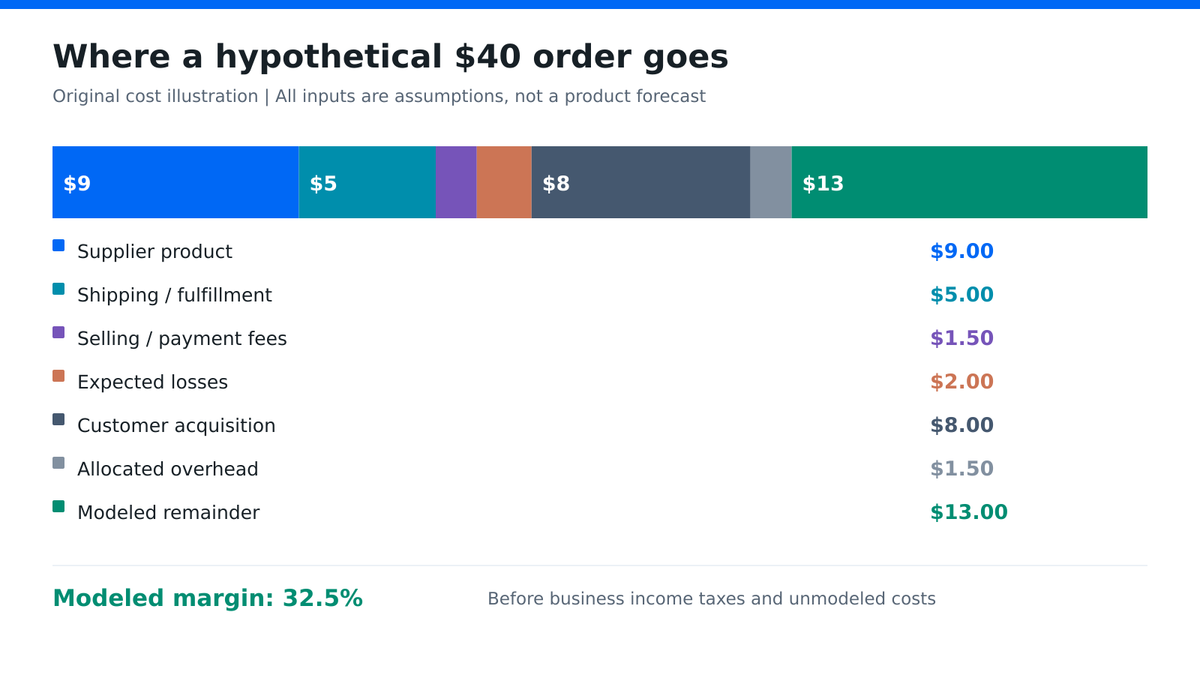
Consider a hypothetical $40 sale with free shipping to the customer. Assume the following costs are all in US dollars, with no collected sales tax included in the $40. The payment and selling fee is an assumed dollar total, not a quoted platform rate.
Worked costs, in text
Selling revenue: $40.00.
Supplier product cost: $9.00.
Shipping and fulfillment: $5.00.
Payment and selling fees: $1.50.
Expected refund/replacement loss: $2.00.
Customer acquisition cost: $8.00.
Allocated subscriptions and overhead: $1.50.
Modeled profit after these costs: $13.00.
The costs total $27. The modeled margin is $13 / $40 x 100 = 32.5%. Before shipping and the other deductions, the product-price spread was $31. That larger figure is not the amount you can keep.
Original hypothetical cost breakdown in USD; not a dashboard screenshot or product forecast.
Refunds need careful handling. Estimate the economic loss per affected order, including refunded revenue, unrecovered stock, reverse shipping, replacement costs, and retained fees, less recoveries. Multiply by the expected affected-order rate. Do not also subtract the same refunded revenue elsewhere: use one consistent model. The $2 reserve here represents the resulting expected additional loss per original order.
For overhead, divide a realistic monthly expense total by the order volume you are testing. A $150 monthly overhead budget spread over 100 orders adds $1.50 per order; at 50 orders it adds $3. Recalculate when volume changes, rather than treating overhead as permanently fixed per sale.
Keep fee assumptions current. Shopify's payment-fee documentation notes that rates vary with plan and market and that third-party providers can introduce additional fees. Enter your actual processor and platform charges, including their applicable fee base.
5. Use Drilify to test break-even acquisition cost
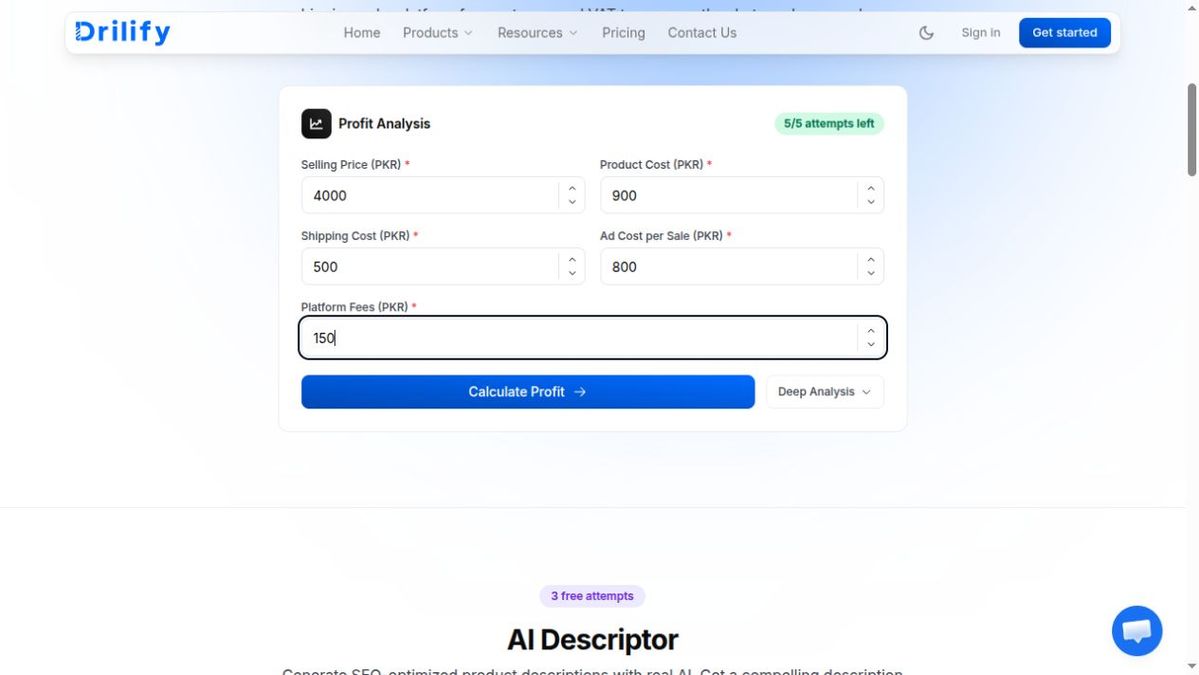
Open the Drilify Margin Calculator for an initial check. Its public form shows selling price, product cost, shipping, ad cost per sale, and platform fees. Use one currency throughout and confirm the currency label shown in your session.
Actual Drilify public calculator, captured October 8, 2026. Illustrative PKR inputs; this article's worked calculation uses USD.
For the complete decision, review the assumptions in Drilify's dashboard Profitability Calculator. The inspected workflow includes product and selling price, shipping, advertising models, platform and fulfillment fees, return assumptions, and overhead. Its results include projected profit per sale and margin, break-even CPA and ROAS, fee breakdown, sensitivity, and what-if scenarios. Access depends on your plan.
Follow this sequence in the calculator:
Select the relevant platform, market, and fulfillment setup where available; check every preset against current terms.
Enter the intended selling price, exact supplier cost, and destination-specific shipping amount.
Enter advertising assumptions and review fees, returns, chargebacks, and overhead. Defaults are assumptions to validate.
Read projected profit per sale alongside margin, then inspect break-even acquisition cost and the detailed deductions.
Change one uncertain input at a time, then test a combined adverse scenario.
In the $40 walkthrough, all modeled non-ad costs total $19. The break-even CPA is therefore $21: you can spend $21 acquiring one order before the modeled remainder becomes zero. With an assumed $8 CPA, the remainder is $13.
Your target should sit below break-even. If you want to retain $8 per order under these assumptions, your maximum CPA is $21 - $8 = $13. That is a testing limit for this model, not a forecast of the CPA an advertising platform will deliver.
Using the same $40 revenue base, break-even ROAS = $40 / $21 = approximately 1.90x. ROAS compares attributed revenue with advertising spend; it does not subtract the other costs. Make sure the revenue definition and attribution period in your ad reporting match the model before comparing them.
Drilify's go, pause, or avoid verdict is a prompt to inspect the economics. A green result does not verify your product quality, market demand, attribution accuracy, or profit. If the pre-ad remainder is zero or negative, there is no positive acquisition budget to work with under those assumptions.
Pro tip: Choose the profit you need to retain first. Spend below the CPA that preserves it, rather than treating break-even as an advertising target.
6. Stress-test dropshipping products with high profit margin
A product should be evaluated across plausible conditions, not just one attractive baseline. Your estimate of acquisition cost might be wrong, shipping could rise, or a price test could require a discount. Change the inputs before paying for that lesson through a larger launch.
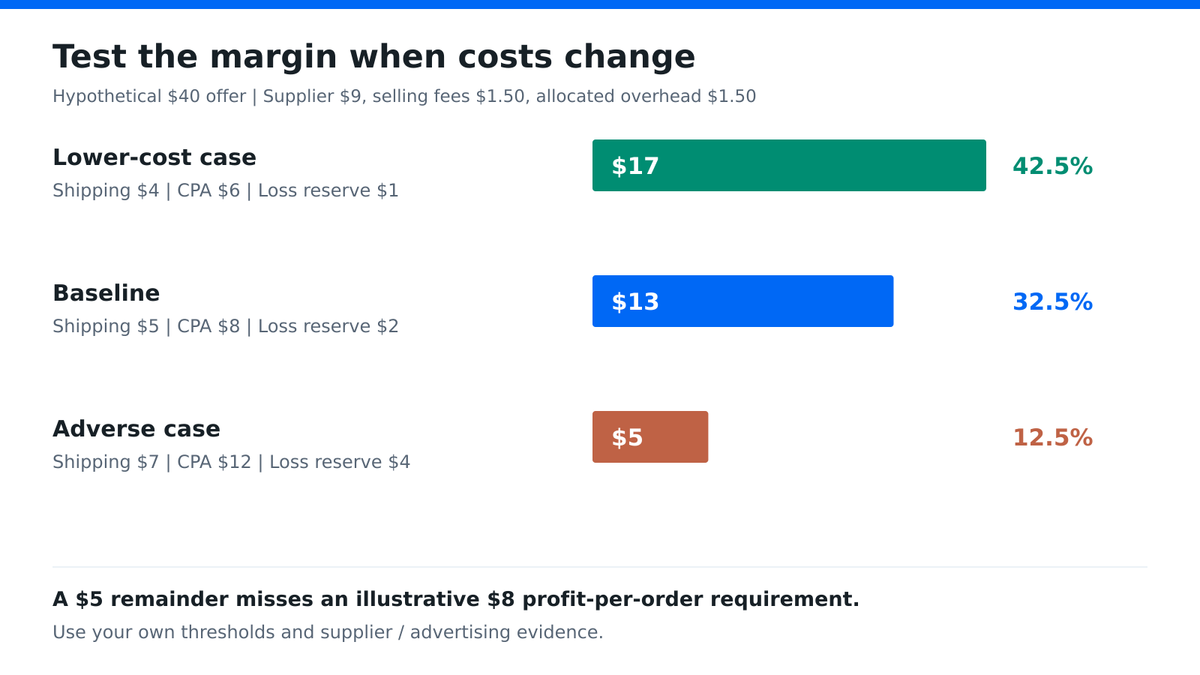
Here are three hypothetical cases for the same $40 offer. Supplier cost stays $9, selling fees $1.50, and allocated overhead $1.50. Only the stated shipping, acquisition, and loss-reserve assumptions change.
Original hypothetical scenarios. Change your own costs and thresholds before spending.
The adverse case misses the illustrative $8 profit requirement. That tells you which assumptions need stronger evidence or improvement before expanding the test. It does not prove the product must fail; it identifies the economic conditions under which it stops meeting your goal.
Also test a discount separately. Dropping the baseline selling price from $40 to $36 reduces the remainder from $13 to $9 if you temporarily hold the dollar costs unchanged. In a real recalculation, percentage fees and other price-linked costs must change too. The discount is not simply a marketing decision: it changes how much acquisition cost you can absorb.
Use Drilify's sensitivity view to find the inputs with the largest effect. A small supplier saving might matter less than a meaningful change in CPA or delivery cost. Test bundle quantities, packaging, and supplier routes as separate offers, with their own revenue and cost assumptions. Avoid applying a one-unit margin to a heavier bundle without a new shipping quote.
7. Check the evidence behind demand, competition, and returns
Bring the economics back to the product research. In Drilify Sales Tracker, available today, yesterday, seven-day, and thirty-day sales or revenue fields, growth, price history, and update time can help distinguish sustained activity from a short spike. Review the period and freshness of each signal.
In Drilify Ad Spy, Meta and TikTok views help you inspect creatives, offers, activity duration, markets, and advertiser context. A long-running ad can justify a closer look at the offer. It does not reveal the advertiser's full costs or prove that their campaign is profitable.
Advertiser Library adds ad counts, active-ad context, countries, and first- or latest-seen information where available. Use it to identify brands and creative patterns to investigate. Do not turn an absent field into a claim of no activity, or a platform score into an audited performance result.
For return risk, examine customer complaints about the exact product type. Drilify Review Intelligence can organize review evidence, recurring complaints, unmet needs, sentiment, and a decision verdict. Read the underlying reviews before treating a generated summary as a product fact. A sizing complaint, fragile part, or unclear compatibility can change both your listing requirements and your loss reserve.
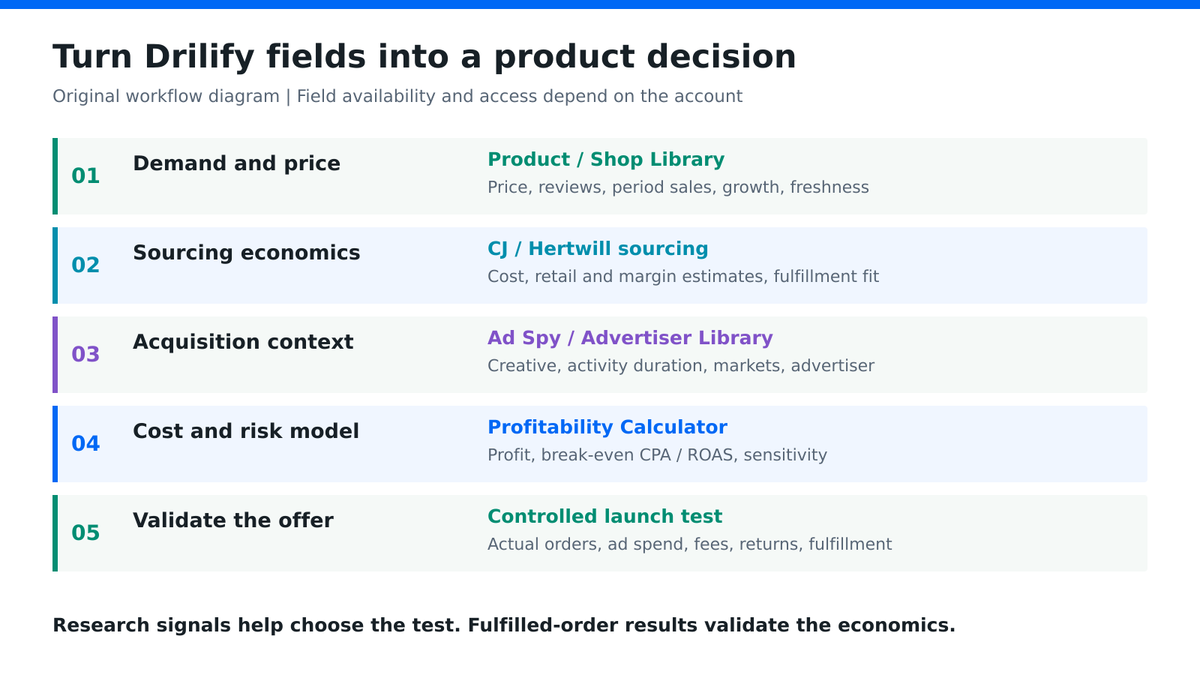
Original research-to-decision diagram using documented customer-facing Drilify fields.
Record the decision each signal supports: price ranges constrain your offer, sourcing quotes constrain cost, sales history informs demand questions, and review themes inform quality checks. None substitutes for actual customer acquisition and fulfilled-order results.
8. Run a controlled test and replace estimates with results
Choose a small test budget you can afford to lose and a clear stop rule before launching. The budget should cover samples, creative preparation, advertising, fulfillment timing, and a reserve for customer problems. Dropshipping reduces the need to hold inventory, but does not eliminate cash needs between supplier payment and payout.
Launch the exact offer you modeled. Keep the product variant, price, shipping promise, and discount policy consistent so you can interpret the results. Changing all four at once makes it harder to understand why your margin changed.
Track ad spend, attributable orders, collected revenue excluding remitted tax, supplier invoices, shipping charges, transaction fees, refunds, replacements, and customer-service issues. Calculate CPA over a defined period using a consistent attribution approach, then reconcile orders and costs with your store records.
Review completed and refunded orders as well as headline sales. Shopify's profit-report documentation explains that product-cost records, discounts, and refunds affect reported gross margin. Add the operating costs your launch decision requires before treating that report as a complete profitability measure.
Recalculate your overhead allocation at the volume you actually reached. A product can clear its per-order contribution target while total sales remain too low to cover the month's fixed costs. A handful of purchases is also too little evidence to assume a stable CPA or return rate.
Continue only when the offer meets your stated requirements with credible fulfilled-order evidence. Otherwise, change the weak input, improve the product or offer, or stop the test. Keep a dated decision record so the next shortlist benefits from what you learned.
Try the Profitability Calculator in Drilify to turn a product idea into explicit cost, price, and acquisition thresholds. Start with the public Margin Calculator, then check current plan access for the dashboard's deeper profitability tools.
Frequently asked questions
What is a good profit margin for dropshipping?
There is no universal percentage that makes an offer safe. Set a target that covers the costs you model and leaves a useful amount per order. Specify whether you mean gross, contribution, or full business net margin, and test the target under adverse shipping, acquisition, and return assumptions.
How do I find dropshipping products with high profit margin?
Shortlist products with plausible demand and a credible selling price, confirm exact sourcing and delivery costs, and calculate profit after fees, acquisition, expected losses, and overhead. Use Drilify's product, supplier, advertising, and profitability fields to investigate the assumptions, then validate them through a controlled test.
Does a high supplier markup mean high profit?
No. A high price-to-cost spread can disappear after fulfillment, ads, refunds, and operating costs. Convert the spread into a complete per-order calculation. Judge both the resulting percentage and the amount remaining, rather than selecting a product because its supplier price is low.
Can I treat Drilify's estimated retail price as my selling price?
Yes. Check comparable offers, exact variants, quality, shipping promises, and the benefit you deliver. Your attainable price comes from customer behavior.
How much can I spend on ads for one sale?
Subtract every modeled non-ad cost from your revenue to find break-even CPA. Then subtract the profit you want to retain. In this guide's hypothetical $40 order, $19 of non-ad costs leaves $21 at break-even and a $13 CPA limit if you want to retain $8.
Can I calculate margin without paying for product research?
Yes. You can do the arithmetic in a spreadsheet or use Drilify's public Margin Calculator within its displayed free-attempt allowance. Research and connected dashboard tools have separate access rules.