Top Trending Products to Sell in 2026: 10 Ideas to Validate
Explore ten 2026 product opportunities, the signals behind them, realistic test prices and margin targets, and a repeatable Drilify validation workflow.
Explore ten 2026 product opportunities, the signals behind them, realistic test prices and margin targets, and a repeatable Drilify validation workflow.
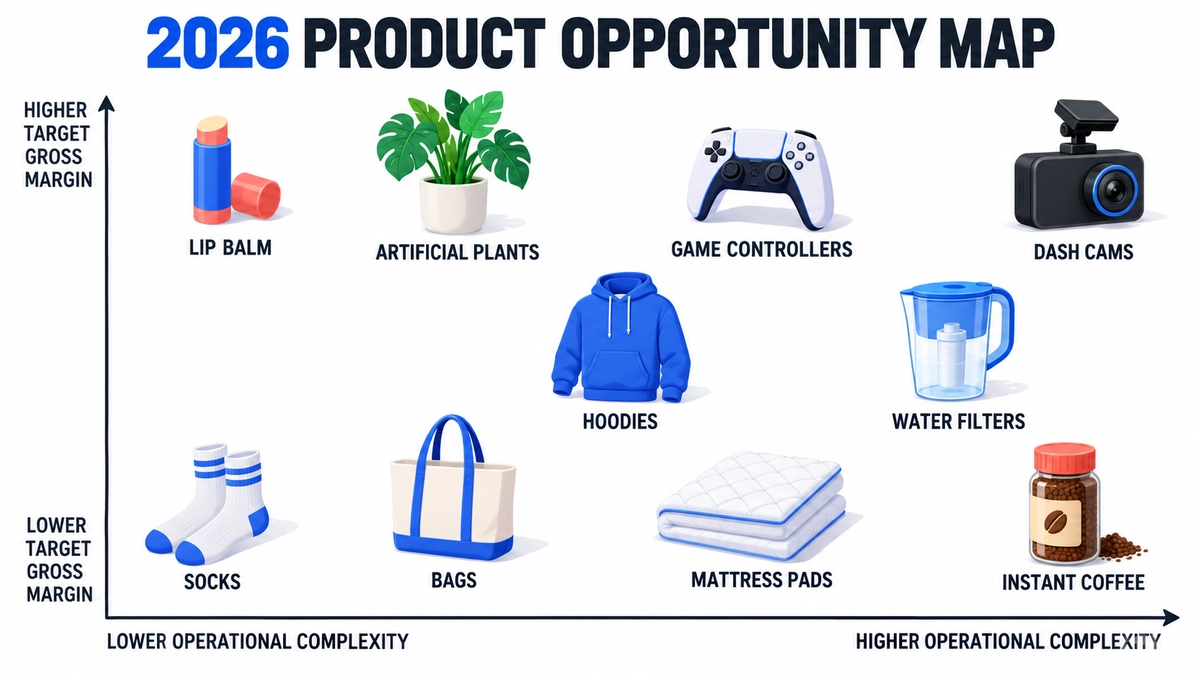
The top trending products to sell in 2026 include satchel bags, mattress pads, ankle socks, lip balms, artificial flowering plants, game controllers, hoodies, instant coffee, in-line water filters, and motor-vehicle electronics. These are opportunity signals, not guaranteed winners. Validate demand, competition, sourcing, shipping, and margin before committing inventory or ad spend.
Shopify's 2026 trend report uses sales from U.S. merchants and search-interest data to identify fast-growing categories. It reports notable year-over-year growth in several of the categories below. TikTok's 2026 trend forecast adds a useful buyer-behavior signal: audiences increasingly look for honest demonstrations, community reviews, and a clear reason to buy. Together, those sources tell you where to investigate. They do not tell you which exact SKU, audience, supplier, or offer will work for your store.
Trending products 2026: quick opportunity table
The price bands below are practical test ranges, not market averages. Gross-margin targets are calculated before advertising, subscriptions, refunds, and overhead. Supplier quotes, shipping destination, return risk, and platform fees can change the result significantly.
Satchel and crossbody bags: test price $35-$85; target gross margin 55%-70%; signal: Strong category growth and giftability; risk: Quality and style saturation.
Cooling mattress pads: test price $45-$120; target gross margin 45%-60%; signal: Sleep-comfort demand; risk: Bulky returns and claim risk.
Performance ankle socks: test price $18-$38 per bundle; target gross margin 55%-70%; signal: Repeatable apparel demand; risk: Commodity competition.
Tinted lip balms: test price $12-$28; target gross margin 60%-75%; signal: Beauty growth and demo-friendly format; risk: Cosmetic compliance.
Artificial flowering plants: test price $24-$75; target gross margin 50%-65%; signal: Home-decor demand without live-plant care; risk: Damage in transit.
LATEST POSTS
More from Drilify
Interviews, tips, guides, industry best practices, and news.
14 min read
11 Best Dropshipping Product Research Tools for 2026
Compare 11 dropshipping product research tools by workflow, current pricing, features, and limitations, including Drilify and useful free resources.
Mobile game controllers: test price $28-$80; target gross margin 40%-60%; signal: Gaming-accessory momentum; risk: Compatibility and warranty issues.
Embroidered or heavyweight hoodies: test price $45-$95; target gross margin 50%-65%; signal: Seasonal comfort and identity-led design; risk: Seasonal demand and sizing returns.
Specialty instant coffee kits: test price $22-$55; target gross margin 45%-65%; signal: Convenience and ritual appeal; risk: Food labeling and shelf life.
Certified in-line water filters: test price $35-$110; target gross margin 35%-55%; signal: Practical home-improvement demand; risk: Certification and replacement-fit claims.
Dash cams and vehicle electronics: test price $55-$180; target gross margin 30%-50%; signal: Durable vehicle-accessory interest; risk: Installation, warranty, and support.
Ten categories to investigate, with validation still required at the product, supplier, audience, and offer level.
1. Satchel and crossbody bags
Satchel bags combine a practical daily use with fashion, gifting, and creator-led styling. Shopify identified satchel bags among its fast-growing categories, making them a useful place to look for narrower opportunities such as commuter bags, compact travel bags, or organizers designed around a specific routine.
Test economics: Try a $35-$85 selling price and aim for a 55%-70% gross margin before ad spend. Compare material, hardware, strap comfort, internal organization, and package dimensions. A generic bag is easy to copy; a clear use case and distinctive construction give the offer a better reason to exist.
2. Cooling mattress pads
Mattress pads sit at the intersection of home comfort and sleep improvement. The strongest offer is not a vague promise of better sleep. It is a verifiable feature set: fabric, depth, washability, fastening method, temperature feel, and compatibility with common mattress sizes.
Test economics: A $45-$120 price can support a 45%-60% gross-margin target, but shipping and returns can erode it quickly. Confirm packed dimensions, return terms, and what the supplier can substantiate. Avoid medical or guaranteed-temperature claims unless you have appropriate evidence.
3. Performance ankle socks
Ankle socks are a simple product with repeat-purchase and bundle potential. A specific audience matters: runners may value ventilation and blister control, while travelers may care about compression, drying time, and odor management.
Test economics: Test multi-packs at $18-$38 with a 55%-70% gross-margin target. Compare fabric composition, seam placement, size range, washing durability, and bundle economics. Commodity competition is intense, so packaging, proof, and audience-specific positioning carry more weight than novelty.
4. Tinted lip balms
Lip balms are easy to demonstrate in short-form video and fit gift, beauty, and self-care content. Tinted, refillable, or fragrance-free variants can create clearer positioning than another general balm.
Test economics: A $12-$28 price and 60%-75% gross-margin target may be workable for a credible formula and presentation. Cosmetics demand stricter supplier checks: ingredients, labeling, stability, market-specific compliance, batch consistency, and claims all need review before launch.
5. Artificial flowering plants
Artificial flowering plants serve buyers who want color without maintenance. Opportunities can be organized by room, season, style, or space constraint rather than by flower name alone. Clear dimensions and honest close-up imagery matter because unrealistic texture is a common objection.
Test economics: Test $24-$75 selling prices with a 50%-65% gross-margin target. Inspect packaging, stem recovery after shipping, color accuracy, fire-safety requirements where applicable, and damage rates. Bundles can lift order value but also increase parcel size.
6. Mobile game controllers
Game controllers and related mobile accessories benefit from sustained interest in interactive entertainment. The useful niche is defined by compatibility and situation: cloud gaming, travel, retro emulation, or a particular device family.
Test economics: Test $28-$80 with a 40%-60% gross-margin target. Verify latency, supported devices, charging, app requirements, button mapping, warranty, and firmware support. Do not rely on a supplier title that says "universal." Compatibility questions can become a support and return burden.
7. Embroidered or heavyweight hoodies
Hoodies combine seasonal demand with identity-led merchandising. A store can compete through fabric weight, fit, artwork, embroidery, small-batch themes, or community relevance. The trend signal is strongest when the product also has a specific audience and a durable creative concept.
Test economics: A $45-$95 selling price can support a 50%-65% gross-margin target. Order samples to check shrinkage, color, stitching, print or embroidery quality, and size consistency. Model measurements and a useful size guide can reduce avoidable returns.
8. Specialty instant coffee kits
Instant coffee has moved beyond a purely low-cost format. Single-origin, cold-serve, travel, sampler, and ritual-focused kits can create an experience that is easy to explain and replenish.
Test economics: Test $22-$55 bundles with a 45%-65% gross-margin target. Food products require careful supplier, labeling, allergen, shelf-life, storage, and import checks. Treat subscription potential as a hypothesis until repeat purchase is measured.
9. Certified in-line water filters
In-line filters solve a practical replacement problem and can produce repeat demand, but fit and certification are central. The opportunity is strongest when the seller can make compatibility and replacement timing easier to understand.
Test economics: A $35-$110 selling price may support a 35%-55% gross-margin target. Verify certifications, contaminant-reduction claims, flow rate, capacity, fittings, installation requirements, and replacement schedule. Avoid broad health claims and do not imply a filter removes substances outside its documented standard.
10. Dash cams and motor-vehicle electronics
Vehicle electronics remain a broad commerce category because drivers upgrade safety, convenience, charging, and entertainment. Dash cams are visually demonstrable, but image quality is only one part of the offer; installation, storage, heat tolerance, app reliability, and support affect customer satisfaction.
Test economics: Test $55-$180 with a 30%-50% gross-margin target. Electronics often need more room for warranty claims, replacements, and support. Confirm regional regulations, power requirements, included accessories, update policy, and the exact recording specifications.
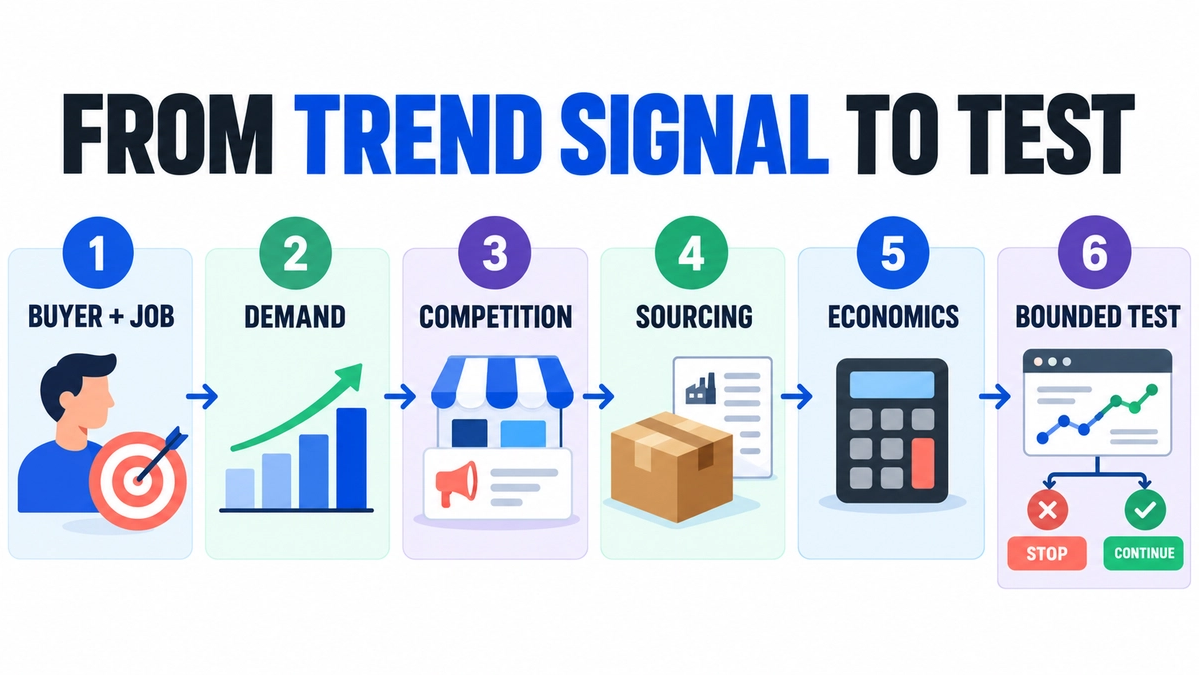
A repeatable validation workflow turns a trend signal into a bounded, evidence-led product test.
How to validate a trending product before you sell it
Use the same workflow for every candidate so excitement does not replace evidence.
1. Define the buyer and job
Write one sentence: "This product helps [specific buyer] do [specific job] in [specific situation]." A broad product becomes testable when the customer and use case are clear.
2. Check recent demand and momentum
In Drilify's Product Library, compare recent sales or revenue signals, price, ratings, reviews, seller, category, and store context where available. Trending views help narrow a larger library toward products with stronger recent activity. Estimates remain estimates, so confirm the pattern with another source and check data freshness.
3. Inspect stores, ads, and customer evidence
Use Shop Library and Sales Tracker to examine store momentum, price movement, and recent performance signals. Review Meta and TikTok creative in Ad Spy, then inspect advertiser activity in Advertiser Library. Long-running ads and repeated creative themes can justify deeper research; they do not prove profit.
4. Compare sourcing and fulfillment
Collect real quotes and compare landed cost, estimated retail price, indicative margin, competition, shipping, destination, supplier terms, and delivery windows. Order a sample before making claims or scaling spend.
5. Stress-test the unit economics
Use Drilify's Profitability Calculator to model product cost, selling price, shipping, fees, returns, advertising, and overhead. Review net margin, break-even acquisition cost, break-even return on ad spend, and pessimistic, baseline, and optimistic scenarios. A high gross margin can still become a weak net margin.
6. Run a bounded test and set stop rules
Create one clear offer, two or three original creative angles, and a limited testing budget. Decide in advance what would make you continue, revise, or stop. Track conversion, acquisition cost, refund reasons, delivery experience, and support questions-not views alone.
Quarterly refresh rule: Recheck this list every three months. Replace products whose demand, economics, supply, compliance, or creative evidence has weakened. Rename the article for 2027 only after the data and examples have been refreshed.
What makes a trend useful instead of risky?
A useful trend has more than attention. It has a defined buyer, repeated evidence across sources, a credible supplier, manageable fulfillment, compliant claims, room for customer acquisition, and an offer that can be differentiated. The more of those elements you can verify before launch, the less you depend on luck.
Drilify brings product, store, sales, ad, sourcing, and profitability signals into one research workflow. Start with the evidence available in the Product Library, then move a promising idea through competition, sourcing, economics, and a small market test.
Current signals point to categories such as satchel bags, mattress pads, ankle socks, lip balms, artificial flowering plants, gaming accessories, hoodies, instant coffee, water filters, and vehicle electronics. A category trend does not validate every product inside it.
Are trending products guaranteed to sell?
No. Trend reports show attention or sales movement across a category. Your exact product still needs demand, competition, supplier, shipping, compliance, margin, and offer validation.
What profit margin should I target?
Use the product-specific ranges in this guide as screening targets, not promises. Calculate gross and net margin with your actual landed cost, fees, expected returns, advertising, subscriptions, and overhead.
How do I find trending products in Drilify?
Use Product Library and Trending to shortlist candidates, then inspect store and sales signals, ads and advertisers, sourcing economics, and the Profitability Calculator before testing an offer.
How often should I update a trending-products list?
Review it at least quarterly. Seasonal categories may need monthly checks. Update the products, evidence date, price assumptions, risk notes, internal links, and year in the title together.
Should I choose a fad or an evergreen product?
An evergreen need with a rising format is often easier to build around than a short-lived fad. Whichever you choose, match inventory, campaign timing, and testing budget to the likely life of the demand.