How to Find Winning Products for Dropshipping in 2026
Finding a winning dropshipping product is not about copying a viral item. This step-by-step process shows how to combine demand, competition, ad, store, sales, supplier, and margin evidence before you test.
Finding a winning dropshipping product is not about copying a viral item. This step-by-step process shows how to combine demand, competition, ad, store, sales, supplier, and margin evidence before you test.
A winning dropshipping product is not simply an item with a viral video, a high sales estimate, or an attractive supplier price. It is a product that attracts a specific buyer, solves a visible problem or creates a strong desire, can be sourced and delivered reliably, leaves enough margin after operating costs, and still gives you room to build a better offer.
That definition matters in 2026 because sellers can see more research data than ever. More data does not automatically produce better decisions. The useful skill is knowing which signals support one another, which numbers are estimates, and what would disqualify a product before you spend on samples, creative, or advertising.
This guide gives you a repeatable process for finding and validating winning products. It uses Drilify to show how product, store, advertising, sales, supplier, profitability, and listing data can fit into one workflow. You can apply the same decision logic even if your first test begins with a smaller toolset.
What makes a product worth testing?
Before opening a product library, define what "winning" means for your store. A useful candidate usually has several of these qualities:
Clear buyer and use case: You can identify who wants it, what problem it solves, and why the buyer would act now.
Demonstrable value: The benefit can be shown quickly in an image or short video.
Demand evidence: Sales, reviews, advertising activity, search behavior, or competitor growth point in the same direction.
Manageable competition: Other sellers validate the market, but the offer is not reduced to an identical price war.
Pricing room: Supplier cost, shipping, fees, returns, and customer acquisition still leave a workable margin.
LATEST POSTS
More from Drilify
Interviews, tips, guides, industry best practices, and news.
14 min read
11 Best Dropshipping Product Research Tools for 2026
Compare 11 dropshipping product research tools by workflow, current pricing, features, and limitations, including Drilify and useful free resources.
Operational fit: The item is not unusually fragile, regulated, oversized, difficult to explain, or likely to create avoidable returns.
Offer potential: You can improve the bundle, positioning, audience, creative, guarantee, delivery experience, or listing.
No single signal proves that a product will win. The objective is to build a compact evidence file, then decide whether the product deserves a controlled test.
Step 1: Define the market and your decision rules
Start with constraints, not products. Choose a target country or region, a buyer type, a selling-price range, and the maximum operational complexity you are willing to handle.
Write down your rules before research begins. For example:
The product must sell between $30 and $80.
It must be small enough for practical parcel shipping.
It should demonstrate its benefit in under ten seconds.
It must leave room for at least a target contribution margin after expected fees and advertising.
It cannot depend on medical, safety, or performance claims you cannot support.
You must be able to explain a differentiated offer in one sentence.
These rules prevent emotional research. Without them, a polished ad or a large revenue estimate can make a weak product look irresistible.
Pro tip: Set both a target and a disqualifier for each major decision. "Good margin" is vague. "At least $18 contribution before fixed overhead, and reject below $12" produces a usable screen.
Step 2: Build a broad candidate list in Product Library
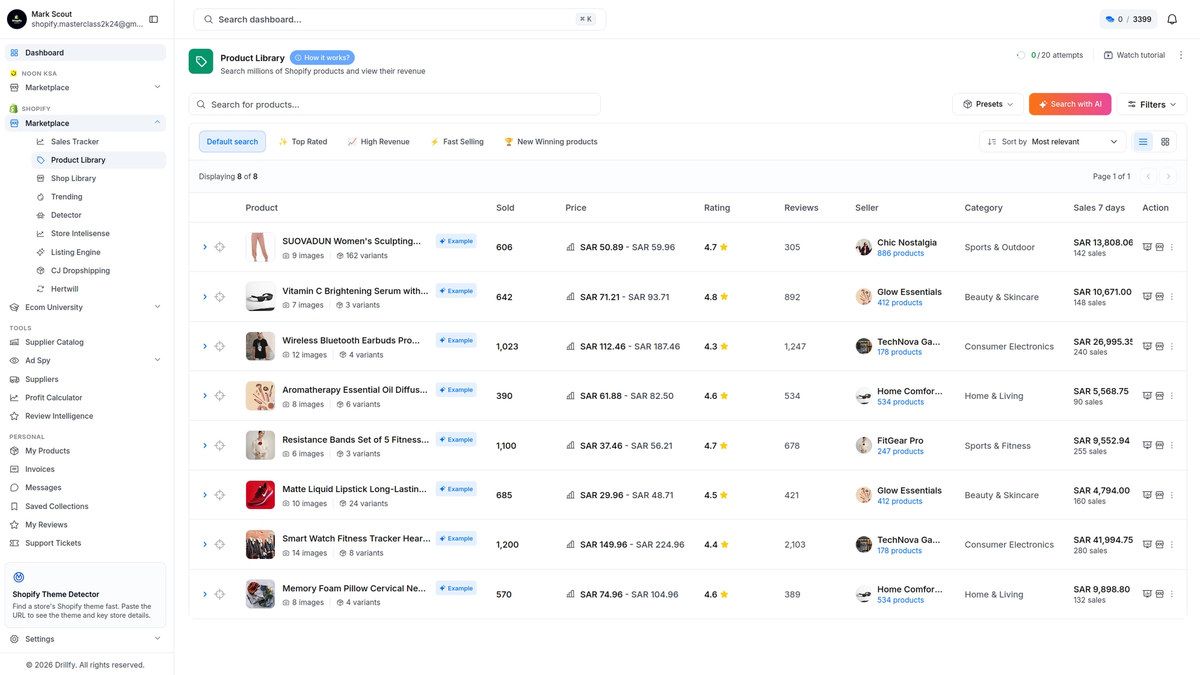
Use a product-research database to create a list of candidates before you judge any one item too deeply. In Drilify's Product Library, you can search and filter products, then compare fields such as sold count, price or price range, rating, reviews, seller, category, and recent sales or revenue where available.
Product Library helps sellers compare demand, price, rating, review, seller, category, and recent sales signals before deeper validation.
At this stage, look for combinations rather than maximum values:
healthy recent activity without an obviously exhausted offer;
enough reviews to indicate buyer interest, but not so many identical competitors that differentiation looks impossible;
a price range that can support customer acquisition and service costs;
products whose benefit can be understood visually;
adjacent products appearing across more than one seller or market;
signals that remain interesting after sorting by recency, rating, or sales momentum.
Create a shortlist of ten to twenty candidates. Record the product, audience, core benefit, observed price range, demand signal, competition concern, and your first differentiation idea.
Do not choose a winner yet. Product-library metrics are screening data, and some sales or revenue values may be estimated. Their job is to help you decide what deserves deeper research.
Pro tip: Save one reason to continue and one reason to reject beside every candidate. If you cannot articulate either, you probably have not researched the product enough.
Step 3: Verify demand through advertising activity
A product can look attractive in a catalog and still be difficult to sell. Advertising research helps you see whether brands are investing in the problem, audience, and creative angle.
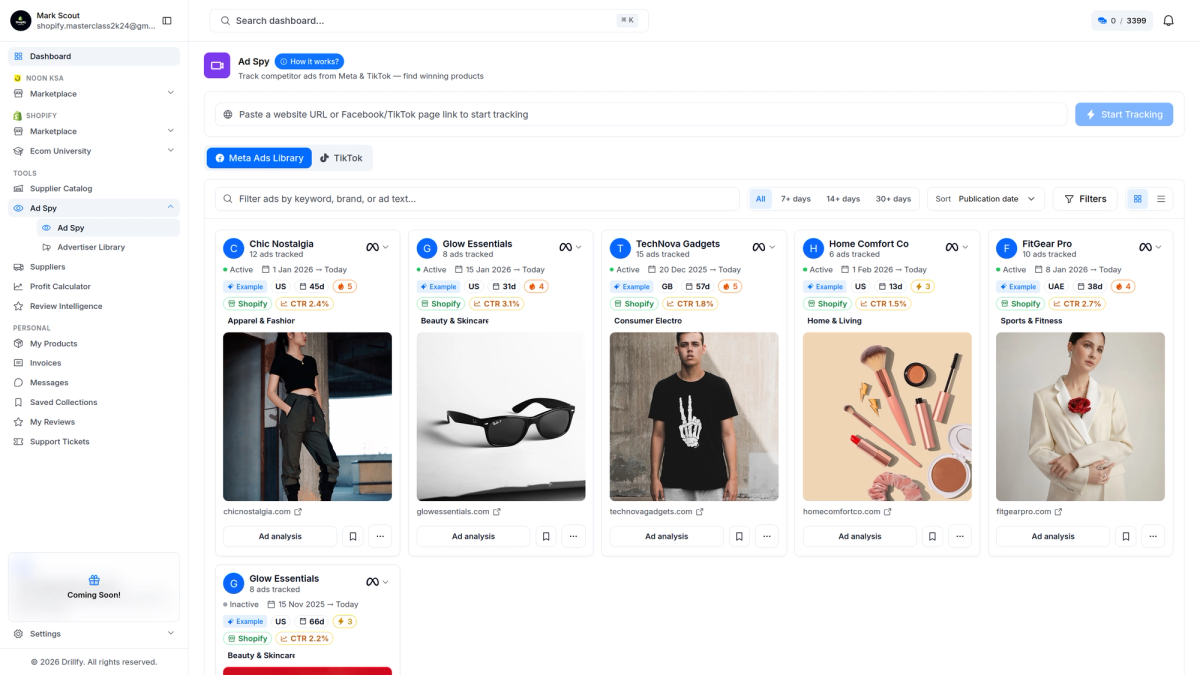
Drilify's Ad Spy provides Meta and TikTok research in separate tabs. Available cards and filters can show creative, ad copy, activity dates, days active, market, industry, advertiser context, and other signals. The Advertiser Library helps you move from an individual ad to the brand behind it.
Ad Spy connects creative research with activity duration, market, industry, advertiser, and Meta or TikTok context.
For each shortlisted product, ask:
Are multiple advertisers testing the same underlying benefit?
Have any ads remained active long enough to suggest continued investment?
Which hooks appear repeatedly across different creatives?
Are advertisers selling the product itself, a bundle, or an outcome?
Which countries and audiences appear most relevant?
Is the market built around one copied creative, or can you see several viable angles?
Longevity is more useful than novelty by itself. A brand may leave an ineffective ad active, and an ad platform does not reveal profit, but sustained activity across multiple advertisers is stronger evidence than one viral clip.
TikTok research in Drilify is surfaced through the TikTok controls in Ad Spy and Advertiser Library. You do not need a separate screen with a competitor's naming convention to investigate TikTok ads and advertisers.
Pro tip: Separate the product from the hook. A weak product can have a great video, and a strong product can be presented badly. Record the repeated customer problem, proof mechanism, objection, and offer behind each creative.
Step 4: Judge competition by quality, not seller count alone
Competition is not automatically bad. Zero competitors can mean an untouched opportunity, but it can also mean no demand. Heavy competition can confirm demand, but only if you have a credible reason for the buyer to choose your offer.
Use a three-part competition check:
Offer competition
Compare price, bundle, guarantee, delivery promise, bonuses, and positioning. Ten sellers offering the same item can still leave room for a specialized bundle or audience. Ten sellers with polished brands, fast delivery, strong reviews, and nearly identical pricing create a harder entry.
Creative competition
Review how many distinct hooks and formats appear in current ads. If every seller uses the same footage and claim, the creative market may be fatigued. If advertisers test demonstrations, comparisons, testimonials, routines, and problem-solution angles, the market may support more than one story.
Operational competition
Estimate how difficult it would be to match delivery speed, product quality, customer support, and returns. A product with simple creative but complex fulfillment may be a poor first test.
Score each category from one to five. A candidate with moderate seller competition but clear offer and creative gaps can be more attractive than a supposedly "low competition" item with no visible demand.
Step 5: Investigate the stores already selling it
Ad research tells you how products are promoted. Store research tells you how the business behind the ad is structured.
Drilify's Store Intelisense organizes competitor information such as estimated traffic and revenue, catalog activity, pricing mix, top products, geography, technology, advertising signals, keywords, and data-source coverage. The Theme Detector adds visible store and theme context.
Store Intelisense organizes competitor scale, traffic, assortment, technology, advertising, and source-coverage signals.
Use store intelligence to answer questions that a product row cannot:
Is the product a store's main offer or a small part of a broad catalog?
Does the store add products frequently or focus on a narrow assortment?
What price band and discount pattern does it use?
Which countries and traffic channels appear important?
Are there visible apps, pixels, email capture, or content strategies you should understand?
Do coverage notes support the conclusion you are drawing?
Revenue, traffic, and growth figures may be estimates. Use them as comparative signals, not audited financial results. The goal is to understand the competitor's shape and identify gaps in audience, merchandising, content, or offer design.
Pro tip: Compare at least three stores. One store can be unusual; repeated patterns reveal the category's operating norm.
Step 6: Confirm momentum in Sales Tracker
Discovery tools provide a snapshot. A tracker helps you see whether the product or store is accelerating, slowing, or changing price over time.
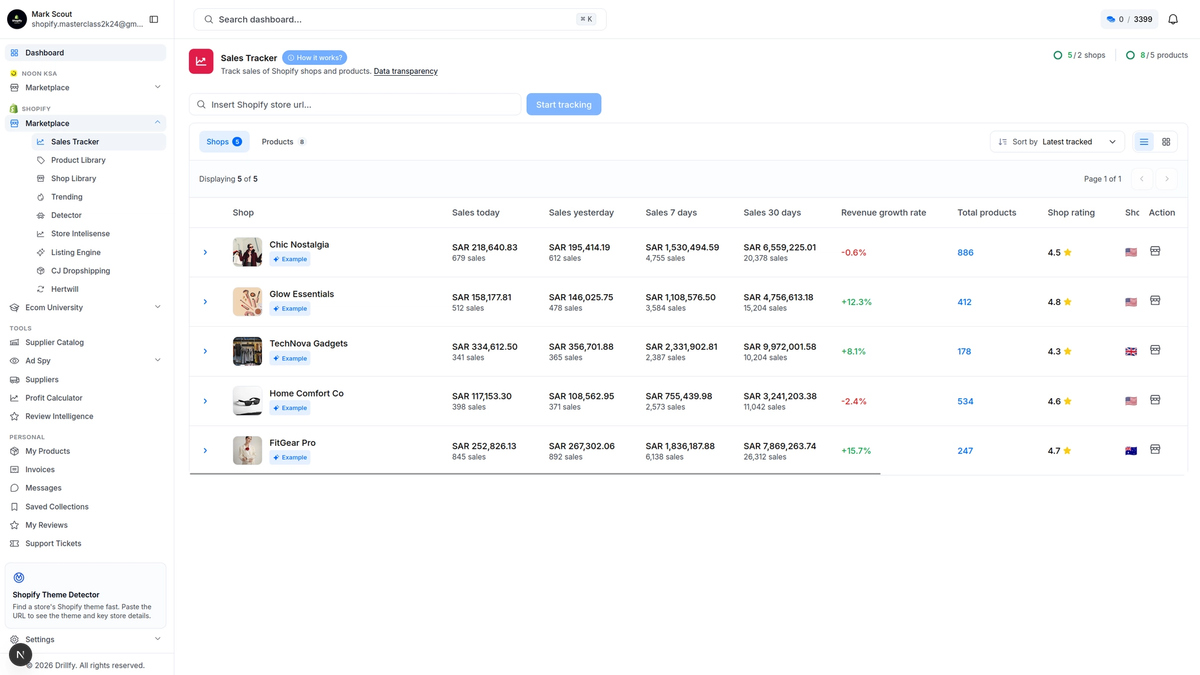
Drilify's Sales Tracker can organize today, yesterday, seven-day, and thirty-day activity, revenue growth, price history, ratings, catalog context, and update time where available.
Sales Tracker compares recent time windows, growth, price movement, store context, and update timing.
Track a small number of serious candidates rather than everything that looks interesting. Over an appropriate observation window, look for:
consistent activity rather than one isolated spike;
growth that is not explained only by a temporary discount;
price stability or a pricing change you can interpret;
more than one seller showing demand;
a relationship between ad activity and sales movement;
recent source and update information.
Tracking uses its own allowance, so save it for candidates that already passed your initial product, ad, and competition screens.
Pro tip: Momentum is a direction, not a number. Record what changed, over what period, and what else changed at the same time.
Step 7: Check supplier economics and fulfillment fit
Once a product shows demand and a possible market gap, check whether you can source it responsibly. A cheap unit cost is not enough.
In Drilify's CJ Dropshipping catalog, decision fields can include supplier cost, estimated retail price, estimated margin, competition, category, shipping type, destination, supplier context, and creation date. Hertwill provides a comparable sourcing path for its catalog and integration workflow.
Compare suppliers on:
total landed cost, not unit cost alone;
destination coverage and delivery expectations;
variants and stock availability;
supplier responsiveness and reliability;
packaging or branding options;
return and replacement practicality;
product quality and claim risk;
the margin remaining at a realistic selling price.
Estimated retail and margin fields help with screening. They are not guaranteed selling prices or realized profits. Request samples before scaling, inspect the product yourself, and verify the customer experience you intend to promise.
Step 8: Model profit before you call the product a winner
A product with demand can still lose money. Calculate unit economics with realistic inputs before you build a large creative campaign.
Drilify's Profitability Calculator can model product cost, selling price, shipping, advertising, platform and fulfillment fees, returns, overhead, and volume. Its decision outputs include net margin, profit per sale, markup, break-even CPA, break-even ROAS, ad-cost headroom, fee breakdown, sensitivity, and scenario comparisons.
Run at least three scenarios:
Pessimistic: higher acquisition cost, more returns, and lower conversion efficiency.
Baseline: your most realistic assumptions based on current evidence.
Optimistic: stronger creative and conversion, but still within a plausible range.
Pay particular attention to break-even CPA. If the product only works when advertising is nearly free, it is not a robust candidate. If a modest improvement in price, supplier cost, or bundle size creates healthy headroom, you have a useful optimization path.
Pro tip: Treat margin as a range. Your first test should reveal which assumption is wrong before you commit more budget.
Step 9: Design the offer and listing before the test
A supplier product is not an offer. Decide what the buyer receives, how it is positioned, and why it is more useful than the alternatives.
Define:
the primary audience and situation;
the problem, desire, or transformation;
the product demonstration or proof;
the core bundle and optional upsell;
the price and guarantee;
the main objection and your answer;
three creative angles for testing;
the delivery and support promise you can actually meet.
Drilify's Listing Engine can turn a product URL, supplier product, connected-store item, or image into an editable listing draft with title variants, description, bullet points, specifications, SEO fields, handle, image alt text, keyword coverage, FAQs, structured data, and indicative pricing fields.
Listing Engine moves a researched product into an editable, review-first listing workflow.
Review and edit every generated field. Match the copy to the real product, remove unsupported claims, use accurate images, and write for the customer rather than the tool.
Step 10: Run a controlled validation test
Research decides whether a product deserves a test. The market decides whether your offer works.
Set a small validation plan with a fixed budget, measurement window, and stop conditions. Test more than one creative angle, send traffic to a credible listing, and measure the whole funnel:
thumb-stop or initial engagement;
click-through rate;
landing-page engagement;
add-to-cart and checkout activity;
conversion rate;
customer acquisition cost;
contribution margin after variable costs;
refund, complaint, and delivery signals.
Do not keep spending simply because the product looked strong in research. If the test misses your threshold, diagnose the layer that failed: product, audience, creative, offer, page, price, or fulfillment.
A winning product is often a winning product-offer-audience combination. Better positioning can rescue an underdeveloped offer, but it cannot repair impossible economics or unreliable fulfillment.
A simple product-validation scorecard
Score each candidate from one to five in the following areas:
buyer and problem clarity;
visual demonstration strength;
recent demand evidence;
ad longevity and angle diversity;
competitive room;
store and market context;
sales momentum;
supplier and shipping fit;
conservative margin;
differentiation potential;
compliance and return risk;
quality of your planned test.
Add the scores, but keep hard disqualifiers separate. A high total should not override dangerous claims, poor quality, unacceptable shipping, or economics that fail your minimum threshold.
Common product-research mistakes
Copying one viral ad
Virality can reflect the creator, trend, or platform moment rather than durable product demand. Look for repeated evidence across ads, advertisers, stores, and time.
Choosing the highest sales estimate
Large sales can attract heavy competition and rising acquisition costs. Use sales as one input, then inspect market structure and your path to differentiation.
Ignoring total landed cost
Supplier price is only the beginning. Shipping, fees, advertising, refunds, replacements, apps, and service all affect the real margin.
Treating estimates as facts
Research tools help compare opportunities, but estimated sales, revenue, retail, margin, and traffic are not guarantees. Check freshness, source coverage, and assumptions.
Researching forever
The objective is not certainty. Define the evidence needed for a small test, reject weak candidates quickly, and let controlled experiments answer the remaining questions.
Frequently asked questions
How do beginners find winning products for dropshipping?
Beginners should start with a narrow market and simple decision rules, build a shortlist in a product library, verify demand through ads and stores, observe momentum, check suppliers and shipping, calculate conservative margins, and run a small controlled test. Avoid choosing solely from viral videos or supplier recommendations.
What is the best indicator of a winning product?
The strongest candidates show aligned evidence: a clear buyer problem, recent demand, sustained advertising, workable competition, reliable sourcing, healthy conservative economics, and an offer you can differentiate.
How much profit margin should a dropshipping product have?
The required margin depends on customer acquisition cost, fees, returns, shipping, support, and overhead. Model contribution margin and break-even CPA instead of relying on a fixed markup rule. Use pessimistic, baseline, and optimistic scenarios before testing.
How long should I track a product before testing it?
Track long enough to distinguish consistent momentum from a brief spike. The useful period depends on product velocity, source freshness, and your test budget. A candidate with strong evidence across several sources may justify a faster small test than one supported by a single signal.
Is high competition always bad for dropshipping?
No. Competition validates demand. It becomes a problem when sellers offer the same product, price, creative, delivery promise, and audience positioning, leaving you no credible reason to win the customer.
Can Drilify guarantee that a product will be profitable?
Drilify helps you compare demand, competition, ads, stores, sales movement, sourcing economics, margins, and listing options. Your actual results depend on product quality, offer, creative, traffic, fulfillment, market conditions, and execution.
Turn product ideas into testable decisions
The best product-research process does not promise certainty. It removes weak ideas early, makes assumptions visible, and tells you what to test next.
Use Product Library to create the shortlist, Ad Spy and Advertiser Library to understand demand and creative patterns, Store Intelisense to study the competitors, Sales Tracker to monitor movement, supplier integrations to check economics and fulfillment, Profitability Calculator to set thresholds, and Listing Engine to prepare the offer for review.
Try Product Library in Drilify and build your next shortlist from evidence, not guesswork.