How to Find Dropshipping Suppliers: A Vetting Guide for Real Orders
Find and vet dropshipping suppliers with a practical sourcing brief, six checks, comparable quote requests, landed-cost example, and test-order plan.
Find and vet dropshipping suppliers with a practical sourcing brief, six checks, comparable quote requests, landed-cost example, and test-order plan.
To find dropshipping suppliers, start with the product and customer location, then search supplier networks, manufacturers, trade directories, and referrals. Shortlist candidates that can ship the item to your market, request the same written quote from each, and place a test order before promising delivery to customers. The cheapest listing is not necessarily the best supplier.
Drilify helps turn that search into a decision. You can research products and sourcing options through its CJ Dropshipping and Hertwill integrations, then model the price and delivery costs before committing to an offer. Its supplier marketplace adds a request-and-quote path where suppliers are available, but it is in beta. This guide shows what to verify yourself at every stage.
Start with a sourcing brief, not a supplier list
A list of supplier names cannot tell you which partner fits your product, buyer, and delivery promise. Write a one-page brief before opening a directory. It should state:
The exact product and important specifications, including materials, dimensions, variants, and packaging.
The destination countries and the delivery window you intend to advertise.
Your forecast order quantity, including a small test volume rather than an assumed scale volume.
The maximum landed cost per order that still leaves room for fees, returns, advertising, and profit.
Any must-have documents or quality checks for the product category and destination market.
For example, "women's cotton tote bag" is too broad. "Unbranded 12-ounce cotton tote, reinforced handles, two colors, shipped to US customers with tracking, 20 test orders a month" gives a candidate something concrete to quote. Your customer-facing promise should come from a verified fulfillment path, not a catalog badge.
If the product itself is still uncertain, use Drilify's product research tools guide to narrow the idea first. A supplier search is more efficient when you know what you are trying to source and the selling price you need to support.
LATEST POSTS
More from Drilify
Interviews, tips, guides, industry best practices, and news.
14 min read
11 Best Dropshipping Product Research Tools for 2026
Compare 11 dropshipping product research tools by workflow, current pricing, features, and limitations, including Drilify and useful free resources.
Networks and sourcing platforms let you search product catalogs and compare candidate prices, categories, and shipping information in one place. This is a fast way to build a shortlist, but a platform listing is a lead, not proof of quality. Confirm which company fulfills the order, where stock sits, what the quoted delivery time includes, and how returns work.
Drilify's CJ Dropshipping and Hertwill integrations support product browsing and sourcing within a Shopify-focused workflow. Check the current product cost and destination-specific shipping terms with the connected provider before you make a margin claim. Availability and terms can differ by item and market.
Manufacturers and authorized distributors
If you know the product brand or manufacturer, ask whether it supports direct fulfillment or can refer you to an authorized distributor that does. This can clarify who controls stock, product documentation, and replacement parts. Do not assume a manufacturer will dropship individual orders; some work only through wholesale minimums.
Trade directories, events, and referrals
Trade associations, niche events, industry directories, and merchant referrals can surface suppliers that do not rank well for a broad Google search. Check whether a directory verifies listings, merely collects submissions, or charges for access. A paid directory can be legitimate, but its fee does not replace your own due diligence. Shopify's supplier selection guidance distinguishes supplier fees from directory fees and recommends evaluating the actual working relationship.
Local wholesalers and regional fulfillment partners
A nearby warehouse may shorten the delivery route for your target market, but geography alone is not a service guarantee. Confirm the stocked SKU, processing time, carrier, tracking, and return address. A supplier with a local office may still ship your specific item from another country.
Vet each candidate through six checks
Use the same checks for every candidate, even when one looks promising. Shopify also recommends samples, clear returns, responsive service, and test orders when selecting suppliers. The goal is not to find a perfect score on a directory; it is to gather evidence that the supplier can fulfill the offer you plan to sell.
1. Verify who you are buying from
Ask for the legal business name, business address, contact person, and an invoice in that entity's name. Compare those details with the website, payment instructions, and any registration information available in the supplier's jurisdiction. Ask whether the company manufactures, stocks, brokers, or forwards the product. These are different roles with different control over inventory and quality.
Do not treat a polished storefront, an account badge, or a high star rating as a substitute for a real contact and coherent paperwork. Reviews can be useful history, but check whether they describe the same product, market, and order size you care about.
2. Inspect the product and its claims
Request current product photos and specifications, then buy a sample to the destination market you intend to serve. Check materials, dimensions, labeling, packaging, and whether the item matches the listing. Record defects and ask how replacements would be handled. Shopify's dropshipping tips recommend samples because they reveal product quality, shipping time, and the unboxing experience.
For products with safety, labeling, or import requirements, ask for relevant documentation and verify it against the market where you will sell. Do not copy a supplier's compliance claim into your storefront without checking it.
3. Calculate the cost that reaches the customer
Compare unit price, shipping, pick-and-pack or per-order fees, payment fees, duties or taxes where applicable, and an expected allowance for returns or replacements. Ask whether prices change with order volume, currency, or destination. A low unit price can lose its advantage once delivery and handling are included.
Use Drilify's Profit Margin Calculator to test selling price, product cost, shipping, fees, and ad spend together. It gives you modeled profit and margin from your inputs; it does not validate the supplier's quote. Keep the supplier's written numbers next to the model so you can update the calculation when terms change.
4. Separate processing time from transit time
Ask how long the supplier takes to pick and dispatch a paid order, which carrier is used, when tracking is issued, and how long the shipment then takes to reach your customer. Request typical and slower-case windows for the exact SKU and destination. A delivery estimate that starts after dispatch can omit several days of processing.
During a test order, record the date you paid, the date tracking became active, the first carrier scan, and the delivery date. Repeat for more than one item or location if your store will sell broadly. Use the observed path to set a realistic store policy.
5. Put returns, stockouts, and damage in writing
Ask who pays for a lost parcel, damaged product, wrong variant, or customer return. Clarify the return window, return address, evidence required, refund timing, and whether replacements are shipped before an investigation ends. Also ask how quickly inventory updates and what happens when a product goes out of stock after your customer has ordered.
The best supplier is not simply the one that ships the first order fast. It is the one whose problem-handling process lets you give customers a clear answer when a shipment goes wrong.
6. Check communication under normal and difficult conditions
Send the same questions to each candidate and note whether the response answers the actual question, not just how quickly it arrives. Ask who handles escalation and whether support covers your selling hours. Then raise one realistic exception, such as a wrong color or late dispatch. A supplier that cannot explain the process before an order may be harder to work with after one.
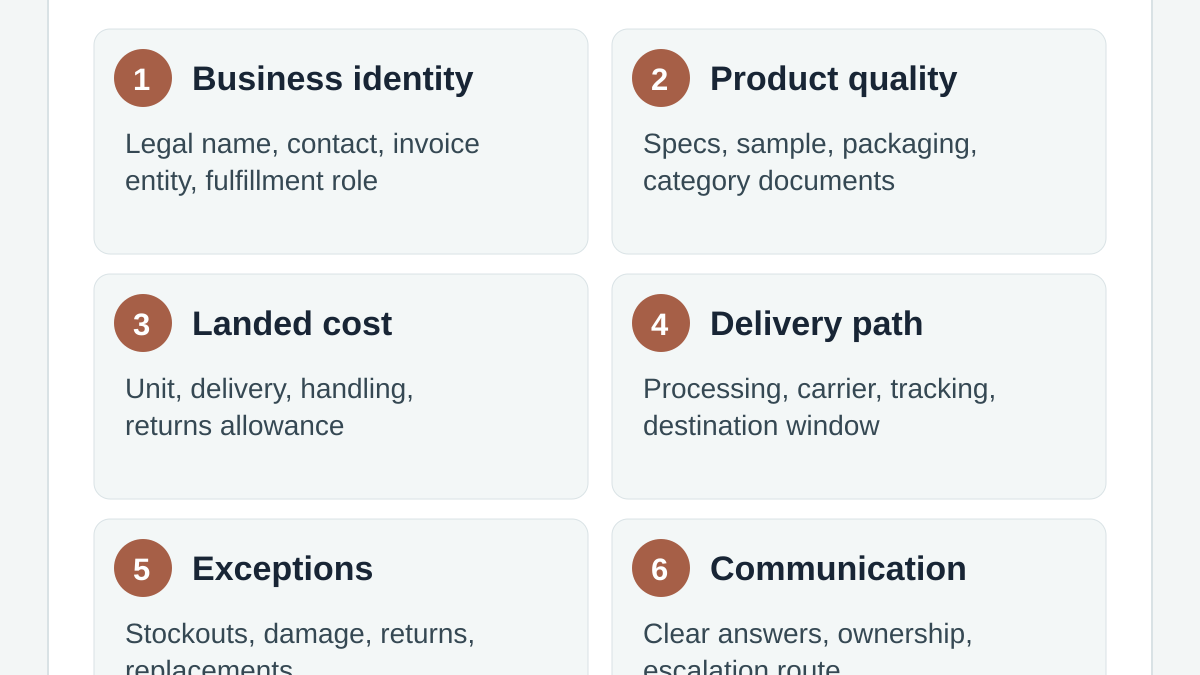
Check identity, product quality, total cost, delivery, exceptions, and communication before listing a supplier's product.
Send one quote request that makes offers comparable
A vague message such as "What is your best price?" produces quotes that cannot be compared. Send each candidate the same product specification and destination, then ask for a written response to these points:
Unit price at the test quantity and at a realistic higher quantity.
Per-order handling fee and shipping price for the destination and service level.
Stock location, available quantity, inventory-update method, and minimum order terms.
Order cutoff, processing time, carrier, tracking, and typical delivery window.
Damage, loss, return, and replacement responsibilities.
Payment terms, invoice entity, currency, and any setup or recurring fees.
Sample availability, customization options, and product documentation.
Ask the supplier to state how long the quote remains valid. If a term is missing, mark it as unknown rather than silently treating it as free or unlimited. Keep the written quote, invoice, and later order record together.
Drilify's supplier marketplace, where a supplier is available, offers a more organized request-and-quote path: a buyer can submit a product request, compare supplier responses, and move an accepted quote toward an order and invoice. It is a beta workflow, so use the same independent checks and confirm the available suppliers for your product and market. A quote card can help compare terms, but it cannot replace a sample or a real delivery test.
Compare landed cost, not headline price
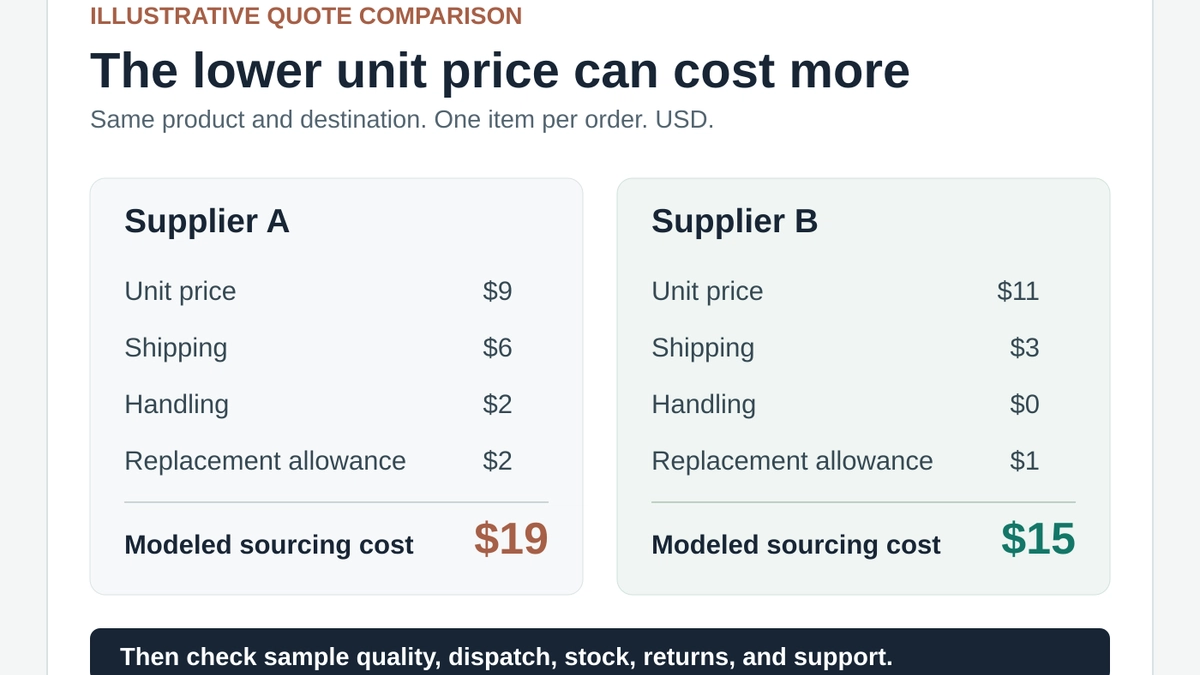
Suppose two suppliers quote the same $35 selling-price product for a US customer. Both offers are illustrative, with one unit per order and no taxes or advertising included:
Supplier B's unit price is higher, yet its modeled sourcing cost is $4 lower. That does not make B the winner automatically. Compare dispatch speed, quality of the sample, stock reliability, return process, and whether those quoted costs hold at your real order volume. If B cannot provide tracking or its stock is inconsistent, the apparent $4 advantage may disappear in support costs and refunds.
Before buying ads, add payment and store fees, expected returns, and acquisition cost to the same model. Drilify's calculator helps you test the margin with each quote. The supplier decision should improve the whole offer, not only the purchase-price line.
In this example, Supplier B's higher unit price still leads to a $4 lower modeled sourcing cost.
Run a small test before relying on the supplier
Place a sample order as a customer would, then repeat with a small set of normal orders if the first one passes. Record four things: what you ordered, what the supplier promised, what actually arrived, and how the supplier handled any difference. Do not announce a shipping promise based on a single best-case package.
Use a simple decision record: Proceed when the product, terms, and observed delivery support the intended offer; retest when a fixable issue needs evidence; reject when identity, product claims, or problem handling cannot be verified. Revisit the decision when the supplier changes stock locations, prices, carriers, or return terms.
Once you have worked with a supplier, documented reviews can add context for future decisions. Drilify supports reviews after a transaction in its supplier workflow, including feedback from both sides of the relationship. Treat reviews as one signal alongside your quote, sample, and order history, not as proof that the next order will be flawless.
Frequently asked questions
How do I find reliable dropshipping suppliers?
Define the product and delivery market first, then search sourcing networks, manufacturers, directories, and referrals. Request comparable written quotes, check business identity and policies, and place a sample order. Reliability is established through the actual product, delivery, and exception-handling record, not a directory claim alone.
Should I choose a local or overseas supplier?
Choose by the total offer, not location alone. Compare landed cost, actual stock location, processing and transit times, quality, returns, and support. A local supplier can still have slow processing, while an overseas supplier may have a predictable route for a particular destination.
Do dropshipping suppliers require a minimum order quantity?
Some do and some do not. Ask whether the minimum applies to a single order, a product variant, a monthly commitment, or a prepaid credit. Include any commitment in your cash-flow calculation before agreeing to it.
What should I ask a supplier before listing a product?
Ask for the exact SKU and specs, current stock, unit and shipping price, processing time, carrier and tracking, return and damage rules, invoice entity, and a sample. Get the answers in writing so your product page and store policy match what the supplier can actually deliver.
Is a supplier rating enough to trust them?
No. Look for reviews about comparable products and order sizes, but also check the written quote, sample, delivery test, and response to a problem. Ratings summarize past experiences; they do not guarantee your product's quality or delivery time.
Can Drilify help me compare suppliers?
Drilify helps you research sourcing options through CJ Dropshipping and Hertwill, model product economics with its Profit Margin Calculator, and compare product-request quotes in its beta supplier marketplace where suppliers are available. You still need to verify the supplier's current stock, terms, sample quality, and actual delivery.
Make the supplier choice part of the product decision
Finding a supplier is the start. Vet the company, verify the item, compare full costs and written terms, then test what customers will experience. Explore sourcing in Drilify, and use the same checklist for every candidate before you put their product and delivery promise in front of buyers.