High-Ticket Dropshipping: Margin, Returns, and Supplier Checks
Before selling a premium dropshipping product, model the full order margin, confirm returns and delivery terms, and stress-test cash exposure with Drilify.
Before selling a premium dropshipping product, model the full order margin, confirm returns and delivery terms, and stress-test cash exposure with Drilify.
High-ticket dropshipping can leave more dollars per order, but a higher price also magnifies what goes wrong. One damaged delivery, slow supplier, expensive return, or over-optimistic ad budget can erase the apparent margin. Before you list a premium product, calculate contribution after the full order cost and confirm who owns each fulfillment and return problem.
Drilify helps you narrow Shopify product candidates, inspect pricing and demand signals, compare available sourcing information, and test the economics in its Profitability Calculator. The supplier's actual shipping and return terms still need direct confirmation. This guide shows the questions to settle before your first high-ticket order.
What makes high-ticket dropshipping different?
There is no universal price that makes an item "high ticket." A $900 chair, for example, is not just a larger version of a $30 accessory. Buyers expect clear dimensions and materials, dependable delivery, responsive support, and a workable return route. The seller may face large outbound and reverse-shipping costs, a bigger supplier payment, and a longer decision cycle before a customer orders. Shopify's high-ticket dropshipping guide also highlights the greater need for trust, service, and careful supplier selection.
The key question is not "Can I sell it for a high price?" It is "Can I deliver the promise and keep enough contribution after every likely cost?" A higher selling price gives you room to build a stronger offer, but it never guarantees a healthy margin.
Calculate the margin that survives a real order
Start with contribution per order: selling price minus product cost, outbound delivery, transaction and fulfillment fees, customer acquisition, and an allowance for expected return or damage losses. Do not call the difference between retail price and supplier quote "profit." That difference has not paid to move, sell, or support the product.
LATEST POSTS
More from Drilify
Interviews, tips, guides, industry best practices, and news.
14 min read
11 Best Dropshipping Product Research Tools for 2026
Compare 11 dropshipping product research tools by workflow, current pricing, features, and limitations, including Drilify and useful free resources.
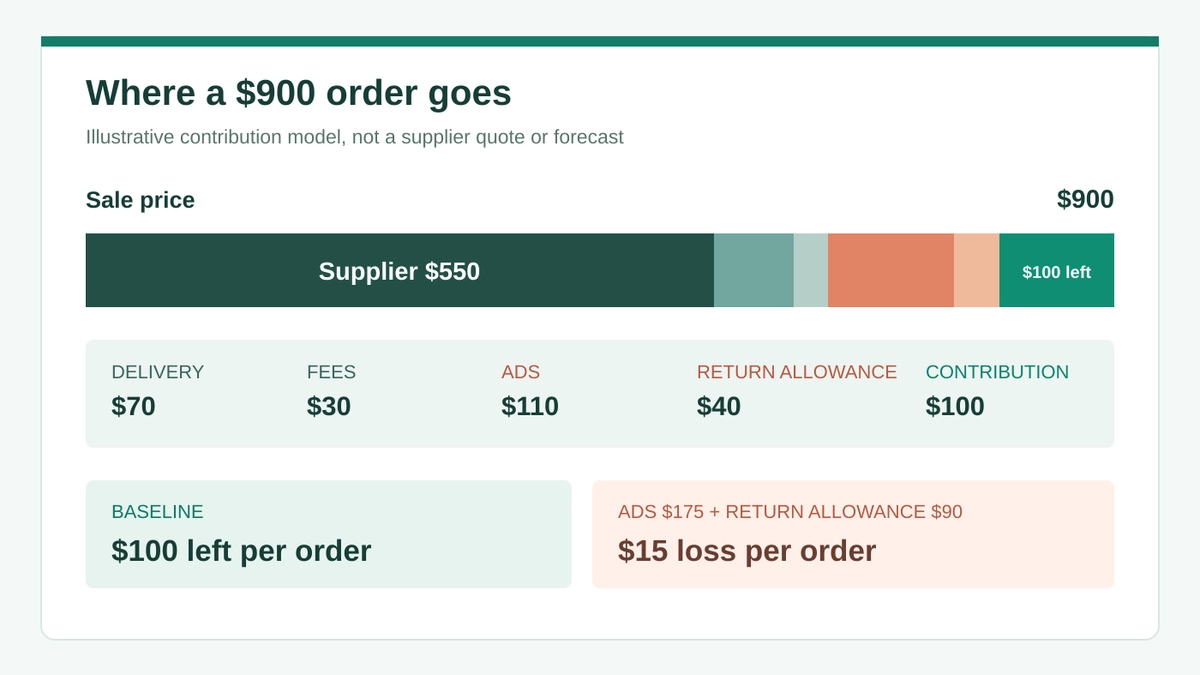
Consider an illustrative $900 chair. Suppose the supplier charges $550, outbound delivery costs $70, fees are $30, ads cost $110 per order, and you set aside $40 per order for expected return and damage losses. The remaining contribution is $100 per order, or about 11.1% of the sale price. The $40 is a planning assumption, not a published return rate or a guarantee that it will cover every claim.
Illustrative contribution model: a higher price does not protect an order from rising acquisition and return costs.
Under those assumptions, the break-even acquisition cost is $210. If acquisition rises from $110 to $175, contribution falls to $35. If return exposure also increases from $40 to $90, the same order loses $15. A premium product can therefore be attractive at one set of inputs and unattractive at a slightly worse set. Set your maximum acquisition cost before launching ads, then update the model with actual results.
Drilify's Profitability Calculator lets you enter product cost, selling price, shipping, ad cost, fees, and returns, then inspect net margin, break-even CPA, price targets, and scenario sensitivity. Use those outputs to compare possible offers. They are only as reliable as the costs and assumptions you enter.
Plan for cash exposure, not only percentage margin
If the supplier requires $550 per chair and $70 delivery, ten orders represent $6,200 in supplier and shipping commitments before your ad spend and any refunds. Your customer payout schedule and supplier payment terms may not line up. Ask when you must pay, when the supplier ships, and what happens if a cancellation or refund arrives before you recover cash. A good margin on paper is not enough if you cannot fund the order cycle or a disputed delivery.
Price the return before you publish a return policy
A high-ticket return is not just a refund button. It may require pickup, oversized packaging, inspection, restocking, replacement parts, or disposal. The person who pays for those steps determines the true cost. Get the answers in writing before listing the product:
Where does a return go? Confirm the return address, authorization process, and whether the supplier will receive the product directly.
Who pays each freight leg? Separate outbound delivery, customer return freight, damage replacement, and a failed-delivery attempt.
What condition is accepted? Confirm whether opened or assembled goods can be returned, and what inspection or restocking charge applies.
When is a credit issued? A supplier credit may arrive after you have refunded the customer. Ask how damaged and lost items are documented.
Who handles the warranty? Define responsibility for defective parts, replacements, repair, and customer communication.
Shopify's dropshipping guidance says a store's shipping and refund information must be publicly accessible and accurate. Your policy should reflect the terms you can actually fulfill, including return costs and timelines, rather than a generic template that conflicts with the supplier agreement. Requirements can vary by market, so check the rules for the places where you sell.
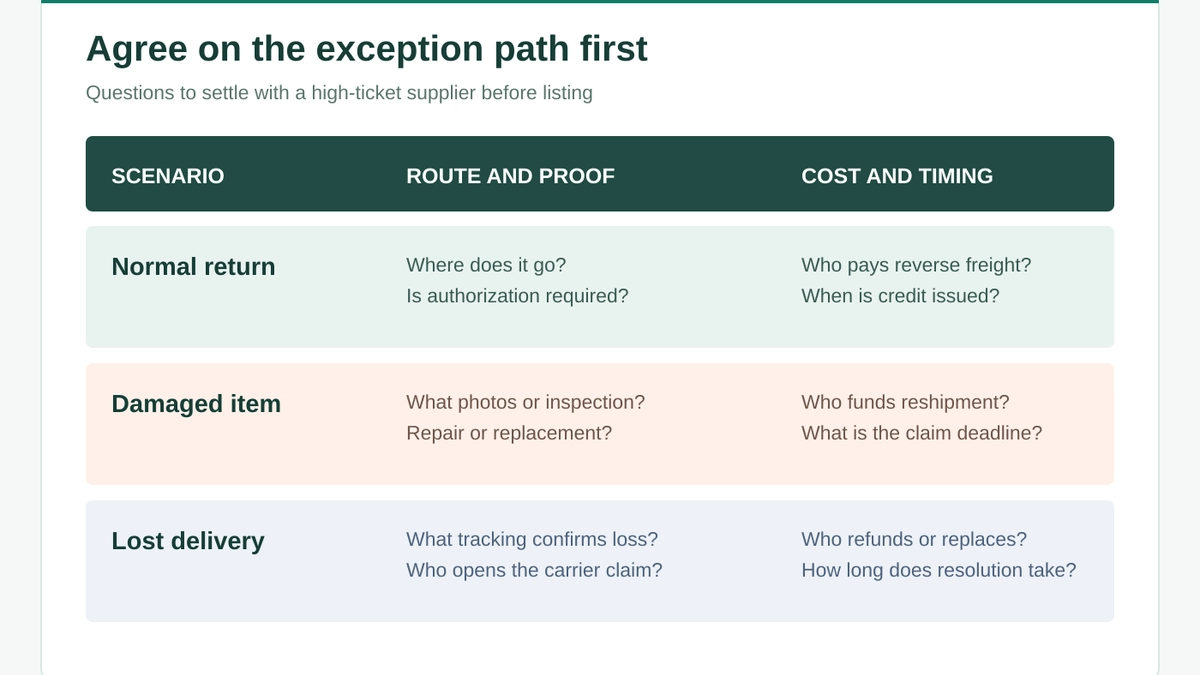
Confirm the exception path with the supplier before promising it to a customer.
The visual translates to a simple rule: agree on the route, payer, proof, and timeline for a normal return, damaged item, and lost delivery. If any of those answers are missing, pause the offer. You cannot make a confident customer promise from a supplier's product photo alone.
Vet the supplier's delivery promise
For a premium item, the product page needs more than "fast shipping." Ask the supplier for a written quote to your target destination that separates processing time from transit time. Confirm stock status, package dimensions and weight, carrier or freight service, tracking, delivery appointment requirements, and whether the customer needs to be present. For bulky goods, establish whether delivery is curbside, to a room, or includes assembly. Do not imply a service the supplier has not agreed to provide.
Request a sample when practical. It helps you inspect material quality, packaging, assembly instructions, and the actual delivery experience. Shopify's supplier selection guidance recommends checking supplier support, inventory information, and return terms. A backup supplier or replacement plan matters when one item is out of stock or arrives damaged.
Use a short supplier scorecard before you sign off: confirmed landed cost; processing and transit range; proof of stock; packaging and damage process; return address and fees; warranty owner; tracking and escalation contact. A seller should be able to answer those seven items without guessing.
Do not let a nominal margin hide delivery risk
Two suppliers may quote the same product price, while one charges substantially more to deliver a bulky item or has no workable return destination. Compare the landed offer, not only the catalog cost. Ask for a quote by destination and order size, then run both versions through your unit-economics model. The cheapest supplier line item is not necessarily the cheaper customer experience.
Find and test a candidate with Drilify
Begin with an item that has a plausible customer and a price customers already consider for that kind of purchase. In Drilify's Shopify Product Library, compare available price, sold count, rating and review count, seller, category, and recent sales or revenue signals. Use the related shop view to see whether the seller has a credible catalog and context. Some signals are estimated or may be missing, so treat them as leads for investigation, not proof of your future demand.
Next, compare the supplier side. Where a sourcing integration is connected and the product is available, Drilify can show supplier cost, estimated retail and margin, competition, and shipping destination information to help narrow the shortlist. Those are starting points. Ask for the current quote, actual package and delivery service, return handling, and warranty terms before you present the item to customers. Drilify does not make a supplier's promise on their behalf.
Finally, enter the actual quote and your own acquisition and return assumptions in the Profitability Calculator. Test the baseline, then worsen one input at a time: higher freight, higher CPA, or greater return loss. If the offer fails with a modest change in assumptions, the launch plan is fragile. Improve the price, supplier terms, or delivery model before spending more on traffic.
Use a go/no-go gate before launch
Move a high-ticket candidate into a controlled test only when these six checks pass:
Demand: The target customer and use case are specific, and product signals support further research.
Offer: The product's dimensions, materials, warranty, delivery, and support promise are clear.
Supplier: The quote, stock, processing range, tracking, and escalation contact are confirmed.
Returns: The return route, freight payer, damage process, and refund timing are agreed.
Economics: Contribution remains positive after realistic fees, ads, delivery, and return allowance.
Cash: You can fund supplier payments and a plausible refund before relying on customer payouts.
Passing these checks does not guarantee sales. It means you have removed the most avoidable surprises before you ask a customer to trust you with a larger purchase. Start with a small test, measure your actual acquisition cost and return reasons, then adjust the model before scaling.
Frequently asked questions
Is high-ticket dropshipping more profitable than low-ticket dropshipping?
Not automatically. A higher order value can create more dollars of gross profit, but ads, freight, service, and returns may also cost more. Compare contribution per order and the cash required to fulfill it, not only a percentage markup.
What price counts as high ticket?
There is no single cutoff for every category. Treat an item as high ticket when its price raises buyer expectations and makes delivery, support, returns, and supplier payment materially important to the decision. Model the actual item rather than relying on a label.
How do I estimate return risk before I have sales data?
Ask the supplier about return and damage terms, inspect a sample where practical, and create a conservative allowance for unrecovered costs. Run a worst-case scenario as well. Replace assumptions with your own observed rates as orders accumulate.
Should I use a supplier with the lowest catalog price?
Only after comparing landed cost, processing and delivery reliability, packaging, returns, warranty, and support. A lower product quote can be offset by high freight or expensive unresolved damage claims.
Can Drilify verify a high-ticket supplier's return policy?
Drilify helps with product, sourcing, and profitability research, but you should obtain the supplier's current return, damage, and warranty terms directly. Do not publish a customer promise based on an estimate or an unconfirmed listing.
What should I track during the first test?
Track conversion, acquisition cost, delivery time, customer questions, damage and returns, and contribution after actual costs. Update the model using those results before increasing spend.
Make the decision before you buy traffic
High-ticket dropshipping works only when the offer survives the full journey from supplier to customer and, when necessary, back again. Use Drilify to shortlist a credible Shopify product and stress-test its unit economics. Then confirm the supplier's delivery and return terms in writing. That sequence gives you a better basis for a small launch test than a high retail price ever could.