Best Dropshipping Software in 2026: Build a Research-to-Fulfillment Stack
Compare the best dropshipping software by job: product research, Shopify storefront, sourcing, fulfillment, and automation. Build a lean stack that works.
Compare the best dropshipping software by job: product research, Shopify storefront, sourcing, fulfillment, and automation. Build a lean stack that works.
Choosing the best dropshipping software is not a contest to find one app with the longest feature list. A seller needs to make a good product decision, put a clear offer in front of buyers, and deliver the order as promised. Those are different jobs. The strongest setup gives each job to a tool that actually does it, without paying for three apps that all show the same trending products.
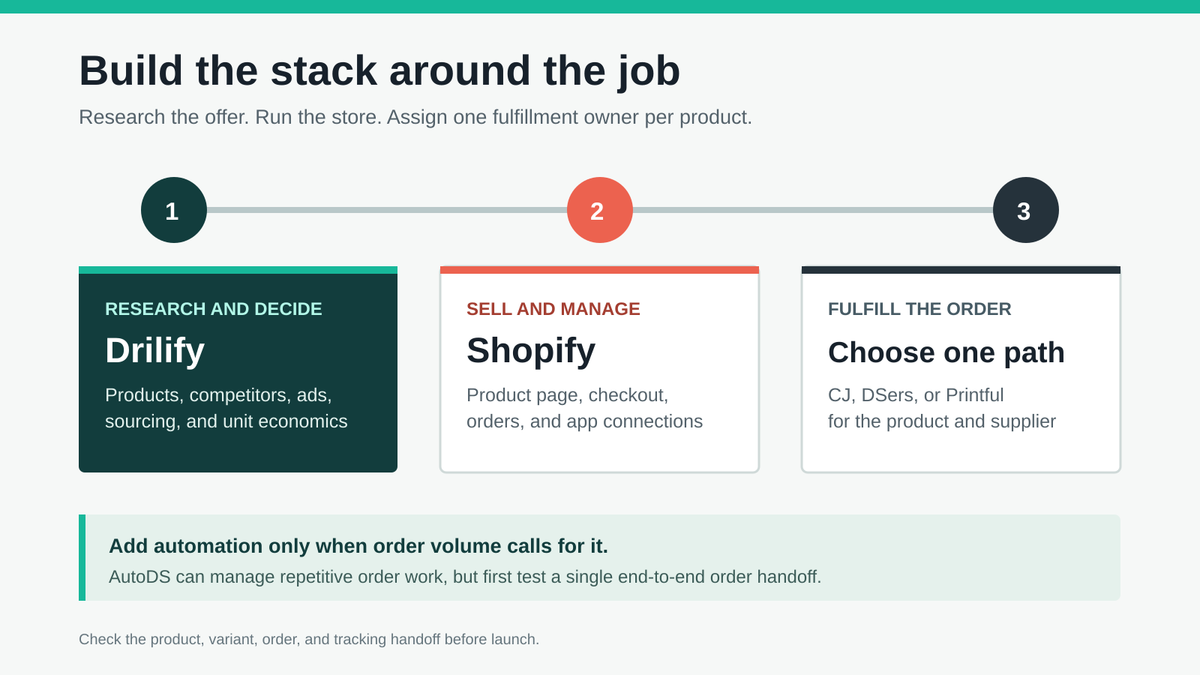
For a Shopify-led business, start with Drilify for product and competitor research, then use Shopify for the storefront and checkout. Add a sourcing or fulfillment service that matches your products: CJdropshipping for a sourced catalog, DSers for an AliExpress-led operation, or Printful for print on demand. AutoDS is worth considering when repetitive order work across suppliers becomes the bottleneck. The best stack is the smallest one that lets you test an offer, fulfill it reliably, and understand whether it makes money.
This guide compares software by its place in that workflow. It is deliberately broader than a list of product research tools: a research app cannot run your checkout, and a fulfillment app cannot tell you whether an ad angle or product margin deserves a test.
The best dropshipping software by job
Drilify - best for the research-to-decision stage. Study Shopify products and shops, examine Meta and TikTok ads, compare sourcing options, and model unit economics before you commit to an offer.
Shopify - best for running the store. Build the product page and checkout, manage orders, and connect the apps that handle supply and fulfillment.
CJdropshipping - best for sourcing and fulfilling a varied catalog. Source products, connect variants to a Shopify store, and have CJ process paid orders.
LATEST POSTS
More from Drilify
Interviews, tips, guides, industry best practices, and news.
14 min read
11 Best Dropshipping Product Research Tools for 2026
Compare 11 dropshipping product research tools by workflow, current pricing, features, and limitations, including Drilify and useful free resources.
DSers - best for AliExpress order management. Map supplier products and process AliExpress orders in batches, with plan-dependent features.
AutoDS - best for broader order automation. Import products and manage order workflows across supported suppliers, with the exact automation path depending on setup.
Printful - best for custom print-on-demand products. Design products, connect them to Shopify, and have Printful print and ship orders.
These are not six direct substitutes. You might need Drilify, Shopify, and one fulfillment partner. Add another service only when it solves a real constraint such as a new product category, supplier network, or order volume.
Choose software by the job it performs, then test each order handoff.
Quick comparison
Research and product decisions: Drilify. Storefront and checkout: Shopify. Sourcing and fulfillment: CJdropshipping for a general catalog, DSers for AliExpress-led orders, or Printful for custom products. Cross-supplier order automation: AutoDS. The overlap to watch is between supplier and automation apps, not between Drilify's research workflow and Shopify's checkout. Before installing a second order app, decide which system owns each product's inventory, order routing, and tracking updates.
1. Drilify: Make the product decision before building the store
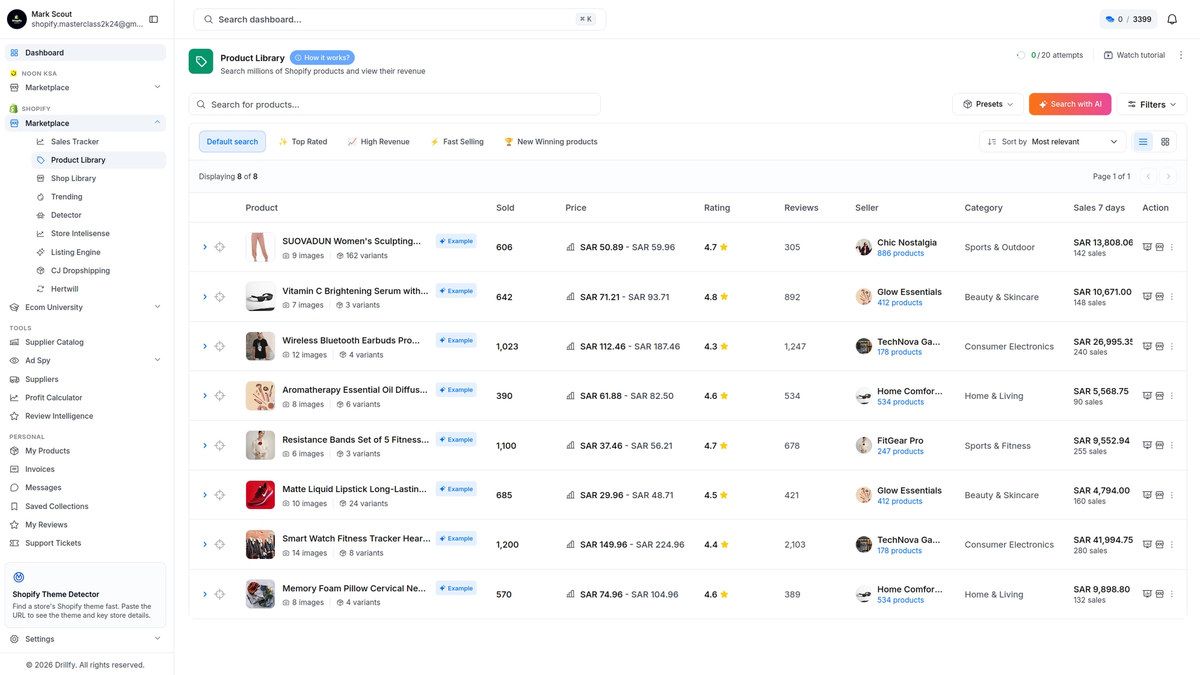
Most software lists start with an importer. That skips the expensive question: which product and offer deserve to be imported? Drilify is the strongest starting point in this stack because it connects product discovery to the decision a seller has to make. Its Shopify Product and Shop Libraries help you investigate products and competing stores. Ad Spy adds Meta and TikTok creative and advertiser context. The supplier marketplace and Profitability Calculator bring sourcing and unit economics into the same research process. You can move from an interesting product to a reasoned test plan rather than treating a viral-looking ad as proof of demand.
For example, shortlist a product in the Product Library, compare the shops and ads around it, check a supplier's offer and delivery terms, then enter the actual product, shipping, fee, and acquisition assumptions in the Profitability Calculator. The output helps you set a maximum acceptable cost per purchase and see which cost would break the margin. It is a model built from your inputs, not a guarantee of profit.
Start with a product shortlist, then compare the evidence behind each candidate.
Best for: Sellers choosing products, positioning an offer, checking competitors, and deciding whether a test has economic room to work. You can use research to evaluate an idea before connecting a store. Where another tool is needed: Drilify is not your Shopify checkout or an automatic AliExpress order-processing app. Its store connection and publishing workflow are Shopify-only. Use a dedicated fulfillment service to execute customer orders.
This distinction matters. A separate research-only database can give you more products to scroll through, while an order app can save clicks after a sale. Drilify earns its place earlier, when you need to decide what to sell, why a buyer might choose it, and whether the economics support the ad or content strategy.
2. Shopify: Run the storefront and order record
Shopify is the commerce foundation here. It provides the store, product pages, checkout, orders, and app ecosystem that a dropshipping operator builds around. It is also the only store platform Drilify currently connects to. Use Shopify to make the offer understandable: clear specifications, delivery expectations, returns information, and a product page that matches what your ads promise.
Shopify does not replace product research or a supplier. Its dropshipping app guidance separates sourcing and print-on-demand services precisely because fulfillment depends on the product and supplier. Install the partner that fits your operating model, then test the complete order path with a real sample before promising a delivery window.
Best for: A seller ready to accept orders through a Shopify store. Watch for: App sprawl. Two apps trying to manage the same SKU or order can create mismatched stock, prices, or fulfillment states. Decide which app owns each task and review its connection settings.
3. CJdropshipping: Source and fulfill a general catalog
CJdropshipping is a sourcing and fulfillment option when you want a broad catalog or need a sourcing request for a particular product. Its Shopify connection lets merchants associate store products with CJ products and bring eligible store orders into CJ for processing. CJ's help center explains that payment and product connection are part of the fulfillment flow; simply finding an item in a catalog is not the same as having it delivered.
The strongest way to use CJ is after research, not instead of it. Use Drilify to judge the product and target price, then compare the specific CJ variant, sample quality, shipping method, destination, and total landed cost. If the variant, material, or delivery promise changes, rerun the economics. A supplier quote cannot validate buyer demand for you.
Best for: Sourcing and fulfilling a varied set of products with a Shopify store. Watch for: Product-to-supplier variant mapping, sample quality, processing time, and the total delivered cost. Shipping estimates depend on the exact item and route, so do not copy a generic transit claim onto your product page.
4. DSers: Manage an AliExpress-led operation
DSers is suited to sellers who deliberately source through AliExpress. It connects with Shopify, helps map store products to supplier listings, and supports order processing. Its bulk-order guidance is useful for higher order volume, but the supplier mapping and AliExpress payment still need attention; bulk processing is not a promise that every order is hands-off.
Use DSers when AliExpress is an actual part of your supply chain, not just because a tool list calls it essential. Compare supplier consistency, variant availability, shipping route, and the landed cost against your offer. A carrier estimate alone is not a customer-ready delivery promise; include the supplier's processing time and the delivery range for your destination.
Best for: AliExpress product imports and order management. Watch for: Supplier and variant mapping, payment steps, plan-dependent bulk features, and the distance between advertised and actual delivery time. DSers helps execute the order flow; Drilify helps decide whether the product and margin warrant that flow.
5. AutoDS: Reduce repetitive order work across suppliers
AutoDS combines product imports with order management and automation options. Its Shopify order guide describes multiple fulfillment methods, including AutoDS fulfillment, auto-order, and manual processing. That flexibility is valuable when your supplier setup is broader than one AliExpress workflow, but it also means you must check which method is active for the products you sell.
Automation is useful after the product and supplier path works. Before switching on automatic order handling, place a test order, confirm the right variant and address reach the supplier, and check how stock, pricing, cancellations, and tracking are synchronized. A faster bad order is still a bad customer experience.
Best for: Sellers whose repeated import, order, and tracking work is consuming time. Watch for: Supplier-specific automation support, extra setup, and overlap with an existing fulfillment app. If CJ or DSers already owns a SKU's order flow, avoid a second app routing the same order without a clear handoff.
6. Printful: Sell custom products without holding stock
Printful fits a different catalog strategy: you design a product and it is produced after the customer orders. It connects to Shopify and can print, package, and ship synced products. Printful's Shopify guidance explains that merchants can choose automatic or manual order import, and that the product's fulfillment location must be set correctly for automatic processing.
This is a good choice when your differentiation is the design, audience, or brand rather than finding a widely available item at a lower wholesale cost. Drilify can still help you examine the market and pressure-test the selling price, but Printful is the production and fulfillment layer for the custom product. Order a sample to assess print quality and packaging before treating a mockup as the final customer experience.
Best for: Print-on-demand apparel, accessories, and other custom merchandise. Watch for: Base product cost, shipping, the sample's print quality, and whether the connected product is correctly synchronized. It is not the default fulfillment choice for every generic dropshipping product.
How to choose a stack without paying for duplicate jobs
Start with one product and follow its journey. Which system helps you choose the product? Where will the buyer check out? Who receives the order, obtains or makes the item, and ships it? Where will you check the margin after product, shipping, fees, returns allowance, and acquisition cost? If you cannot answer one of those questions, adding another catalog does not solve the gap.
A lean setup for a first Shopify test
Use Drilify to shortlist and examine a product, Shopify to present the offer, and one supplier or fulfillment partner. Choose CJ for a suitable sourced product, DSers if AliExpress is the supplier route, or Printful for a custom design. Build a one-page handoff map: the product record, supplier variant, store SKU, order recipient, tracking source, and person responsible when something fails. Only then turn on more automation.
A setup for a store with growing order volume
Keep Drilify for new-product research and periodic checks on competing offers. Keep Shopify as the order record. Review whether your fulfillment partner's current workflow is the real bottleneck. AutoDS may help when import and order management across supported suppliers are taking too much manual work; it is not automatically an upgrade for a store whose CJ or DSers process is already reliable. Test one SKU and one complete order path before changing the rest.
A setup for a custom-product brand
Research the audience and price point, build the Shopify listing, then connect Printful for the products that are actually printed on demand. Check the sample, shipping zones, and total unit cost. If you also sell sourced catalog products, give each product a clear fulfillment owner. Do not let two apps claim the same order.
The checks that matter more than a feature count
Fit to your product: A print-on-demand tool will not source a generic household product, and an AliExpress order manager will not create a custom shirt. Pick the supply model first.
A complete handoff: Confirm that a customer order reaches the right supplier with the right variant and address, then that tracking returns to the store. Run this check with a sample order before launch.
Economics after all costs: Use the Drilify Profitability Calculator with the supplier's actual product and shipping quote, payment and platform fees, a returns allowance, and a realistic acquisition-cost scenario. A low product price is not a viable offer if the delivery cost or ad spend absorbs the margin.
Customer promise: Match the product page's materials, size, dispatch time, delivery range, and returns terms to what the chosen fulfillment service can actually provide. This is especially important when the same-looking item is available from several suppliers with different specifications.
A reason to add another app: Add software when it removes a measured bottleneck. If the next tool only shows another version of the same trending list, invest that time in testing the offer or improving the product page instead.
Frequently asked questions
What is the best dropshipping software for beginners?
For a beginner using Shopify, a practical starting stack is Drilify for research and economics, Shopify for the store, and one supplier app that matches the product. CJdropshipping, DSers, and Printful serve different supply models, so there is no universal fulfillment winner. Keep the first workflow small enough that you can inspect every handoff.
Is Drilify a dropshipping fulfillment app?
No. Drilify helps with product, store, ad, supplier, and profitability research and supports Shopify-connected workflows. A separate supplier or fulfillment service executes the order and shipment. That boundary is useful: decide what to sell with evidence, then choose the operator that can deliver it.
Do I need both DSers and AutoDS?
Usually not at the start. DSers is a focused choice for an AliExpress-led operation. AutoDS offers broader import and order-management options. If both are installed, assign each SKU a single order-routing owner and test the result to avoid duplicate or missed fulfillment.
Can I use Printful with a standard dropshipping catalog?
You can have different product types in one Shopify store, but Printful is designed for products it prints on demand. Give generic sourced items their own suitable supplier and make sure product locations, order routing, and shipping rates are correct for each group.
What should I check before paying for another tool?
Name the job it will do, the job your existing tools already do, and the time or errors it should reduce. Then test its Shopify connection, sample order, tracking update, and total cost on one product. If it does not improve a real decision or handoff, it is probably not the next purchase.
The best dropshipping software stack begins with a sound product decision and ends with a customer receiving the right item. Drilify gives you a connected place to investigate the product, competitor activity, supplier options, and margin before you build the offer. Pair it with Shopify and a fulfillment service chosen for the product you actually plan to sell.