AI Dropshipping in 2026: Where AI Helps and Where You Decide
See where AI can speed up dropshipping research, listings, marketing, and operations, and which product, supplier, budget, and customer decisions remain yours.
See where AI can speed up dropshipping research, listings, marketing, and operations, and which product, supplier, budget, and customer decisions remain yours.
AI dropshipping means using AI to speed up parts of a dropshipping business, not letting a bot run an unverified store. The useful version begins with real product and customer evidence, turns that evidence into editable work, and leaves pricing, supplier promises, customer claims, and launch decisions with you. Drilify connects several of those decisions in one Shopify-focused workflow.
If you are deciding whether AI belongs in your store, the question is not "Can it automate everything?" Ask which step slows you down, what evidence the tool can see, and what you must approve before a customer sees the result. This guide maps those decisions across the full workflow.
What is AI dropshipping?
Dropshipping is a fulfillment model: you sell a product without holding that inventory yourself, and a supplier ships the order to the customer. AI is a layer of assistance around that model. It can summarize research, organize customer language, draft product copy, and surface possible improvements. It does not make a supplier reliable, make an ad profitable, or remove the seller's responsibility for the order.
The distinction matters because "AI dropshipping" is often sold as a push-button business. A generated store may look finished while its product claims, delivery estimates, margins, and return policy remain untested. Start with a small workflow you can inspect, not a promise of passive income.
The AI dropshipping decision map
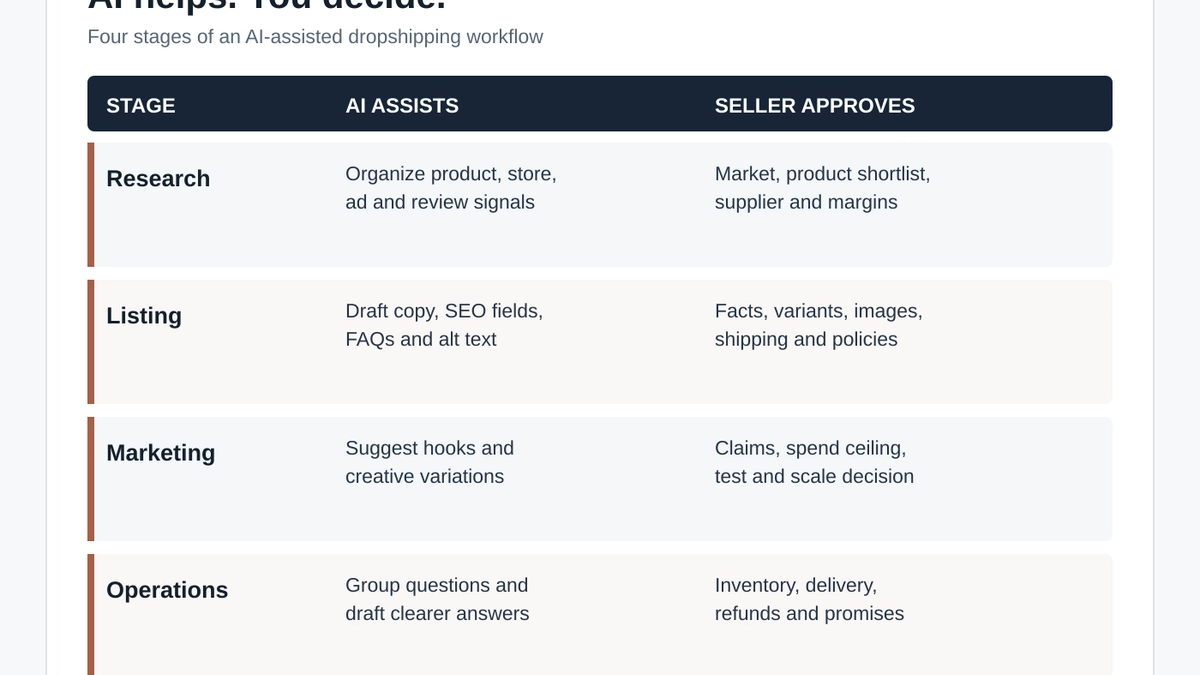
Use AI to prepare the work; keep the consequential decisions under seller approval.
The map has four stages. In research, AI can organize product, store, ad, and customer signals; you decide whether a candidate meets your market and margin criteria. In listing, AI can draft titles, descriptions, and search fields; you confirm product facts, images, variants, and policies. In marketing, AI can suggest angles and compare creative themes; you approve claims, budget, and the actual test. In operations, AI can summarize recurring questions or issues; you verify inventory, delivery, refunds, and every customer promise with the responsible supplier or store system.
LATEST POSTS
More from Drilify
Interviews, tips, guides, industry best practices, and news.
14 min read
11 Best Dropshipping Product Research Tools for 2026
Compare 11 dropshipping product research tools by workflow, current pricing, features, and limitations, including Drilify and useful free resources.
Drilify is strongest where those stages meet. Its Shopify Product and Shop Libraries help investigate product and store signals; Meta and TikTok Ad Spy shows creative and advertiser context; the AI Listing Engine prepares editable listing assets. The free profitability calculator helps you test the economics before you commit to an ad budget. Each is a decision aid, not a replacement for the underlying evidence.
1. Use AI to organize research, not manufacture demand
Begin with a customer and a use case: who is buying, what problem is the product meant to solve, and what would disqualify it? Then collect observations from more than one source. Product activity, competitor stores, ad creatives, reviews, shipping terms, and potential margins answer different questions. No single score proves that a product will sell for you.
In Drilify, start with Shopify product and store research, then inspect Meta or TikTok ads for how sellers present similar products. Look for recurring hooks, offers, and objections. Use AI to group your notes into a shortlist or highlight contradictions. You should still open the underlying product pages and creatives, check the geography, and ask whether the evidence is recent and relevant to your customer.
If you already have a candidate, write down the decision you need: "Should I test this product with a $300 budget in the US?" A summary that cannot explain shipping cost, realistic selling price, or why the ad angle might resonate is not enough. Drilify lets you carry those signals forward into the next steps instead of treating a generated product list as a verdict.
2. Check supplier and unit economics before generating copy
AI can make a product sound compelling in seconds. That speed is a liability if the supplier cannot ship the right variant on time. Verify the product sample, processing time, destination coverage, tracking, return terms, stock handling, and what happens when an item arrives damaged. Ask for a comparable quote rather than taking the lowest catalog price at face value.
Drilify's CJ Dropshipping and Hertwill sourcing integrations can help you investigate sourcing options, subject to the account connection and available catalog. Use the supplier's written terms and your own test order for the final call; a catalog listing alone does not prove fulfillment quality.
Run the numbers before building an ad. Suppose a product sells for $40. If product cost is $12, shipping is $6, payment fees are $2, and expected returns and support cost $3, the pre-ad contribution is $17. An AI-generated headline cannot change that $17 ceiling. At $20 acquisition cost, the order loses $3 before overhead. Use the Drilify profitability calculator to explore a scenario, then replace every assumed input with current quotes and your actual fee structure.
3. Draft a product listing that you can defend
Once the product is viable enough to test, AI can turn verified specifications and customer language into a first listing draft. Drilify's AI Listing Engine can prepare editable title options, benefits, descriptions, SEO fields, FAQs, image alt text, and structured product details. That saves the blank-page work while keeping the seller in control of what goes live.
Drilify's Listing Engine prepares editable listing assets that you can check against the product and supplier terms.
Review the draft in this order: the product identity and variant, measurable specifications, what is included, care or usage limits, shipping and returns, then the headline and search presentation. Remove claims you cannot substantiate. If the supplier says "up to 10 hours" but your sample only ran for six, do not quietly turn that into a universal ten-hour promise. If a product image shows an accessory that is not included, make the difference explicit.
The strongest listing is not the one with the most AI-generated adjectives. It is the one that answers the customer's actual buying questions. Drilify helps assemble those assets, and the seller decides which facts deserve to appear on the Shopify product page. Shopify is Drilify's supported store connection and publishing platform; Meta and TikTok here are ad research sources, not store integrations.
4. Turn ad research into a small, measurable test
AI can suggest hooks, headlines, scripts, and creative variations after you inspect real ads and customer objections. Drilify's Ad Spy provides Meta and TikTok creative and advertiser context that can make those prompts more specific. A long-running ad is a research lead, not proof of sales or profit. Study the promise, format, landing page, and market before adapting an idea.
Pick one product, one audience, and a few distinct creative angles. Set the maximum spend and the decision threshold in advance. For example, if the pre-ad contribution is $17, you need acquisition cost below $17 just to cover the listed variable costs, and lower still to leave room for overhead and profit. Compare actual orders, refunds, and acquisition cost with that threshold. Do not let an AI dashboard turn a small early sample into a claim that you have found a winner.
The value of Drilify here is continuity: research a product, examine competitor messaging, check the economics, and prepare listing assets without losing the reasoning between tools. You still control campaign setup and spend, and you need to verify that the offer and creative accurately represent the product.
5. Use AI for customer patterns, not automatic promises
Customer questions are useful input. AI can group repeated objections about sizing, materials, assembly, or delivery and suggest clearer FAQs or listing revisions. A review-analysis workflow can help identify patterns to investigate, but a generated summary should send you back to the original feedback before you change a claim.
For fulfillment, keep the order and supplier record as the source of truth. Before telling a buyer an item is in stock or will arrive by a particular date, check current inventory and the supplier's processing and transit terms. Before promising a refund, check your actual policy and the order's circumstances. Automation is useful for routing and drafting, but accountable customer communication needs a human-approved policy and reliable data.
This is where seller discipline becomes an advantage. A faster reply is only valuable if it is correct. Use AI to spot the top three questions you keep answering, then update the product page and support templates so the next customer receives a clearer answer before they ask.
A practical first-week AI workflow
Day one: choose a customer, market, product category, and a clear rejection rule. Day two: shortlist three products in Drilify using product, store, and ad signals. Day three: contact suppliers, request comparable quotes, and order a sample for the strongest candidate. Day four: calculate contribution and a testable acquisition-cost ceiling. Day five: use the Listing Engine to prepare an editable Shopify listing, then fact-check it against the sample and supplier terms. Day six: prepare two or three truthful creative angles informed by ad research. Day seven: decide whether to run a limited test, request more evidence, or reject the product.
This is a sequence, not a guarantee that a supplier will respond or a sample will arrive within a week. The point is to keep each AI-assisted output attached to a decision and a verification step. A product that fails the economics or supplier check should not advance just because the copy looks polished.
What should stay under your control?
Keep four approvals explicit. You approve product and supplier selection after seeing the sample and written terms. You approve prices and budgets against actual costs. You approve customer-facing product, delivery, and refund claims. You approve whether test results justify more spend. AI can prepare options and surface omissions; it should not silently change those commitments.
That division also helps you choose tools. If you need help only writing product descriptions, a focused writing tool may be enough. If you need to carry research, ad intelligence, sourcing context, economics, and listing work into one seller decision, Drilify is the more useful starting point. It does not remove the need for a store platform, supplier, advertising account, or your own verification.
Frequently asked questions
Can AI run a dropshipping business for me?
AI can assist with research summaries, listing drafts, creative ideas, and pattern detection. It cannot guarantee supplier performance, profitable ads, compliant product claims, or good customer service. Keep the commercial decisions and customer promises under your control.
Is AI dropshipping the same as automated fulfillment?
No. AI helps interpret information or draft work. Fulfillment depends on the supplier and the order systems you use. Verify inventory, processing, shipping, tracking, and returns in the real workflow before treating it as automated.
Where should a beginner start with AI dropshipping?
Start with one product decision. Define the buyer and market, investigate evidence, verify a supplier, calculate unit economics, and only then draft the listing and a small test. This is more useful than generating an entire store around an untested item.
Does Drilify build or run a Shopify store automatically?
Drilify supports Shopify-focused research and editable listing work. It does not replace Shopify or guarantee that AI-generated content is ready to publish without review. Use its product, ad, sourcing, and listing tools to prepare a better decision, then approve the store changes yourself.
Can AI tell me which product will win?
No tool can promise that. AI can compare signals and expose questions worth testing. The answer depends on your offer, supplier, audience, creative, economics, and execution. Use a small test and judge the result against a predefined threshold.
Which parts of the workflow should I never skip?
Supplier verification, a product sample when feasible, accurate product claims, a realistic contribution calculation, and a controlled test. Those checks are what keep fast AI output connected to a real customer experience.
Make AI useful by making each decision traceable
The best AI dropshipping workflow does not remove the seller. It makes research and drafting faster while leaving every consequential decision anchored to evidence. Explore Drilify to bring Shopify product and store research, Meta and TikTok ad research, sourcing context, profitability checks, and editable listing assets into one place. Start with one candidate, write down what would make you reject it, and let AI help you investigate the answer.