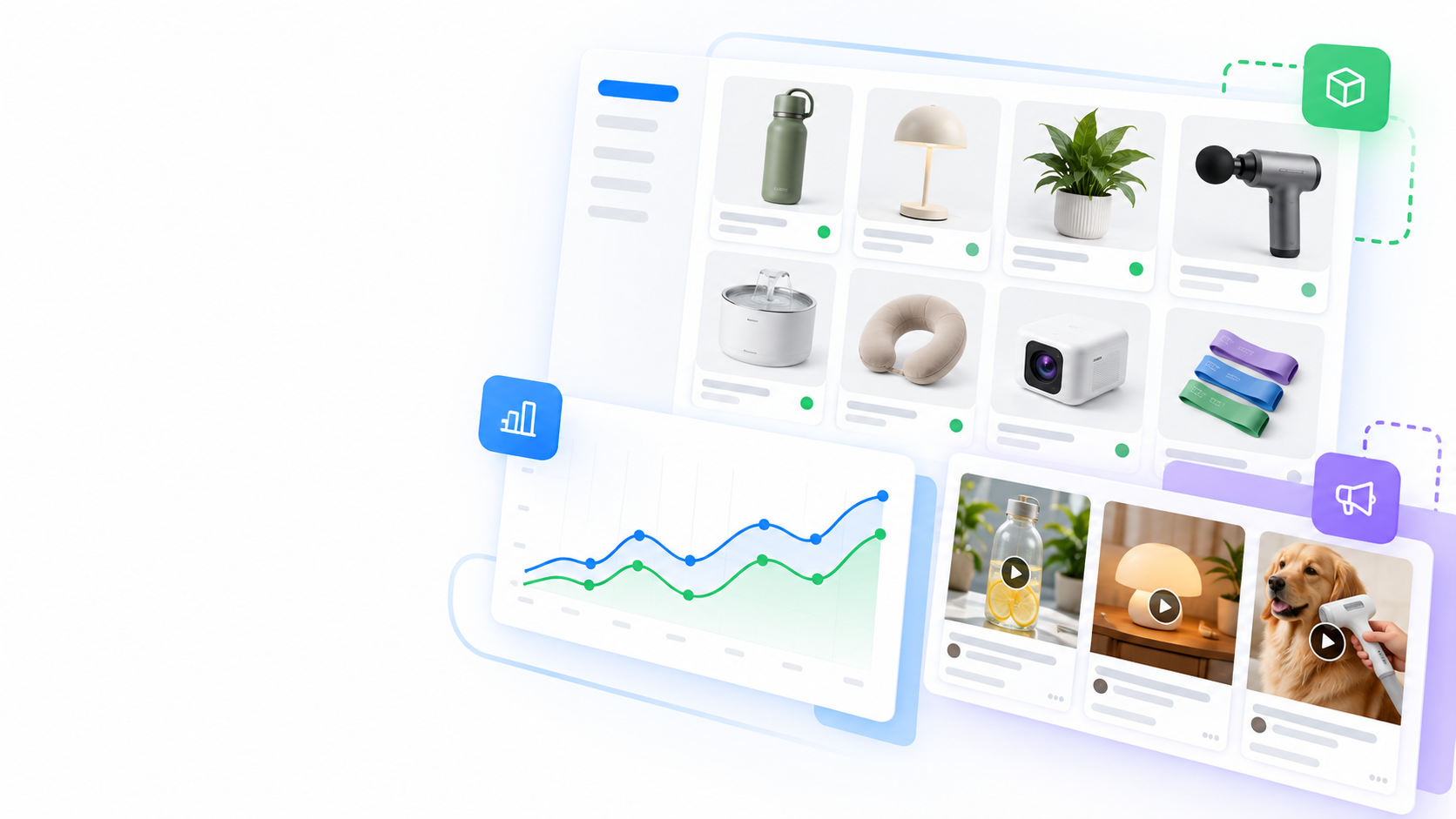
Learn how to use AI and Drilify to shortlist dropshipping products, compare real market signals, check margins, and plan a focused test.
Learn how to use AI and Drilify to shortlist dropshipping products, compare real market signals, check margins, and plan a focused test.
AI is most useful in product research when it helps you compare real evidence, not when it guesses the next bestseller. Drilify gives you a place to bring product, ad, customer, sourcing, and cost signals into one workflow. Use AI to turn those signals into a shortlist, then test the strongest candidate with a clear budget.
That approach saves time at the point where research usually fragments. You can compare product activity with ad angles, customer objections, supplier terms, and unit economics before committing to a listing or campaign. A persuasive AI summary is helpful only if the underlying numbers and claims hold up.
This guide walks through the process step by step: set your criteria, use Drilify to gather the right signals, let AI organize and challenge the evidence, and move the best-supported idea into a controlled test.
What AI should and should not do in product research
Use AI to define criteria, group signals, compare candidates, find contradictions, extract customer language, and turn research into a decision memo. These tasks reward speed and consistency while keeping the decision grounded in sources you can revisit.
Do not treat a generated product list as demand data. An active ad is worth studying, but it does not reveal the advertiser's profit. A margin estimate can help screen a candidate, but the final calculation needs your current costs.
Give each decisive claim a simple status: observed in a source, estimated from available data, inferred from several signals, or still unknown. You can then see exactly which question to answer before spending on a test.
A practical sequence for moving from a product idea to a small, evidence-backed test.
1. Define the decision before opening an AI tool
LATEST POSTS
More from Drilify
Interviews, tips, guides, industry best practices, and news.
14 min read
11 Best Dropshipping Product Research Tools for 2026
Compare 11 dropshipping product research tools by workflow, current pricing, features, and limitations, including Drilify and useful free resources.
Start by writing the decision you need to make. “Find a winning product” is too vague. A useful decision sounds like: “Choose one product to test in the United States with a retail price between $35 and $80, room for paid acquisition, manageable shipping, and a clear customer problem.”
Turn that decision into criteria. Include the target market, price range, acceptable supplier cost, desired gross margin, maximum delivery time, product size or fragility limits, seasonality tolerance, channel, and any category restrictions. Add rejection rules as well. For example, reject candidates with unclear claims, regulated-use risk, weak creative potential, or shipping costs that destroy the margin.
This gives AI a stable frame. Without it, the model tends to reward novelty or repeat whatever is common in its training data. With it, you can ask the model to score candidates against the same standard and explain which evidence is missing.
Pro tip: write your rejection rules first. A short disqualification list prevents an exciting product image from pulling the analysis away from shipping, compliance, or margin reality.
2. Build a candidate set from product evidence
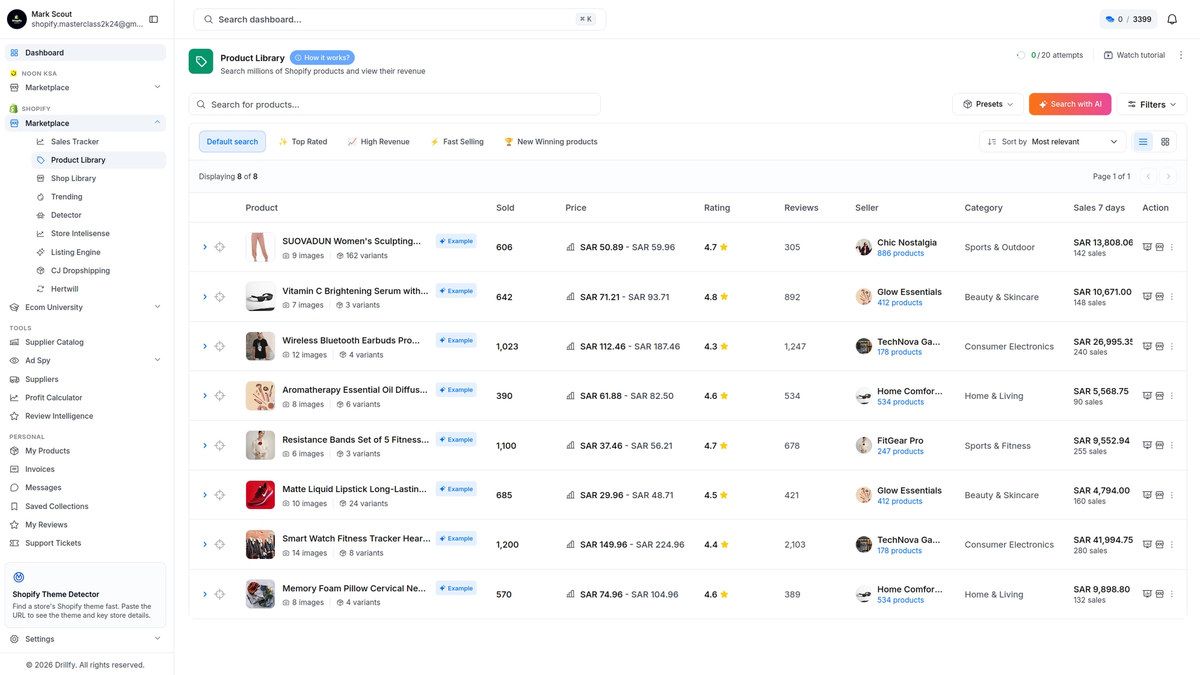
Start with Drilify's Product Library to assemble a focused candidate set. Product records can bring price, ratings, reviews, store context, category, sales or revenue signals, and freshness cues into view, so you can filter by your target market and price before asking AI to compare anything.
Filter for your business constraints instead of browsing indefinitely. A reasonable first pass might collect 10 to 20 candidates that fit the target price, market, category, and evidence requirements. Keep the source URL and the time you collected each record. If a field is marked estimated, preserve that label in your notes.
Now give AI a compact evidence sheet, not screenshots alone. Use one row per candidate with consistent fields: product, market, price, available sales signal, review count, rating, source freshness, apparent problem solved, supplier cost if known, shipping if known, and missing data. Ask the model to normalize the rows and flag incomparable fields rather than filling gaps.
Use Drilify Product Library to narrow candidates by the product signals that matter to your market.
Pro tip: do not ask AI to score a blank field as zero. Missing data means unknown. Treating unknown as poor performance can eliminate promising candidates; treating it as strong can create false confidence.
3. Ask AI to organize demand signals, not invent demand
Once the candidate set is consistent, ask AI to organize the evidence into three groups: direct observations, supporting indicators, and unanswered questions. Direct observations are things you can point to, such as a displayed price, rating, review count, ad creative, or source date. Supporting indicators combine evidence, such as repeated sales activity alongside recent reviews. Unanswered questions are the work queue.
A useful prompt is: “For each product, list the strongest demand evidence, the strongest reason for caution, and the next source needed to reduce uncertainty. Do not infer values for missing fields. Quote the supplied field name beside every conclusion.”
This is where AI helps most. It can notice that one product has stronger activity but weaker review quality, or that another has attractive pricing but no current sourcing information. It can also expose inconsistent time windows. Seven-day activity and 30-day activity should not be compared as though they are the same measurement.
Keep the shortlist to three to five candidates. That gives you enough variety to compare without spending research time on products that fail your first criteria. Drilify's product view helps you narrow the field; the next steps determine whether the leading options can make a viable offer.
4. Research ads and advertiser patterns
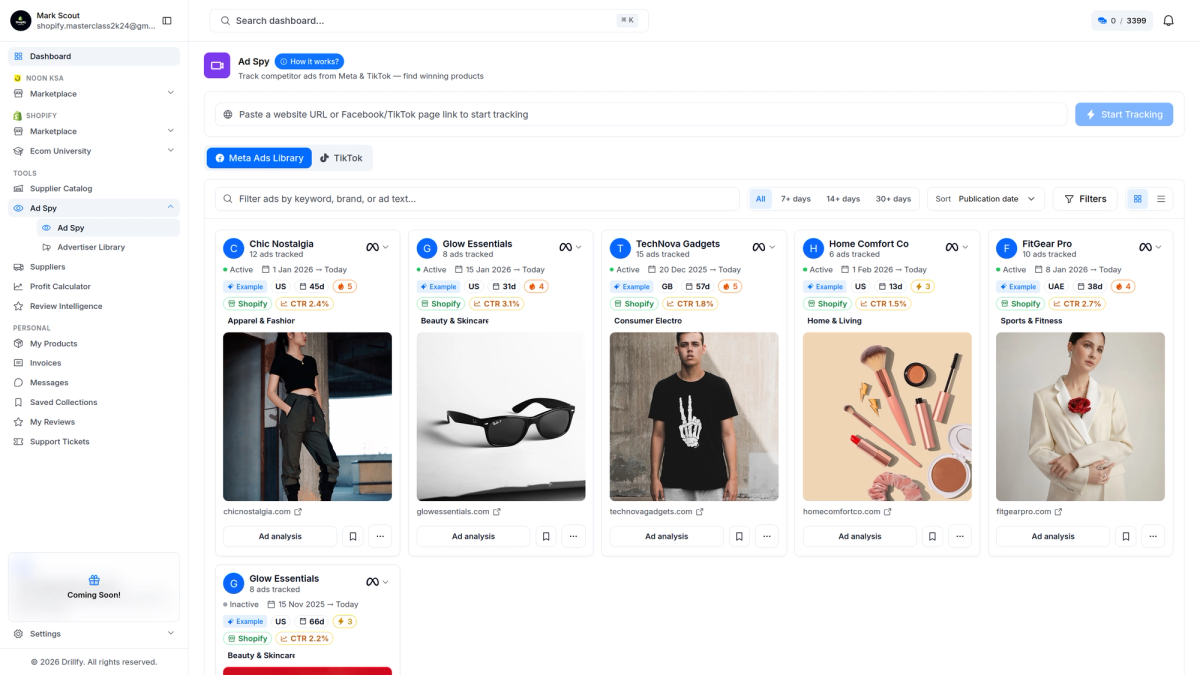
Now examine how each product or problem is marketed. Drilify's Ad Spy lets you research Meta and TikTok creatives, while Advertiser Library adds advertiser context. Compare hooks, offers, copy, markets, and activity patterns where the source provides them. Together, these views make it easier to distinguish a promising product angle from a single attention-grabbing ad.
Collect multiple ads for each shortlisted product or problem. Ask AI to group hooks, offers, proof styles, objections, formats, and calls to action. Then ask it to separate repeated patterns from one-off creative choices. A repeated hook may signal a persistent customer concern, but it still needs customer and product evidence.
Use ad activity to decide which angles deserve a closer look, not to assume a campaign is profitable. Match promising claims against customer reviews, landing pages, product details, and eventually your own test.
Compare Meta and TikTok creatives in Drilify Ad Spy to identify hooks, offers, and advertiser patterns worth testing.
Pro tip: ask AI for contradictions, not just common themes. If ads promise convenience while reviews repeatedly mention setup difficulty, that gap may be a product risk or a better positioning opportunity.
5. Mine customer language and product gaps
Ads show what sellers emphasize. Reviews show what customers experience. Gather reviews from current, relevant sources and preserve the rating, date, product variant, and source beside each excerpt. Avoid mixing reviews from materially different products just because the titles look similar.
Ask AI to cluster customer language into desired outcomes, praised strengths, recurring complaints, failed expectations, missing features, and phrases customers use naturally. Require the model to count how many supplied excerpts support a theme and to return the source references. A vivid complaint repeated once is not the same as a pattern repeated across many recent reviews.
Drilify Review Intelligence can help turn review evidence into themes such as recurring complaints, unmet needs, and customer language, with supporting examples where available. Use those themes to sharpen supplier questions and listing angles, then check any proposed claim against the reviews behind it.
The result should be a customer-evidence brief, not instant marketing copy. For each shortlisted product, write the primary desired outcome, the top three objections, the most serious product risk, the clearest improvement opportunity, and the exact claims that would require proof before publication.
6. Compare sourcing economics and fulfillment fit
Demand is only half the decision. Check supplier cost, retail price, shipping method, destination, delivery time, and margin before promoting a product to your final shortlist. Drilify connects product discovery with sourcing workflows, including CJ Dropshipping and Hertwill, so you can move from an attractive product signal toward the terms needed to sell it.
When values are estimates, carry the label into the AI prompt. Ask for a best case, expected case, and stress case rather than one precise recommendation. If an estimated retail or margin field is still calculating, wait for the interface to populate it before analyzing the candidate. Do not ask AI to guess the missing number.
Also consider operational fit: minimum order terms, supplier responsiveness where relevant, stock availability, destination support, product weight, breakage risk, variants, and the ability to obtain reliable product information. For supplier marketplace workflows, quotes, delivery time, supplier reputation, invoices, and order milestones help move the decision from discovery toward fulfillment.
Pro tip: make AI produce a sourcing question list. Questions about materials, dimensions, included accessories, certifications, stock, packaging, and dispatch time are often more valuable than another generic product score.
7. Stress-test profitability before choosing a winner
Next, model the offer with product cost, shipping, selling price, payment and platform fees, returns, discounts, and advertising assumptions. Drilify's profitability tools and free calculator tools help you compare profit, margin, and break-even advertising cost as the inputs change. This makes the financial check part of the same decision process, not an afterthought.
Give AI the calculator outputs and assumptions, not just the headline margin. Ask it to identify which variables can break the case. For example: “At what acquisition cost does contribution profit reach zero? What happens if shipping rises 20 percent? What return rate removes half the expected profit? Which input has the greatest effect?”
This analysis should produce ranges. An expected scenario might use the current supplier quote and a conservative acquisition cost. The stress scenario should raise costs and reduce conversion assumptions. The best case can show upside, but it should never be the only case used to approve a test.
The best candidate is not simply the one with the highest displayed margin. Favor the offer that still works when shipping, acquisition cost, or returns move against you. If a small change erases the profit, adjust the offer or keep researching.
8. Turn the evidence into a research memo
With product, ad, customer, sourcing, and cost evidence collected, ask AI to create a decision memo. The memo should be short enough to audit. Require sections for the decision, evidence for demand, customer problem, creative patterns, sourcing fit, economics, major risks, unknowns, and the next test.
Use an explicit evidence vocabulary: observed, estimated, inferred, and unknown. Each important sentence should include a source name or field. The model should never upgrade an estimate into a fact or present an inference without the evidence that produced it.
A practical prompt is:
“Act as a research analyst, not a product predictor. Using only the evidence below, compare the candidates against my criteria. Label every conclusion as observed, estimated, inferred, or unknown. Cite the supplied source and date. Do not fill missing fields. For each candidate, give the strongest supporting evidence, the strongest counterargument, the variable most likely to break the economics, and the smallest test that would reduce uncertainty. End with a ranked recommendation and explain what new evidence could change the ranking.”
Read the memo line by line. Open the source for every decisive claim. If the evidence does not support the wording, correct it before the memo guides budget or content. The audit is part of the workflow, not a final formality.
9. Prepare the listing and test plan
Once a candidate survives the evidence and economics checks, turn the research into an editable listing brief. Drilify's AI Listing Generator can draft a title, description, SEO fields, pricing suggestions, and related content from supported product inputs, including a supplier product, URL, connected store item, or image. Bring verified customer language and specifications into that draft so the listing reflects the product you can actually deliver.
Give the listing workflow the customer language you verified, the actual specifications, the objections the page must answer, and the claims you can prove. Remove unsupported superlatives. Confirm dimensions, materials, compatibility, included items, shipping statements, and safety language against supplier documentation or the physical product.
Then create a test plan: target audience, primary angle, one or two creative concepts, landing-page promise, price, budget ceiling, test duration, success threshold, and stop conditions. AI can draft variants, but keep the experiment narrow enough that you can explain the result.
Turn verified product details and customer insights into an editable listing draft in Drilify.
10. Verify the claims and run a limited test
Before spending, perform a final verification pass. Confirm that product and ad records are current enough for the decision. Reopen customer evidence. Recheck supplier cost, shipping, destination, and delivery expectations. Recalculate the economics using the actual proposed price and budget. Review the listing for unsupported claims.
Then run the smallest test that can answer the next important question. That may be whether the creative earns qualified clicks, whether visitors engage with the product page, whether the price creates purchase intent, or whether fulfillment terms are acceptable. Set the stop conditions before launch so a weak test does not continue because of sunk cost.
Feed results back into the research memo. AI can compare actual test data with the original hypotheses and identify which assumptions failed, but use the platform’s measured data as the source of truth. The loop is collect, organize, verify, test, and update.
Pro tip: archive the memo, source dates, assumptions, and test result together. That record prevents the next research cycle from repeating disproven ideas and makes changes in the market easier to spot.
Common dropship AI product-research mistakes
The first mistake is asking for ideas before defining constraints. You get a generic list that may ignore market, shipping, price, compliance, and acquisition cost. Define the decision first.
The second is mixing observations with estimates. Preserve the interface labels and dates. If one field is estimated and another is measured over a different period, do not let AI flatten them into a single score without qualification.
The third is mistaking ad visibility for business performance. Use ads to study creative, positioning, and advertiser behavior. Verify demand and economics elsewhere.
The fourth is summarizing reviews without source discipline. Keep review date, product variant, rating, and link. Ask for recurring patterns and counterexamples.
The fifth is optimizing the listing before validating the product case. Better copy cannot repair weak economics, unreliable sourcing, or a product that does not solve a meaningful problem.
The sixth is accepting AI’s final ranking without a challenge step. Require the strongest counterargument and the evidence that would reverse the recommendation. Good research makes uncertainty visible.
Use Drilify as the evidence workspace
Drilify's value is the connected path from discovery to a testable offer. Build a candidate set in Product Library, study Meta and TikTok angles in Ad Spy, examine customer feedback, check sourcing and profit, then prepare the listing. AI helps compare the evidence at each handoff, while the underlying product and cost data stay visible for your decision.
Start with the Product Library and choose a small shortlist that fits your market and margin target. From there, use the connected research views to challenge each candidate and move only the strongest case into a limited test.
AI can help shortlist and compare products. Use it to organize current product, ad, customer, sourcing, and cost evidence. The final decision should depend on verified inputs and a controlled market test.
What data should I give AI for product research?
Provide your target market and constraints plus consistent candidate data: price, product or sales signals, ratings and reviews, source freshness, ad patterns, customer complaints, supplier cost, shipping, estimated margin, and known gaps. Label estimates and include source dates.
Is dropship AI product research accurate?
Its accuracy depends on the evidence and instructions. AI is useful for grouping, comparing, summarizing, and challenging a research set. It is unreliable when asked to invent missing data, predict profit from general knowledge, or treat estimates as facts.
How does Drilify support an AI product-research workflow?
Drilify connects product research, Meta and TikTok ad research, advertiser context, review insights, sourcing, profitability checks, and listing preparation. That lets you compare a product's appeal with the practical work of selling and fulfilling it, instead of choosing from an AI-generated idea list alone.
Can I use ChatGPT alone for dropshipping product research?
You can use a general AI assistant to structure criteria, analyze evidence you supply, and draft a research memo. It cannot replace current product, ad, customer, supplier, or cost data. Pair it with inspectable sources and verify every decision-critical claim and for that our top recommendation is Drilify.
What should I verify before testing a product?
Verify source freshness, actual product specifications, customer evidence, supplier cost, shipping destination and timing, fee and return assumptions, break-even acquisition cost, compliance-sensitive claims, and the accuracy of the listing. Define the budget, success threshold, and stop conditions before launch.