How to Start Dropshipping: Complete Beginner's Guide
Learn how to start dropshipping in eight practical steps, from product and supplier research to unit economics, store setup, launch testing, and measurement.
Learn how to start dropshipping in eight practical steps, from product and supplier research to unit economics, store setup, launch testing, and measurement.
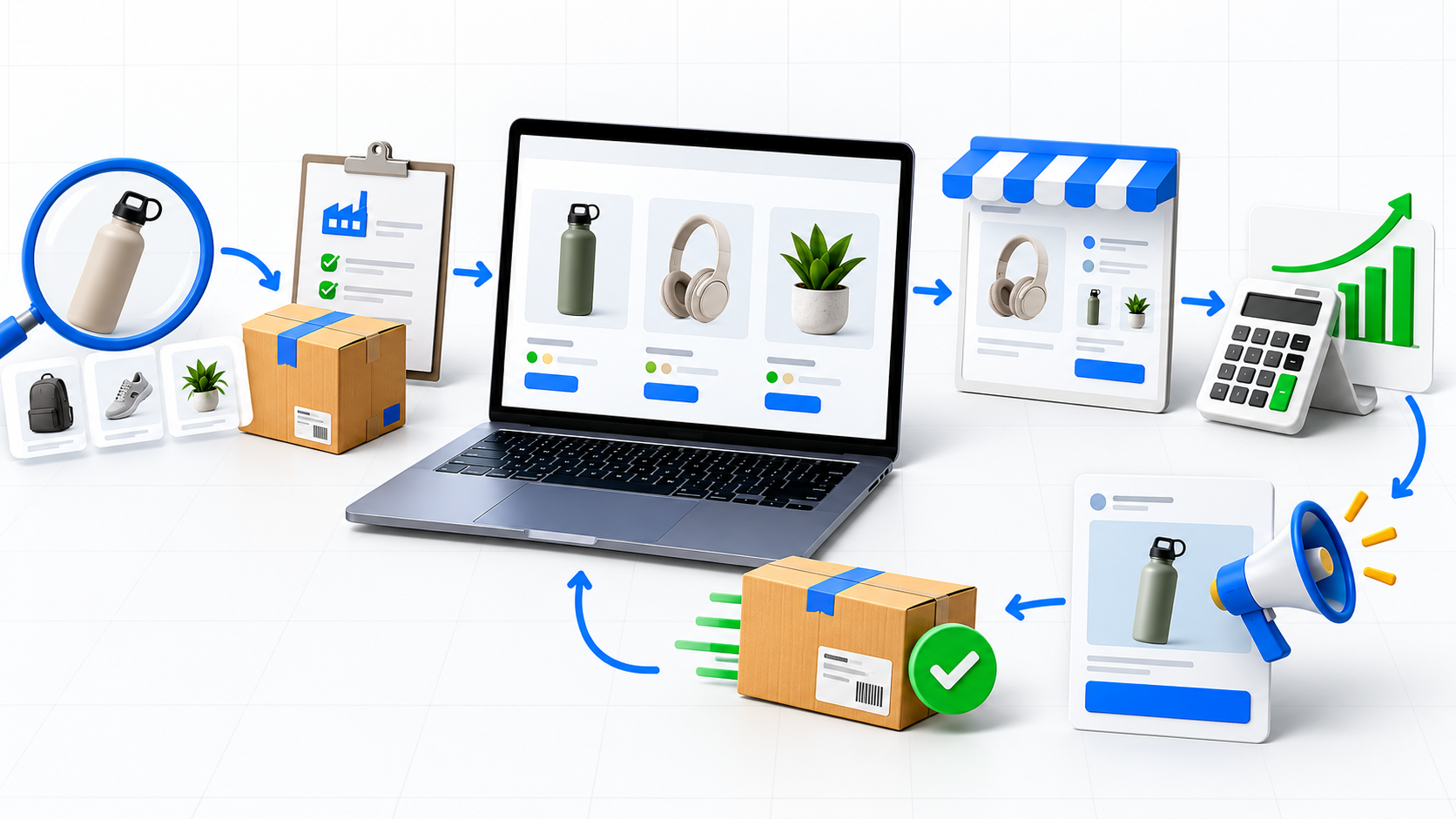
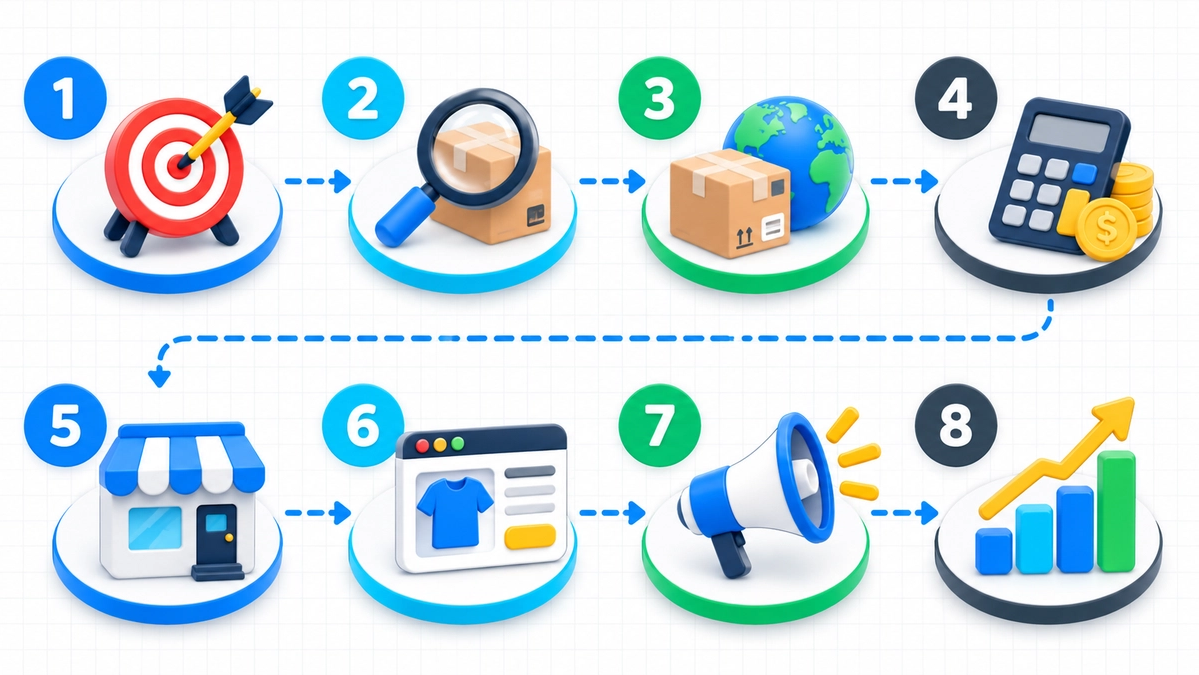
To start dropshipping, choose a specific customer and market, validate a product, confirm the supplier and delivery terms, calculate the true cost of each order, build a trustworthy store, and test one offer. Drilify helps connect those decisions: research products and competing stores, study ads, check sourcing and margin assumptions, prepare a listing, and monitor what changes after launch.
This eight-step guide shows you what to do first, what to check before spending, and how to use Drilify to move from a product idea to a focused first test.
What is dropshipping, and how does it work?
Dropshipping is a retail fulfillment model in which your store markets and sells a product without keeping that product in your own warehouse. When a customer places an order, you send the order details to a supplier. The supplier then packs and ships the item to the customer.
You still own the customer relationship. That means you are responsible for the offer, storefront, advertising, payment experience, customer service, refunds, and the accuracy of the information on your product page. The supplier handles fulfillment, but the buyer holds your store accountable.
The basic money flow is straightforward: the customer pays your retail price, you pay the supplier's product and shipping costs, and the amount left must cover payment fees, advertising, returns, support, taxes, apps, and profit. A product that looks profitable before those costs can become unprofitable after them.
The complete beginner workflow, from choosing a market to measuring the first sales test.
Before you start: set realistic expectations
LATEST POSTS
More from Drilify
Interviews, tips, guides, industry best practices, and news.
14 min read
11 Best Dropshipping Product Research Tools for 2026
Compare 11 dropshipping product research tools by workflow, current pricing, features, and limitations, including Drilify and useful free resources.
Dropshipping lets you sell without buying inventory in advance, but you still need a budget for samples, store setup, marketing, support, and tests that may not work. The advantage of a focused launch is that you can learn from a small number of clear decisions before expanding.
Treat the first month as a validation period: one customer group, one primary product, one supplier, one offer, and one acquisition channel. Drilify gives you a connected place to compare product and competitor signals, check the numbers, and organize the next decision.
Start with one market, one primary product, and one measurable test. A focused launch makes it easier to understand why customers buy, where they hesitate, and which cost is damaging your margin.
1. Choose a customer, market, and product direction
Begin with a customer group you can describe in one sentence. Instead of targeting everyone who shops online, choose a narrower situation such as apartment dwellers organizing small kitchens, new dog owners managing travel, or home-office workers reducing cable clutter. A clear customer helps you judge products, messages, and channels consistently.
Then choose the market you will serve. Check language, currency, common payment methods, delivery expectations, import rules, product restrictions, return rights, and advertising policies. A product suitable for one country may be difficult to ship, advertise, or support in another.
Create a simple product filter before browsing ideas:
The product solves a visible or recurring problem.
The benefit can be demonstrated quickly in an image or short video.
The item is practical to package and ship to the target market.
The expected retail price leaves room for all operating costs.
The category is allowed by your store, payment, and advertising platforms.
The supplier can provide consistent quality and trackable fulfillment.
Avoid choosing a product only because it appears in a viral post. Popularity is a starting signal, not proof of demand, margin, or reliable supply.
2. Research products with multiple demand signals
Product research is the process of building and testing a hypothesis. Look for several independent signals: recent sales momentum, review activity, price stability, the number and quality of competing sellers, active advertising, customer complaints, and supplier economics. No single metric proves that a product will succeed.
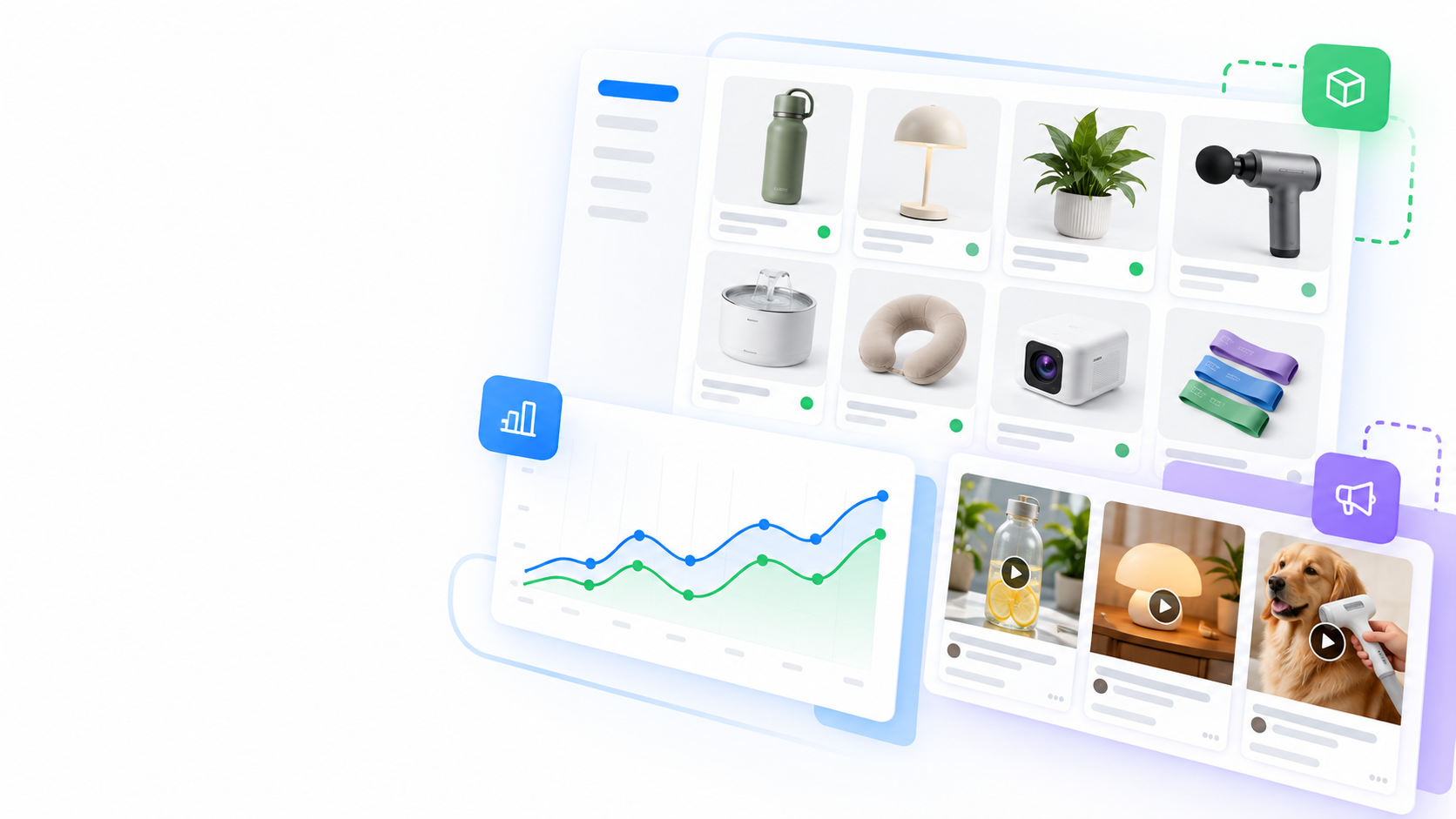
Use Drilify Product Libraries to compare product, price, rating, review, seller, category, and available sales signals across supported markets. Shortlist candidates that fit your customer and price range, then carry the strongest into competitor, supplier, and margin checks instead of judging each signal in isolation.
Compare product, price, seller, review, and available sales signals in Drilify Product Libraries.
For each candidate, record:
The customer problem and the promised outcome.
The target retail price and the prices buyers already see.
Recent demand, review, or momentum signals available in your research tools.
The strongest competitors and how they position the product.
Common complaints that your offer, supplier, or instructions could address.
Likely supplier cost, delivery time, and return risk.
A reason the product fits your chosen audience better than a random trend.
Shortlist three to five candidates, then eliminate weak options with evidence. Research is most useful when it helps you say no before you spend on samples, a store, or ads.
3. Study competing stores and advertisements
Study competing stores and ads to see what buyers already expect, then build a clearer offer of your own. The best opportunity may be a better demonstration, more useful product information, reliable delivery, or support that removes a common buying concern.
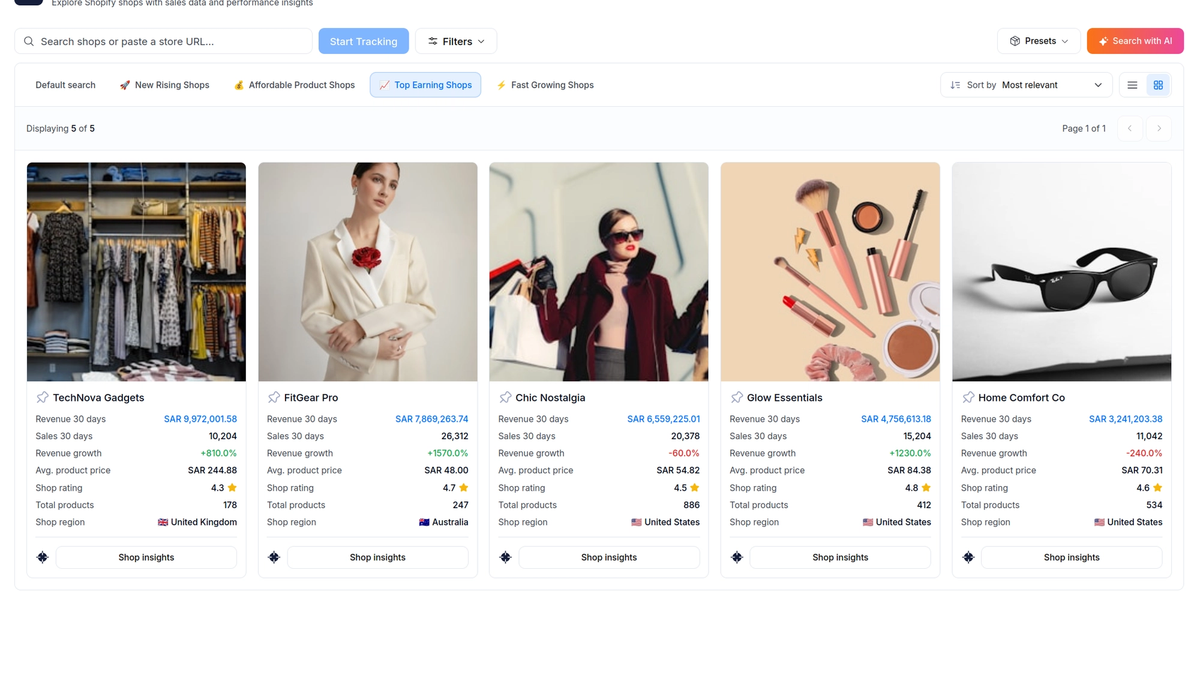
Use Store Intelligence and Competitor Research to compare product mix, pricing, positioning, available store signals, and trust cues. Then use Ad Spy to inspect Meta and TikTok creatives and advertiser activity. Moving from store to ad context inside Drilify makes it easier to connect a creative angle to the offer behind it.
Create a competitor worksheet with five columns: customer problem, opening hook, product demonstration, offer, and trust evidence. Add notes about shipping promises, guarantees, FAQs, reviews, and the landing-page experience. The useful question is not, "What can I copy?" It is, "What uncertainty is this competitor reducing for the customer, and can I reduce it more clearly?"
An ad that has remained active deserves investigation, but duration or engagement does not prove profit. Your own cost, conversion rate, return rate, and customer feedback determine whether an offer works for your business.
4. Choose a supplier and verify fulfillment
Your supplier affects product quality, delivery time, packaging, tracking, returns, and customer support workload. Do not select one from price alone. Contact more than one supplier and compare the complete fulfillment offer.
Ask each supplier for:
The current product and variant cost.
Shipping methods, tracking quality, destination coverage, and realistic delivery windows.
Processing time before the parcel leaves the warehouse.
Minimum order or account requirements.
Packaging options and whether supplier branding appears.
Defect, replacement, return, and refund procedures.
Inventory availability and how stock changes are communicated.
Recent product photos, specifications, and compliance documents when relevant.
Order at least one sample to the market you intend to serve. Inspect the item, packaging, instructions, tracking messages, and delivery time. Create your own photos and demonstration material when possible. A product page cannot fix a poor product or an unreliable fulfillment process.
Use Drilify's sourcing information to compare product cost, estimated retail and margin signals, competition, and delivery context where available. Put the strongest supplier options beside your shortlist, then confirm actual terms and order a sample before committing to an offer.
Place the sample order using the same shipping method a customer will receive. The unboxing and tracking experience are part of your product, even when a supplier performs the physical fulfillment.
5. Calculate the full unit economics
Unit economics show whether one order can contribute to profit after variable costs. Start with the selling price, then subtract product cost, shipping, transaction fees, marketplace or platform fees, expected advertising cost per purchase, return and refund allowance, taxes or duties you must cover, and a share of recurring operating expenses.
Use this planning equation:
Contribution per order = selling price - product cost - shipping - transaction and platform fees - advertising cost per purchase - expected return and support costs.
Then calculate contribution margin as a percentage of revenue. Test pessimistic, baseline, and optimistic scenarios. A plan that works only when every assumption is perfect is fragile.
Use Drilify's Profitability Calculator to compare selling price, product cost, shipping, fees, advertising, and break-even assumptions in one place. Run a baseline and a higher-cost scenario before launch; replace the estimates with your actual supplier and campaign figures as they arrive.
Also set a maximum acceptable acquisition cost. If a sale contributes $18 before advertising, spending more than $18 to acquire it loses money before overhead. Your real ceiling may need to be lower to leave room for profit and unexpected costs.
6. Build a trustworthy store and essential policies
Choose a commerce platform that supports your target market, payment provider, taxes, shipping setup, analytics, and supplier workflow. Purchase a clear domain, configure a professional email address, and keep navigation simple. A beginner store needs clarity more than visual effects.
Before taking an order, publish accurate pages for:
Shipping regions, processing times, delivery estimates, and tracking.
Returns, refunds, replacements, and damaged orders.
Privacy and data handling.
Terms and conditions.
Contact details and customer support expectations.
Use truthful delivery estimates based on your sample and supplier evidence. Do not hide long processing times behind vague language. Make the total price, currency, variants, stock status, and any subscription terms clear before checkout.
Install analytics and verify the full purchase path on mobile. Test product selection, cart, shipping, taxes, payment, confirmation, and support contact. Place a test order if your platform supports it. Fix confusing steps before paying to send visitors.
7. Create a product listing that answers buying questions
A strong product page explains the problem, outcome, evidence, limitations, delivery, and next action. Use the supplier's facts as raw material, but rewrite the page for your customer. Do not copy another seller's text, photos, reviews, or brand assets.
A practical listing structure is:
A specific headline that names the product and core outcome.
A short opening that connects the product to the customer's situation.
Three to five benefit sections supported by accurate feature details.
Original images or video showing scale, use, included items, and important limitations.
Specifications, materials, variants, compatibility, care, or safety information.
Shipping, return, and support details.
A focused FAQ based on genuine objections.
A clear call to action without invented urgency.
Drilify's AI Listing Engine can turn supported product inputs into an editable listing draft and structured SEO information. Use it to move your researched product into a page that answers real buying questions, then check every claim against the supplier specification and your sample before publishing.
Build an editable product listing in Drilify, then confirm its claims and details against the product.
Write for a buyer, not an algorithm. Search-friendly structure helps discovery, but accurate answers, useful evidence, and clear policies help a person decide.
8. Launch a controlled test and measure the result
Choose one primary acquisition channel based on where your customer already spends attention. That might be Meta ads, TikTok ads, search, creators, communities, or content. Learn one channel well enough to interpret the result before spreading a small budget across several platforms.
Define the test before spending:
The audience and customer problem.
The creative angle and the evidence it presents.
The landing page and offer.
The daily and total budget limit.
The primary conversion event.
The minimum data needed before you change the test.
The conditions that mean pause, revise, or continue.
Track the full funnel, not only clicks. Measure impressions, creative engagement, landing-page visits, add-to-cart events, checkout starts, purchases, acquisition cost, contribution margin, refunds, delivery issues, and support themes. A high click-through rate with no purchases can indicate curiosity without buying intent, a weak offer, a confusing page, or a trust problem.
Drilify Sales Tracking puts recent sales, growth, price movement, ratings, and update context in time-based product and store views where available. Watch those signals alongside your own store analytics to decide whether to refine the creative, offer, supplier, or economics.
Follow product momentum and price changes over time in Drilify Sales Tracking.
After the first test, change one major variable at a time. If the creative attracts the right audience but the page loses them, improve the offer or page. If buyers purchase but complaints concentrate around quality or delivery, fix the supplier. If revenue rises but contribution margin remains negative, change the economics before scaling.
Common beginner mistakes to avoid
Launching too many products. A large catalog multiplies research, content, supplier, support, and measurement work. Start narrow enough to learn.
Treating revenue as profit. Revenue ignores product cost, shipping, fees, ads, returns, refunds, taxes, software, and support.
Skipping the sample order. Supplier images and descriptions cannot show the exact delivery and unboxing experience your customer will receive.
Copying competitors. Copying creates legal, brand, and performance risks. Use competitor research to identify customer questions and produce original answers.
Making unsupported claims. Avoid medical, safety, environmental, performance, scarcity, and comparative claims you cannot prove.
Scaling before operations work. More orders amplify inventory errors, tracking problems, slow support, and refund exposure.
Ignoring customer feedback. Questions, returns, and reviews reveal unclear expectations and recurring product issues. Feed those lessons back into your supplier choice, listing, policies, and creative.
A practical 30-day launch plan
Days 1 to 5: choose the audience and market, define your product filter, research several candidates, and shortlist three to five.
Days 6 to 10: study stores and ads, contact suppliers, compare fulfillment terms, calculate scenarios, and order samples for the strongest candidates.
Days 11 to 18: select the product and supplier, build the store, draft policies, prepare original assets, and write the product page.
Days 19 to 23: configure analytics, test the mobile purchase path, prepare two or three original creative angles, and define the budget and stop conditions.
Days 24 to 30: launch one controlled test, review the complete funnel, answer customer questions quickly, and document what to keep, change, or stop.
Frequently asked questions
How much money do I need to start dropshipping?
There is no universal amount. Budget for the store and domain, product samples, payment or app fees, creative production, a controlled marketing test, refunds, and a cash buffer for supplier payments. Build a written budget from your market and chosen platform rather than relying on a single headline figure.
Is dropshipping legal?
The fulfillment model is legal in many markets, but your business must follow applicable registration, tax, consumer-protection, product-safety, privacy, advertising, and intellectual-property rules. Requirements vary by country and product category. Use qualified local advice when the rules are unclear.
Do I need a business license?
That depends on where you operate, where your customers are, your revenue, and the products you sell. Check national, regional, and local requirements before taking orders. A commerce platform or supplier account does not replace your legal obligations.
Can I start dropshipping without paid ads?
Yes. Search-focused content, social content, communities, partnerships, creators, email, and marketplace discovery can attract customers. These channels still require time, skill, and consistent work. Choose the channel that matches the customer's research and buying behavior.
How long does it take to become profitable?
There is no dependable timeline. Profitability depends on product-market fit, contribution margin, supplier performance, creative quality, conversion rate, return rate, and acquisition cost. Set validation milestones and spending limits instead of planning around a promised date.
Is Drilify suitable for beginners?
Yes. Drilify helps a beginner work through product research, competitor and ad analysis, sourcing context, margin planning, listing preparation, and tracking in a connected workflow. Start with one product and a bounded test, then use real supplier and customer results to improve the next decision.
What should I do after my first sale?
Confirm that the order reaches the supplier correctly, send accurate tracking information, monitor delivery, and support the customer. Then update your unit economics with the real acquisition, fee, shipping, support, and return data. One sale validates a transaction, not a scalable business.
Start with evidence, then earn the right to scale
The strongest first launch is not the biggest store. It is a clear customer problem, a product with enough supporting evidence, a supplier you have checked, a price that covers the full costs, and a test you can measure.
Drilify helps you take that path from idea to action: shortlist products, examine competing stores and ads, check sourcing and margins, prepare the listing, and follow product signals over time. Start with one focused test and use the results to decide what deserves more investment.