10 Best Product Research Tools for E-Commerce in 2026
Compare ten e-commerce research tools by channel, pricing, and decision value, from product discovery to sourcing economics and launch preparation.
Compare ten e-commerce research tools by channel, pricing, and decision value, from product discovery to sourcing economics and launch preparation.
The best product research tools connect product ideas with demand, competition, and a workable selling price. Drilify brings those research jobs together with sourcing economics, profitability checks, and listing preparation. Amazon and eBay sellers can also use marketplace-specific tools, while free trend and advertising resources help check a shortlist before committing money.
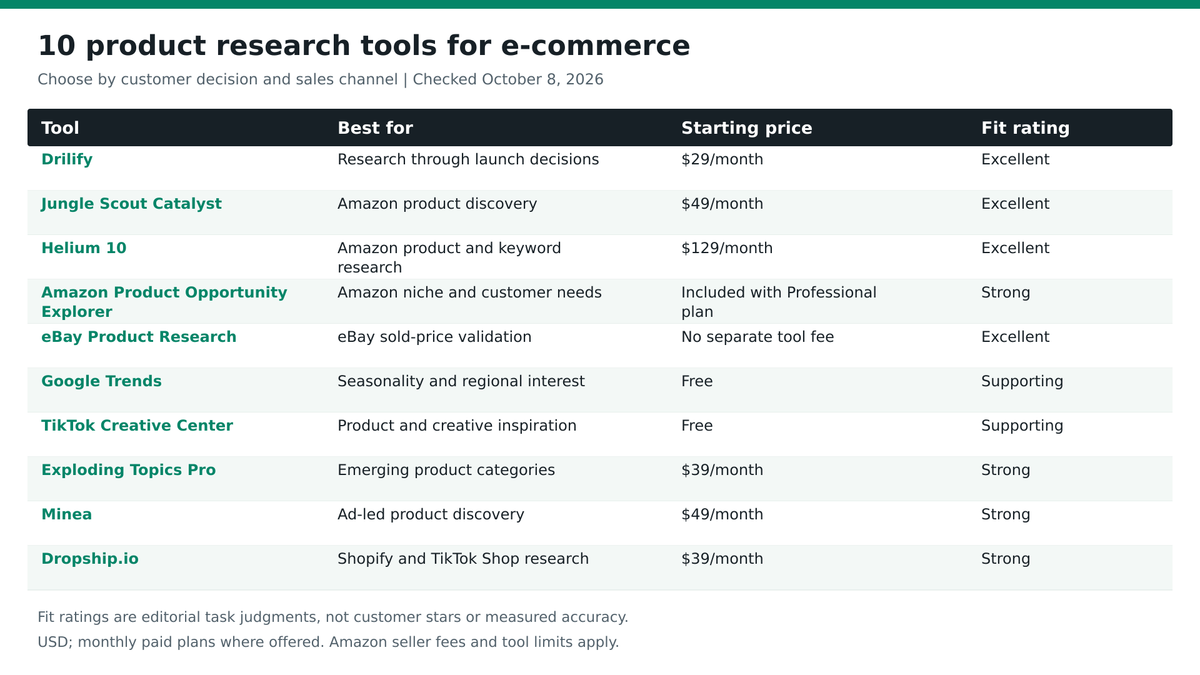
Best product research tools: quick comparison
Official prices checked October 8, 2026. Editorial fit is not a customer rating or accuracy score.
Comparison in text
Drilify: Best for: Research through launch decisions. Starting price: $29/month. Editorial fit rating: Excellent.
Jungle Scout Catalyst: Best for: Amazon product discovery. Starting price: $49/month. Editorial fit rating: Excellent.
Helium 10: Best for: Amazon product and keyword research. Starting price: $129/month. Editorial fit rating: Excellent.
Amazon Product Opportunity Explorer: Best for: Amazon niche and customer needs. Starting price: Included with Professional plan. Editorial fit rating: Strong.
eBay Product Research: Best for: eBay sold-price validation. Starting price: No separate tool fee. Editorial fit rating: Excellent.
Google Trends: Best for: Seasonality and regional interest. Starting price: Free. Editorial fit rating: Supporting.
LATEST POSTS
More from Drilify
Interviews, tips, guides, industry best practices, and news.
14 min read
11 Best Dropshipping Product Research Tools for 2026
Compare 11 dropshipping product research tools by workflow, current pricing, features, and limitations, including Drilify and useful free resources.
TikTok Creative Center: Best for: Product and creative inspiration. Starting price: Free. Editorial fit rating: Supporting.
Exploding Topics Pro: Best for: Emerging product categories. Starting price: $39/month. Editorial fit rating: Strong.
Minea: Best for: Ad-led product discovery. Starting price: $49/month. Editorial fit rating: Strong.
Dropship.io: Best for: Shopify and TikTok Shop research. Starting price: $39/month. Editorial fit rating: Strong.
Prices are in USD, checked October 8, 2026. Paid figures use monthly billing where explicitly offered; taxes, promotions, and limits can change. Amazon's Professional selling plan costs $39.99/month plus selling fees. Ratings describe fit for the stated task: Excellent means several useful research decisions, Strong means a focused research workflow, and Supporting means an input to validate elsewhere. They are editorial judgments, not customer stars or measured accuracy scores.
This guide compares official product documentation and pricing with Drilify's documented dashboard capabilities. It does not claim paid-account accuracy testing. Choose by the information you need, rather than treating a high score or a large database as proof of a profitable product. For a narrower dropshipping shortlist, see the dropshipping product research tools guide.
1. Drilify: best for connecting research to launch decisions
Drilify covers the shared work of finding products, investigating shops, studying competitor ads, and following sales signals. The added value is the next decision: whether a candidate has pricing room, a useful customer angle, suitable sourcing, and economics worth testing.
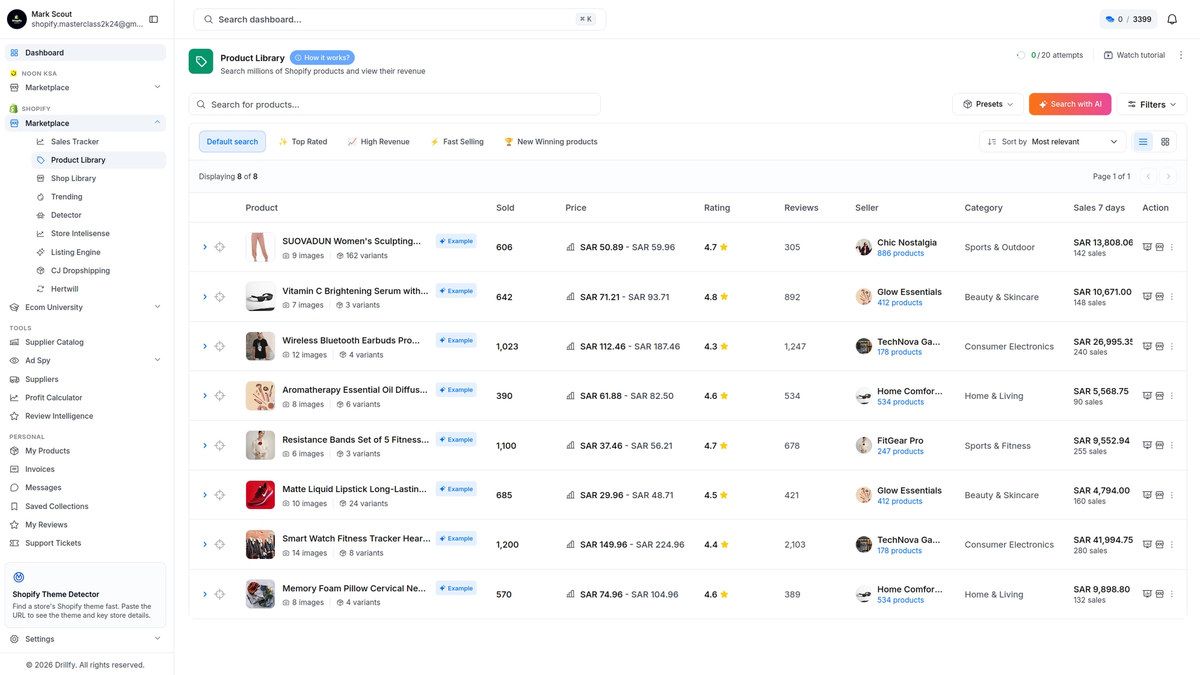
The Product Library presents price, ratings, reviews, seller context, and available sales signals. Sales Tracking adds time windows and price movement, helping distinguish momentum from a single attractive total. Platform-specific fields and available history vary; estimated figures should be read alongside their update dates.
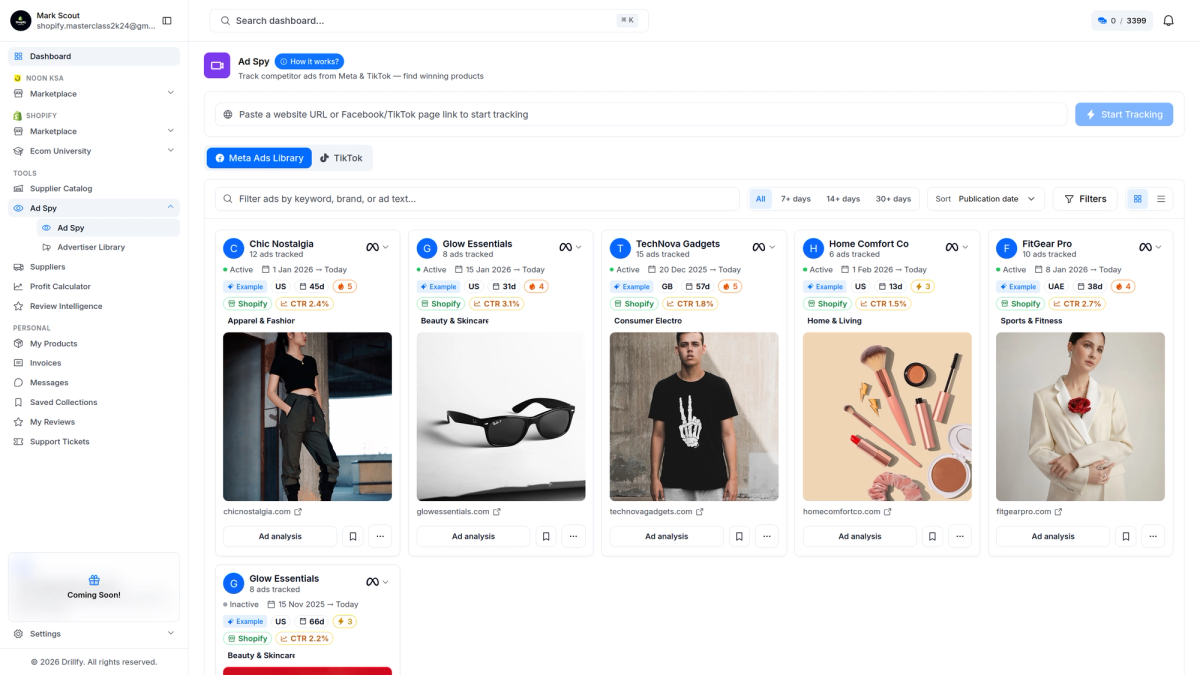
Drilify's Meta and TikTok Ad Spy and Advertiser Library support creative and brand research. TikTok shop and brand research appears within those TikTok controls. Ad duration, creative, markets, and advertiser activity help identify what deserves investigation, without making an ad's existence proof of profit.
Official Product Library page visual. It illustrates the interface; the displayed figures are not a forecast for your product.
Drilify goes further with CJ sourcing insights: supplier cost, estimated retail price, margin, competition, and shipping context. Hertwill offers a comparable sourcing workflow. These help compare pricing room and fulfillment fit before importing. The Profitability Calculator tests costs, fees, returns, and acquisition assumptions; the Listing Engine turns supported product sources into editable listing drafts.
Key features: Product and shop research, Meta/TikTok advertising research, sales tracking, sourcing economics, profitability scenarios, and listing preparation. Credit Transfers lets sellers shift unused credits from eligible, less-used features toward tools they use more, subject to current rules.
Pricing:Launch is $29/month, Scale $49, and Dominate $89. Advanced reports, calculator access, generation modes, and allowances depend on the plan. Free access and the limited three-day trial have restricted entitlements.
Pros: A connected path from discovery to sourcing and listing decisions; useful economic fields; flexible credit allocation. Cons: Connections and plan access must be checked, research consumes allowances. Best for: Sellers who want to move a researched candidate toward a controlled launch test.
2. Jungle Scout Catalyst: best for Amazon product discovery
Jungle Scout Catalyst organizes Amazon product discovery through Product Database, Opportunity Finder, Product Tracker, and Keyword Scout. Its value is narrowing a broad category into products and niches that deserve a closer look, then following them over time.
Key features: Product searches, estimated sales, keyword research, and product tracking. Plan limits matter: Starter lists 100 monthly Product Database searches and 50 tracked products; higher tiers expand the research workflow. Use consistent marketplace and date settings when comparing candidates.
Pricing:Starter costs $49/month. Its $29/month equivalent requires $348 annual billing. Growth Accelerator costs $79/month. The standard offer has a seven-day money-back guarantee, which differs from a free trial.
Pros: Several Amazon research tasks in one suite and clear search allowances. Cons: History, export, and advanced features vary by tier; sales estimates do not establish your own margins. Best for: Amazon sellers building and monitoring a product shortlist.
The shared job is discovering and tracking opportunities. For a wider commerce workflow, Drilify's Product Library carries a candidate into sourcing economics and listing preparation. Match the research channel to where you intend to sell.
3. Helium 10: best for linking Amazon products and keywords
Helium 10 combines product discovery with keyword and listing research. Black Box filters candidates; Xray adds product analysis, while Cerebro and Magnet help investigate how shoppers search. This makes it useful when a product idea must also become a discoverable Amazon listing.
Key features: Black Box filtering by marketplace, category, competition, price, and monthly revenue; Xray analysis; keyword discovery; listing tools. Those filters help formulate a shortlist rather than automatically choosing a winner. Black Box's official guide explains its simple and advanced searches.
Pricing:Platinum is $129/month, or a $99/month equivalent billed yearly. Higher tiers add broader operations and intelligence features. Check the current feature matrix for individual limits.
Pros: Product and keyword research can inform the same listing decision. Cons: The subscription is substantial for a new seller, and access differs across plans and marketplaces. Best for: Amazon sellers who need research to feed listing and keyword work.
Drilify also connects research with listing preparation, adding sourcing and profitability decisions to that workflow. Validate both the product economics and the claims in any generated copy.
4. Amazon Product Opportunity Explorer: best for niche-level customer needs
Amazon Product Opportunity Explorer uses Amazon customer search and purchasing information to organize product opportunities. It is especially useful for investigating a customer need rather than simply copying an individual bestseller.
Key features: Niche and ASIN research, search and sales trends, customer-review insights, and return themes. These signals help ask whether a category has persistent demand and what buyers want improved. Amazon's overview explains how search terms and products form niches and how review and return insights support product decisions.
Pricing: Amazon describes the tool as free for Professional selling accounts. The US Professional plan is $39.99/month plus selling fees; the tool has no separate subscription charge.
Pros: First-party marketplace context and customer-needs research. Cons: Requires the eligible seller account, and Amazon demand does not automatically transfer to a standalone store. Best for: Sellers exploring an Amazon niche or improving an offer.
The next decision is whether a differentiated offer can be sourced and presented. Drilify's competitor-research workflow helps connect store context with those launch questions.
5. eBay Product Research: best for checking actual sold prices
eBay Product Research helps sellers assess what buyers have paid, rather than relying on optimistic active listing prices. That distinction matters for resale, used goods, and products where condition changes value substantially.
Key features: Up to three years of sales data, average sold prices, sold-price ranges, shipping costs, and seller counts. Sell-through rates apply to searches covering 90 days or less. Category, condition, location, and product filters improve the relevance of the comparison. eBay's documentation also distinguishes Product Research from Sourcing Insights.
Pricing: Product Research is available to sellers with Seller Hub access without a separate tool subscription. Sourcing Insights has different eligibility: a business seller with a Basic Store subscription or above.
Pros: Transaction-based pricing context and condition-specific research. Cons: Poorly matched searches distort the comparison, and sales history does not include your future sourcing costs. Best for: eBay sellers validating price, timing, and competition.
Carry a plausible selling price into a cost model. For a standalone-store offer, combine Drilify's Sales Tracking with its free tools margin calculator to follow pricing and test cost assumptions.
6. Google Trends: best for seasonality and regional interest
Google Trends is a free check on whether interest is rising, seasonal, or concentrated in particular regions. Use it early to compare a product topic across longer and shorter periods before treating a recent spike as durable demand.
Key features: Relative search-interest charts and geographic comparisons. Google's data explanation states that scores are normalized from zero to 100. They are not absolute search volumes or sales totals; a low-volume query can appear as zero.
Pricing: Free.
Pros: Accessible trend context and a useful check on seasonality. Cons: Interest can reflect news or curiosity, and scores depend on the selected period and geography. Best for: Sellers checking timing and regional relevance before deeper research.
For example, compare a broad product topic over several years before reviewing the latest quarter. A yearly peak suggests a different inventory decision from steady demand. Then investigate actual products and stores through Drilify's Product Library, adding pricing and sales context before deciding what to test.
7. TikTok Creative Center: best for product and creative inspiration
TikTok Creative Center helps sellers discover products, trends, and advertising approaches suitable for the platform. Its Top Products resource highlights products featured in TikTok ads, while Top Ads offers selected high-performing creatives.
Key features: Product inspiration, Top Ads, trends, and creative guidance. TikTok's Creative Center overview describes the free resource and recommends logging in for fuller access. Its creative guidance explains Top Products.
Pricing: Free; visible access varies with login and resource.
Pros: Native-platform inspiration and useful creative context. Cons: Selected ads are not a complete view of every advertiser, and attention does not prove profitable sales. Best for: Sellers testing product demonstrations, hooks, and creative angles.
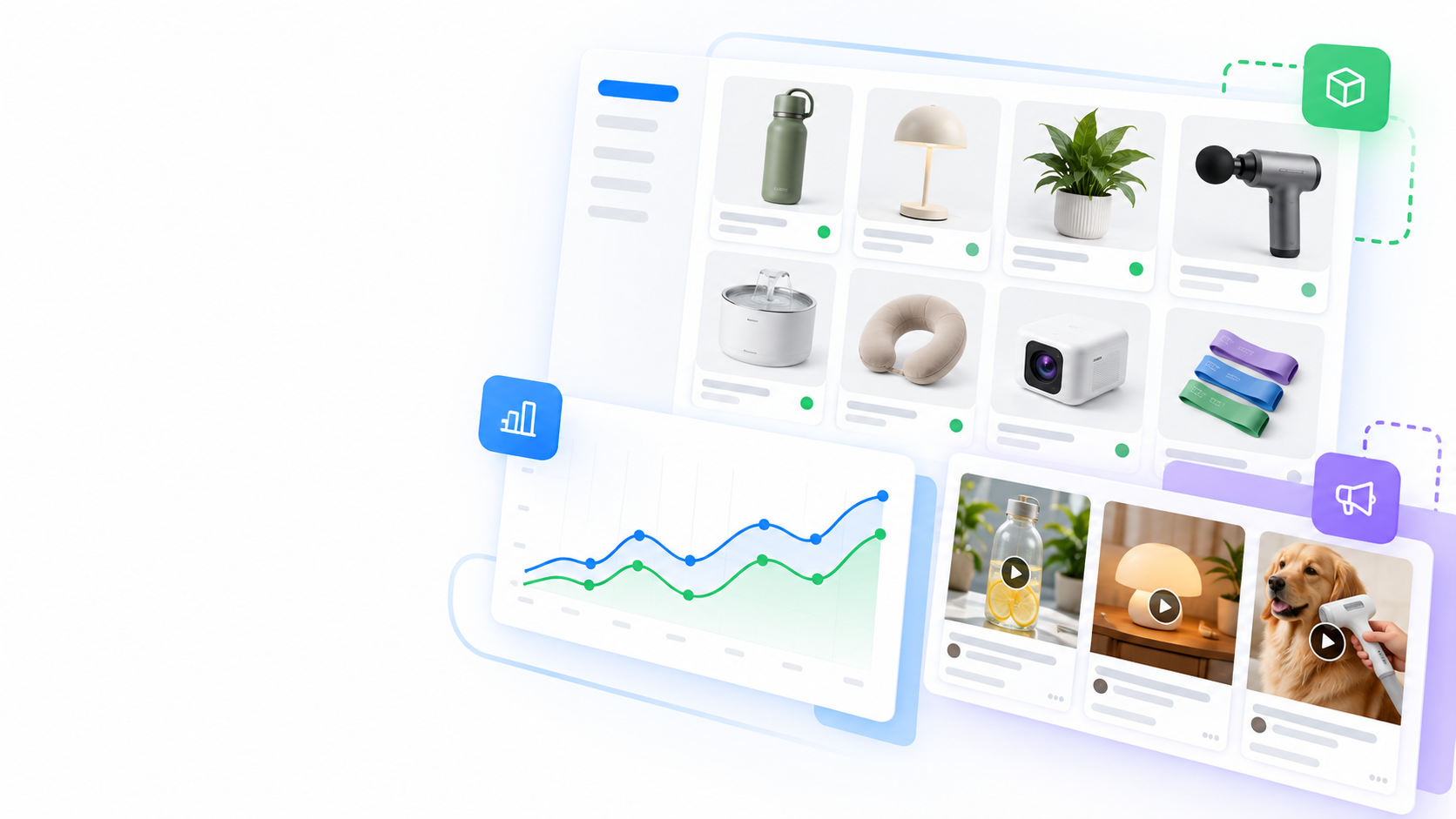
Drilify's Ad Spy supports the shared job of studying TikTok creative and brands, alongside Meta. Its added decision path connects that research with advertiser activity, product economics, and listing preparation, so an appealing creative becomes a testable offer.
Official Ad Spy page visual. Platform tabs and creative context help organize research; campaign duration alone does not establish profitability.
8. Exploding Topics Pro: best for emerging product categories
Exploding Topics Pro helps find growing topics and product categories before committing to individual stock-keeping units. It is useful when a merchant needs a direction for category expansion, rather than a list of products to copy immediately.
Key features: A trends database, trending products, tracked trends, trend analyses, and channel breakdowns. Its official plans include forecasting and additional research features on higher tiers. A category's growth is a starting hypothesis; it still needs a realistic offer, sourcing, and price.
Pricing: Entrepreneur is listed at $39/month, with 100 tracked trends and ten trend analyses. Investor is $99 and Business $249. A seven-day free trial is advertised.
Pros: Category-level discovery and organized ongoing monitoring. Cons: A promising topic is not evidence that your specific product can acquire customers profitably; advanced features cost more. Best for: Merchants exploring adjacent categories or longer-term product directions.
Drilify's Store Intelligence adds competitor assortment, traffic context, and available performance estimates to the decision. Use those signals to investigate how an emerging category is actually being offered.
9. Minea: best for ad-led product shortlists
Minea brings advertising, product, and shop research into a discovery workflow. It helps sellers investigate the relationship between an offer, its creative, and the store selling it, rather than browsing isolated ads.
Key features: The current plan page lists Meta ads, products, shops, brand tracking, niche lists, and AI ad analysis. Starter includes ten ad analyses and ten transcripts per month. Check the selected plan for channel access and allowances rather than assuming every advertised function is unlimited.
Pros: Connected ad, product, and shop discovery, with structured research features. Cons: Analysis and tracking allowances affect how far a shortlist can be investigated. Ads still need sales and cost validation. Best for: Sellers who start product research from competitor creative.
Drilify shares that research job through Ad Spy and advertiser research. Drilify then adds sourcing price, estimated margin, competition context, and profitability testing to help decide whether an ad-discovered product merits a launch.
10. Dropship.io: best for Shopify and TikTok Shop investigation
Dropship.io provides product, shop, sales-tracking, and Facebook advertising research. Its current offering includes TikTok Shop product and shop research as well as Shopify; older descriptions presenting it as Shopify-only are outdated.
Key features: Product and Shop Libraries, sales and revenue context, tracking, advertiser research, and product filters. The official feature and pricing page shows credit and tracked-item limits that differ by tier. Read reported sales figures in context rather than treating them as your own expected revenue.
Pricing: Basic is $39/month, Standard $59, and Premium $99. Annual Basic is $312, equivalent to $26/month; that is a yearly commitment, not the monthly price.
Pros: Several linked product and competitor research surfaces. Cons: Credits and tracking limits constrain investigation depth, and research signals still need sourcing and margin validation. Best for: Sellers investigating Shopify and TikTok Shop candidates.
Drilify supports the shared product, shop, brand, and ad-research jobs. Its Shop Library and related tools connect that work to sourcing economics, profitability scenarios, and listing preparation. Compare the information that supports your decision rather than expecting identical screen names.
How to choose the best product research tools for your store
Start with your sales channel and the decision you need to make this week. An Amazon launch requires Amazon-specific evidence; a Shopify seller needs an offer, a reachable audience, and workable acquisition costs. A tool stack becomes expensive when several subscriptions answer the same question.
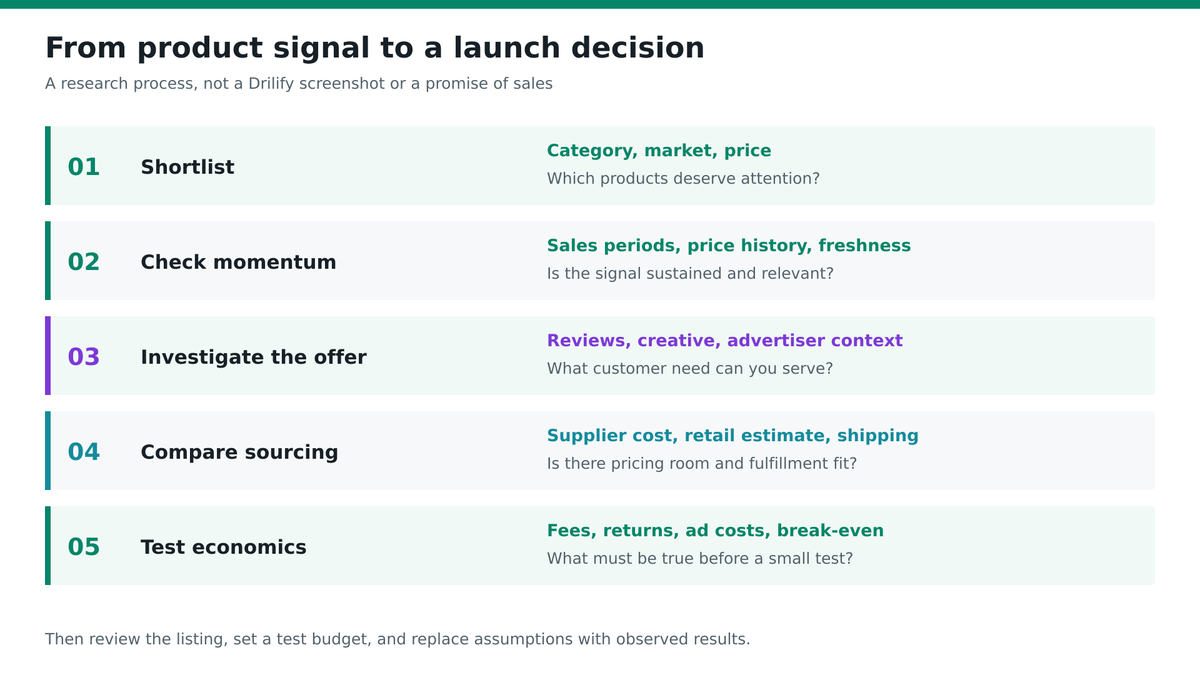
Original decision diagram, not an app screenshot. The steps describe a research process; they do not guarantee sales.
Shortlist: Choose a category, market, and price range. Save a few candidates instead of endlessly browsing rankings.
Check demand: Compare relevant sales history, price movement, search seasonality, and data dates. Agreement across signals is more useful than one dramatic chart.
Investigate the offer: Look at customer complaints, competitor positioning, creative, and fulfillment promises. Find a reason someone would choose your version.
Check economics: Use supplier quotes and realistic shipping, fees, returns, and ad costs. Drilify's sourcing estimates help frame the question; its calculator lets you test assumptions.
Prepare a small test: Review listing copy, set a spending limit, and record the result. Replace assumptions with observed conversion and return data before scaling.
For Drilify, choose the plan around the report sections and allowances you will actually use. Credit Transfers can help rebalance eligible unused allowances, but it does not eliminate feature access rules or the need to budget research.
Frequently asked questions
What are the best product research tools for a new e-commerce store?
Start with a tool suited to your intended channel, plus a free trend check. Drilify is useful when product discovery must connect to sourcing and listing decisions. Amazon and eBay sellers should include evidence from their own marketplace before committing to inventory.
Can free product research tools replace a paid subscription?
They can support an initial shortlist. Google Trends and TikTok Creative Center help investigate interest and creative, while eligible marketplace tools provide channel-specific evidence. A paid suite becomes useful when you need repeated monitoring, connected research, or a more organized decision workflow.
Are product sales estimates the same as actual orders?
No. An estimated sales figure is a research signal, not an audited order record or a forecast for your store. Check the label, period, source coverage, and update date. Actual transaction evidence, such as eBay sold prices, also needs a relevant comparison and cost model.
What does Drilify add after competitor research?
Drilify connects the shared research jobs with sourcing costs, estimated retail and margin, competition context, profitability scenarios, and editable listing preparation. That helps turn a promising product into a concrete question about pricing, fulfillment, and a controlled launch test. Access depends on plan and connections.
Does a long-running ad mean a product is profitable?
It suggests sustained advertising activity, not verified profit. The advertiser could be testing, building awareness, or accepting a different margin. Investigate the offer and likely costs, then measure your own acquisition and fulfillment economics during a limited test.
How can I avoid paying for overlapping research tools?
Write down the decisions each subscription answers and its limits. Keep the tools that provide useful evidence for your channel, and remove repeated functions. In Drilify, check whether eligible Credit Transfers can shift unused allowance toward the features you use most.
Start with evidence, then build the offer
The best product research tools should make your next decision clearer. Drilify brings product, shop, and advertising research into a wider path covering sourcing economics, profitability, and listing preparation. Start with the plan that matches your work, validate the numbers, and test a focused shortlist.